Sometimes time behaves like a little magician. You look at the clock, blink once, and suddenly the meeting is closer, the delivery window is almost here, or a special family moment is just a few hours away.
When someone is waiting to welcome a baby girl, for example, even a single hour can feel unusually long. Families may keep checking the current time, wondering when they should leave, when relatives will arrive, or what time an important update might come. It sounds simple, but honestly, time can get confusing pretty quick.
An Hours From Now Calculator makes this kind of time calculation much easier. Instead of manually adding hours and minutes to the current time, you can enter the amount of time you want to add and quickly discover the exact time in the future.
If the calculation crosses midnight, the tool can also help identify the correct future date, which is where ordinary mental math sometimes starts acting a little suspicious.
Whether you’re planning a trip, scheduling an appointment, setting a reminder, organizing an online event, or simply asking, “what time will it be 12 hours from now?”, an online calculator gives you a straightforward answer.
You don’t need to stare at the clock doing calculations in your head, which is probably good because clocks have never been very sympathetic to tired brains.
| Hours from now | Time |
|---|---|
| 1 hour | 11:01 PM |
| 2 hours | 12:01 AM |
| 3 hours | 1:01 AM |
| 4 hours | 2:01 AM |
| 5 hours | 3:01 AM |
| 6 hours | 4:01 AM |
| 7 hours | 5:01 AM |
| 8 hours | 6:01 AM |
| 9 hours | 7:01 AM |
| 10 hours | 8:01 AM |
| 12 hours | 10:01 AM |
| 18 hours | 4:01 PM |
| 24 hours | 10:01 PM |
What Is an Hours From Now Calculator?
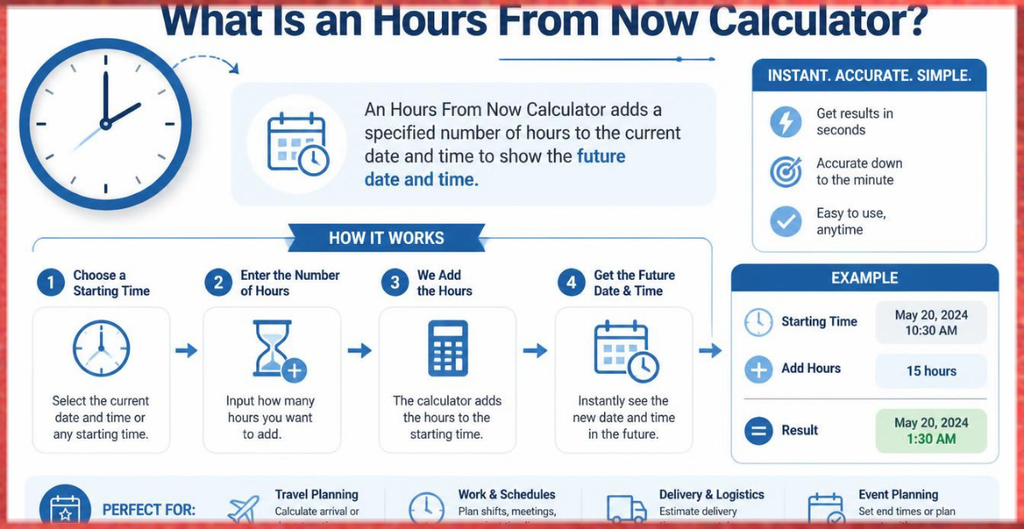
An Hours From Now Calculator is an online calculator designed to determine a future time by adding a selected number of hours and minutes to the current time.
You enter the amount of time you want to move forward, and the calculator provides the resulting time, often showing whether the answer falls on the same day or a different future date.
For example, if the current time is 08:41 PM and you add two hours, the answer is 10:41 PM. If you add six hours, however, the result moves beyond midnight and becomes 02:41 AM on the following day. Thats the useful bit: the calculator handles the day change instead of making you figure it out yourself.
The tool is especially useful when you need an exact time from now rather than a rough estimate. It can work with hours and minutes, making it practical for everyday schedules as well as more detailed planning.
How Does the Hours From Now Calculator Work?
The basic idea behind a time from now calculator is surprisingly simple. First, the tool identifies the current time. Then it adds the number of hours and minutes you enter. If the resulting time passes midnight, the calculation continues into the next calendar day.
Suppose the starting time is 08:41 PM on August 29, 2026. Adding one hour gives 09:41 PM on the same date. Adding four hours gives 12:41 AM on August 30, 2026. The calculation isn’t difficult, but doing several of these manually can become annoying, especially when the date changes.
A modern online time calculator may also support both a 12-hour format and a 24-hour format. That means you can view 8:41 PM as 20:41 when using a 24-hour clock. Same moment, different clothing, basically.
Why Use an Hours From Now Calculator?
The biggest advantage is automatic calculation. Instead of adding time manually, the calculator quickly determines the result and can account for midnight and date changes. This makes it handy when you’re tired, busy, or simply don’t feel like doing clock mathematics for no good reason.
It can also reduce small mistakes. A person might correctly add five hours but forget that the calculation crossed into another day. An automatic time calculation tool can provide both the resulting time and the relevant date, making the answer more complete.
People use an hours calculator for appointments, travel plans, medication reminders, work schedules, online meetings, cooking timers, deadlines, study sessions, and many other everyday situations. Sometimes you just need to know when something will happen, and thats all there is to it.
Hours From Now Calculator for Everyday Planning
Imagine you have a flight at 7:00 AM tomorrow and need to leave home several hours earlier. Or maybe a package is expected within a certain number of hours and you’re trying to decide whether to stay home. These situations are small, but the exact timing matters more than we like to admit.
An Hours From Now Calculator lets you calculate hours from now without manually moving through the clock. You can enter 3 hours and 30 minutes, for example, and receive a precise result rather than guessing based on the position of the clock hands.
This becomes even more helpful for people working unusual shifts. Someone beginning work late at night may need to calculate when a 10-hour shift ends, while a traveler might want to know the local time after a long journey. A quick time calculation can save a surprisingly annoying amount of thinking.
Hours From Now Calculator and Date Changes

One of the most important features of an Hours From Now Calculator is its ability to handle a change in date. Adding a small number of hours might keep the result on the same day, while adding a larger amount can move the answer into tomorrow or several days later.
For example, starting from 08:41 PM on August 29, 2026, adding four hours results in 12:41 AM on August 30, 2026. Adding 28 hours results in 12:41 AM on August 31, 2026. So the calculator isn’t only doing a clock calculation; it is also performing a basic date calculation.
For longer periods, the date keeps moving forward naturally. A result may fall on August 30, 2026, August 31, 2026, September 1, 2026, September 2, 2026, or September 3, 2026, depending on the number of hours entered. This is why simply looking at the hour isn’t enough sometimes.
12-Hour Format and AM/PM
The 12-hour format divides the day into two groups: AM and PM. The clock runs from 12:00 AM through 11:59 AM, then from 12:00 PM through 11:59 PM. This format is common in everyday conversations, especially when people say things like “I’ll call you at 8 PM.”
When using AM/PM, you need to pay attention to whether the starting time is before or after noon. For example, adding three hours to 08:41 PM produces 11:41 PM, while adding four hours produces 12:41 AM the next day. That little jump from PM to AM is where mistakes often sneak in.
A calculator that supports the 12 hour time format can make the result easier to read for everyday users. You don’t have to convert anything manually, which is quite nice when all you want is an answer.
24-Hour Format and Military Time
The 24-hour format represents the entire day using numbers from 00:00 through 23:59. Instead of 8:41 PM, you would write 20:41. Instead of 2:30 PM, you would write 14:30.
This system is often called the military time format, although it is also widely used in transportation, healthcare, computing, international scheduling, and many professional environments. The advantage is that AM and PM confusion largely disappears.
For example, if your starting time is 20:41, adding five hours gives 01:41 on the next day. The calculation is very direct. A good time calculator can display the answer in whichever format makes the most sense for you.
How to Calculate Future Time Manually
You can always calculate future time without a calculator, provided the number isn’t too complicated. Start with the current hour and add the required number of hours. Then check whether the result passes 12 in a 12-hour clock or 24 in a 24-hour clock.
For example, if the current time is 8:41 PM and you want to find the time 6 hours from now, add four hours to reach 12:41 AM, then two more hours to reach 2:41 AM. The answer is therefore 2:41 AM the following day.
This method works, sure, but when you’re calculating 37, 48, 72, or 100 hours, things become more tedious. Thats when an online hours calculator becomes much more useful.
Hours From Now Examples

Here are a few common examples showing how future-time calculations work. These examples assume a starting time of 08:41 PM on August 29, 2026, simply so the date changes can be seen clearly.
| Hours From Now | Resulting Time | Date |
|---|---|---|
| 1 hour from now | 09:41 PM | August 29, 2026 |
| 2 hours from now | 10:41 PM | August 29, 2026 |
| 4 hours from now | 12:41 AM | August 30, 2026 |
| 12 hours from now | 08:41 AM | August 30, 2026 |
| 24 hours from now | 08:41 PM | August 30, 2026 |
| 48 hours from now | 08:41 PM | August 31, 2026 |
| 72 hours from now | 08:41 PM | September 1, 2026 |
| 100 hours from now | 12:41 AM | September 3, 2026 |
The table gives a useful snapshot of how hours from now can affect both time and date. Notice that 24 hours from a particular time normally lands at the same clock time on the following date, while 48 and 72 hours move two and three days forward.
What Time Is X Hours From Now?
The question “what time is X hours from now?” can have a different answer depending on the exact starting time. That’s why simply saying “five hours from now is 5 PM” isn’t always correct. The current clock time has to be included first.
If it is 08:41 PM now, then 5 hours from now is 01:41 AM tomorrow. If it is 08:41 AM, however, 5 hours from now is 01:41 PM today. Same number of hours, completely different answer, which is why the starting point matters so much.
An exact time from now calculator removes this uncertainty by using the current time as its starting reference. You get the answer based on the actual input rather than a generic assumption.
How Many Hours From Now?
People often search phrases such as “how many hours from now” or “how many hours until” when planning something that will happen later. These questions can refer to a specific event, deadline, appointment, flight, celebration, or simple personal reminder.
For instance, if a concert begins in 12 hours, you may want to know the exact clock time instead of simply knowing the duration. The calculation turns a vague period into a concrete timestamp, which makes planning a whole lot easier.
For longer periods such as 24 hours from now, 48 hours from now, 72 hours from now, or 100 hours from now, remembering the date becomes equally important. A duration and a calendar date are connected, but they aren’t exactly the same thing.
Hours From Now Table for Quick Reference
A simple hours from now table can be useful when you frequently need common calculations. It works almost like a small cheat sheet, letting you see how different durations affect the future timestamp.
For a starting time of 08:41 PM on August 29, the progression looks like this:
| Duration | Future Time | Future Date |
|---|---|---|
| 1 hour | 09:41 PM | August 29 |
| 2 hours | 10:41 PM | August 29 |
| 12 hours | 08:41 AM | August 30 |
| 24 hours | 08:41 PM | August 30 |
| 48 hours | 08:41 PM | August 31 |
| 72 hours | 08:41 PM | September 1 |
| 100 hours | 12:41 AM | September 3 |
This kind of hours from now chart is especially handy for understanding how larger durations move across calendar dates. Still, for a live answer, using a calculator is better because the actual current time keeps changing every minute.
Hours From Now and Travel Planning

Travel is one area where time calculations become unexpectedly important. A journey may take 8 hours, 14 hours, or even longer, and crossing midnight can make the arrival date confusing.
Suppose you leave at 8:41 PM and travel for 12 hours. You won’t arrive at 8:41 PM the next day; you’ll arrive at 8:41 AM the next day.
Add another 12 hours and you’re back at 8:41 PM. Simple enough when written down, but a little messy when you’re juggling tickets, luggage, and sleepy children.
A date and time calculator can help travelers calculate time and date together. It is particularly useful when planning long journeys or checking schedules that extend over multiple days.
Hours and Minutes Calculator
Not every question involves whole hours. Sometimes you need to add 2 hours and 35 minutes, 6 hours and 20 minutes, or another combination. That’s where an hours and minutes calculator becomes particularly useful.
Suppose the starting time is 8:41 PM and you add 2 hours and 30 minutes. First, two hours takes you to 10:41 PM. Another 30 minutes gives 11:11 PM. If you add one more hour, the result becomes 12:11 AM the following day.
The minutes can create a date change too, so they shouldn’t be treated as a tiny detail. Thirty minutes may seem harmless, but around midnight, that half-hour can move the result into tomorrow.
Hours From Now vs. Hours Ago Calculator
An hours ago calculator works in the opposite direction. Instead of adding hours to the current time, it subtracts them. So if you want to know what time it was 7 hours ago, the calculation moves backward.
An hours calculator, on the other hand, may refer more generally to tools that add, subtract, or compare hours. Both types are useful, but they answer different questions.
Think of it this way: “What time will it be 7 hours from now?” moves forward, while “What time was it 7 hours ago?” moves backward. The clock itself doesn’t care which direction you’re going, thankfully.
Time From Now Calculator for Schedules
A time from now calculator can be useful for building simple schedules. Students can calculate when a study session will end, employees can estimate when a shift finishes, and families can determine when a planned activity should begin.
Imagine starting a four-hour road trip at 3:15 PM. Adding four hours gives 7:15 PM, assuming there are no stops or delays. The calculation provides the planned arrival time, while real life may of course have other ideas.
For this reason, a calculated time should usually be treated as a planned timestamp rather than a guarantee. Traffic, delays, breaks, and unexpected events can all change the actual outcome.
Time From Now and Future Dates

A longer calculation may produce not only a future time but also a future date. Once the number of hours becomes large, date calculation becomes part of the answer.
For example, 24 hours moves you one calendar day forward. Seventy-two hours moves you three days forward. One hundred hours equals four days and four hours, meaning the resulting date depends on the starting time.
This is why a time and date calculation is more useful than looking at the clock alone. The final answer tells you both when and on which date something occurs.
Real-Life Uses of an Hours Calculator
There are more uses for an online hours calculator than people might expect. It can help with work schedules, appointments, travel, cooking, study plans, event preparation, project deadlines, reminders, and countdowns.
A parent may use it to estimate when a family member will arrive home. A student may calculate how much time remains before an exam.
Someone organizing a birthday celebration may need to determine when preparations should begin. And yes, someone waiting for exciting family news may keep checking the clock every few minutes anyway.
The tool is valuable because it turns a duration into something understandable: a precise clock time and, when needed, a specific calendar date.
Automatic Calculation Makes Time Easier
Manual calculations are perfectly possible, but automatic time calculation is faster and often less error-prone. You enter the starting time and duration, and the tool handles the arithmetic.
This matters especially when several calculations are needed. If you’re comparing 12 hours, 24 hours, 36 hours, 48 hours, and 72 hours from the same starting point, doing each calculation manually can become repetitive very quickly.
A real-time calculator is also useful because the current moment keeps moving. A result calculated at 8:41 PM won’t remain the same if you check it again at 8:50 PM. Time has no patience for old answers, apparently.
12-Hour Time vs. 24-Hour Time
The choice between the 12-hour clock and 24-hour clock mostly comes down to preference and context. The 12-hour system is familiar and conversational, while the 24-hour system is often clearer for professional schedules and international communication.
| 12-Hour Format | 24-Hour Format |
|---|---|
| 12:00 AM | 00:00 |
| 6:00 AM | 06:00 |
| 12:00 PM | 12:00 |
| 3:00 PM | 15:00 |
| 8:41 PM | 20:41 |
| 11:59 PM | 23:59 |
Neither system changes the actual moment. They simply represent it differently, so a time conversion between the two formats is mostly a matter of changing the written representation.
Tips for Getting an Exact Time From Now

To get an exact time from now, always begin with the correct current time. If you’re entering a time manually, check whether it is AM or PM and make sure the date is correct.
Next, enter both hours and minutes if the calculator provides separate fields. This is especially important when you’re working with durations such as 3 hours and 45 minutes.
Finally, check the resulting date if the calculation crosses midnight. A result such as 1:30 AM may technically belong to tomorrow, not today. Small detail, big difference.
Why Exact Time Matters
Knowing an exact time can make planning much easier. “Sometime tonight” is vague, while “10:30 PM” gives you something concrete to work around.
For appointments, online meetings, travel connections, deadlines, and family events, precision can prevent misunderstandings. Even a difference of one hour can matter when people are coordinating across busy schedules.
The same idea applies to an exact date. If an event occurs after midnight, the correct date helps everyone understand whether it happens today or tomorrow. Clocks and calendars work together, whether we like their little complications or not.
How to Use an Hours From Now Calculator
Using an Hours From Now Calculator usually takes only a few steps. First, look at the displayed current time. Then enter the number of hours you want to add. If needed, enter additional minutes.
Choose either the 12-hour format with AM/PM or the 24-hour format, depending on your preference. After entering the information, let the calculator perform the automatic calculation.
The result should show the future time, and if the calculation passes midnight, it should also identify the appropriate future date. That’s it. No complicated formulas, no staring at the ceiling wondering whether you accidentally counted midnight twice.
A Simple Way to Think About Future Timestamps
A future timestamp is simply a specific point in time that occurs after the starting moment. If today is August 29 and you calculate a time that lands after midnight, the timestamp belongs to August 30.
Thinking in terms of timestamps can make time calculations easier. Instead of asking only “How many hours?”, think, “What exact moment will this duration reach?”
That small mental shift is useful for scheduling, programming, travel, appointments, and everyday planning. It turns an abstract number of hours into something you can actually put on a calendar.
How to Make Time Calculations More Personal and Useful

A calculator gives you the mathematical answer, but you can make that answer more meaningful by connecting it to what you’re actually planning. If you’re counting down to a family celebration, write the event name beside the resulting time. If you’re planning travel, note the expected arrival date as well.
For an important family moment, even something as simple as “Baby girl arrives around this time” can turn a plain timestamp into a memory marker.
Different cultures and families celebrate a newborn’s arrival in their own ways, from gathering relatives and sharing food to offering blessings, prayers, gifts, or handwritten notes. The clock may give you the time, but people give that time its meaning.
One grandparent might simply say, “The moment she arrived changed the whole house.” That’s the kind of sentence no calculator can produce, and maybe thats exactly why human moments still matter more than numbers.
Frequently Asked Questions
What is an Hours From Now Calculator?
An Hours From Now Calculator determines a future time by adding a chosen number of hours and minutes to the current time. It can also show the resulting date when the calculation crosses midnight.
What time will it be X hours from now?
The answer depends on the exact starting time and the number of hours added. An online time calculator can quickly determine the precise future time and date.
Can I calculate 1 hour from now?
Yes. To calculate 1 hour from now, simply add one hour to the current time. For example, 8:41 PM becomes 9:41 PM on the same day.
What about 24 hours from now?
24 hours from now is normally the same clock time on the following calendar day. For example, 8:41 PM on August 29 becomes 8:41 PM on August 30.
How do I calculate 48 hours from now?
48 hours from now is two full days after the starting moment. The clock time generally remains the same while the calendar date moves forward two days.
What is 72 hours from now?
72 hours from now means three days after the current moment. A calculator can provide both the exact future time and the corresponding date.
Can I calculate 100 hours from now?
Yes. 100 hours from now equals four days and four hours after the starting point. Because the duration crosses several calendar days, using a calculator is often easier than doing the calculation manually.
Is an Hours From Now Calculator different from a time difference calculator?
Yes, generally. An Hours From Now Calculator moves forward from a starting moment, while a time difference calculator usually compares two separate times or dates to determine the duration between them.
Frequently Asked Question
23 hours from now
23 hours from now means the same time on the next day, minus one hour. The exact result depends on the current time when you make the calculation.
when is 72 hours from now
72 hours from now is exactly 3 days after the current date and time. The clock time remains the same, unless another time adjustment is involved.
when is 48 hours from now
48 hours from now means 2 full days after the current time. For example, 8:00 PM today becomes 8:00 PM two days later.
what is 36 hours from now
36 hours from now equals 1 day and 12 hours after the current time. It may fall on the second calendar day after today, depending on the starting time.
48 hours from now is what time
48 hours from now is the same clock time two days later. For example, if it is 8:41 PM now, it will be 8:41 PM two days from now.
Read this blog www.topster.net/text/kolorieren.html
Final Thoughts on the Hours From Now Calculator
Time is one of those strange everyday things that everybody understands until someone asks a deceptively simple question: “So, what time will it be 37 hours from now?” Suddenly the clock looks like it has become a puzzle.
An Hours From Now Calculator keeps the process simple. Enter the starting current time, add the required hours and minutes, and let the calculator determine the exact time and, when necessary, the exact date.
It can handle ordinary schedules, longer periods, date changes, and different clock formats without making the user perform every little step.
From 1 hour from now to 100 hours from now, the basic idea stays the same: move forward through time carefully and keep track of the calendar as you go.
For everyday planning, travel, work, study, events, or those strangely emotional moments when a family is waiting to welcome a newborn daughter, having a clear timestamp can make the waiting feel a little more organized.
And perhaps that’s the nicest thing about a time calculator. It doesn’t make time move faster, sadly. But it does make time a little easier to understand.