There is something strangely satisfying about asking, “What time was it a few hours ago?” It sounds like a tiny question, almost too small to need a calculator, yet when midnight gets involved, dates change, or the number of hours becomes 37 or 82, the little calculation suddenly becomes less obvious.
We’ve all stared at a phone clock and tried to count backwards on our fingers, then somehow lost track somewhere between dinner and yesterday.That is where an Hours Ago Calculator becomes genuinely useful.
Instead of guessing, counting clock marks, or doing mental gymnastics at 11:57 PM, you can use a simple time calculation to discover the exact past time, and when necessary, the exact past date too.
The basic idea is beautifully simple: take the current time, subtract a chosen number of hours, and account for any movement across midnight or into another calendar day.
Whether you are checking when an event happened, reviewing a work schedule, understanding a timestamp, or simply wondering what time was it X hours ago, a reliable time calculator turns that little mystery into an exact answer. And yes, it saves you from doing arithmetic when your brain has already decided that today is quite enough.
| Hours ago | Time |
|---|---|
| 1 hour | 10:03 AM |
| 2 hours | 9:03 AM |
| 3 hours | 8:03 AM |
| 4 hours | 7:03 AM |
| 5 hours | 6:03 AM |
| 6 hours | 5:03 AM |
| 7 hours | 4:03 AM |
| 8 hours | 3:03 AM |
| 9 hours | 2:03 AM |
| 10 hours | 1:03 AM |
| 11 hours | 12:03 AM |
| 12 hours | 11:03 PM (previous day) |
| 18 hours | 5:03 PM (previous day) |
| 24 hours | 11:03 AM (previous day) |
| 48 hours | 11:03 AM (2 days ago) |
Formula: Current time − number of hours = exact time hours ago.
What Is an Hours Ago Calculator?

An Hours Ago Calculator is a tool for finding a previous clock time and, if needed, its corresponding date. You provide an initial time or use the current time, enter the number of hours you want to move backwards, and the calculator gives you the resulting past time.
For example, suppose the clock says 10:23 PM and you want to know what time it was 4 hours ago. You subtract four hours and arrive at 6:23 PM.
Easy enough. But ask what time was it 24 hours ago, and the answer isn’t merely “the same clock time”; it is the same time on the previous date.
The useful part is that the calculator handles this time difference automatically. If your calculation crosses midnight, the date and time change together, which is where manual calculations can get a bit sneaky.
A typical calculator may ask for:
- Initial time
- Number of hours
- Number of minutes
- Date
- AM/PM or 24 hour time
- Sometimes a particular time zone
Once the input is supplied, the calculator produces a result time, and often the corresponding calendar date as well. No dramatic mathematics required, thankfully.
How Hours Ago From Now Actually Works
The underlying rule is simple: hours ago from now = current time minus specified hours. In other words, if the clock currently reads 8:00 PM and you travel 3 hours backwards, you arrive at 5:00 PM.
The calculation becomes more interesting when the subtraction reaches midnight. Imagine the current date is August 30, 2026, and the time is 2:00 AM.
If you subtract 5 hours, you do not get “3:00 AM,” because clocks have no interest in entertaining that nonsense. You move backward through midnight and land at 9:00 PM on August 29, 2026.
This is called a date rollover.
A simple way to think about it is:
Current time time interval = calculated past time
So:
- 10:00 PM 2 hours = 8:00 PM
- 10:00 PM 8 hours = 2:00 PM
- 2:00 AM 5 hours = 9:00 PM on the previous day
- 12:23 AM 1 hour = 11:23 PM on the previous day
- 12:23 PM 12 hours = 12:23 AM on the same date
It sounds obvious once written down, but at midnight even obvious things sometimes start looking suspiciously complicated.
Hours Ago Calculator for Everyday Time Questions
People use a time ago calculator for far more situations than they might expect. The question may be practical, personal, technical, or simply born from curiosity.
Here are some common questions that an Hours Ago Calculator can answer:
- What time was it 1 hour ago? Subtract one hour from the current clock time.
- What time was it 2 hours ago? Move the clock backwards by two hours.
- What time was it 24 hours ago? Keep the same clock time but move to the previous calendar date.
- What time was it 50 hours ago? Move back two full days plus two additional hours.
- What time was it 100 hours ago? Move back four days and four hours.
- What was the time X hours ago? Enter X as the number of hours.
- What date was it X hours ago? Include the current date so the calculator can identify the correct calendar day.
- How many elapsed hours have passed? Use the starting and ending times to determine the elapsed time.
- What time was an event posted? Work backward from the current timestamp when a platform only gives a relative time.
- What was the clock time before midnight? Subtract the required interval while allowing the date to roll backward.
These are little calculations, but they pop up constantly in real life. A message marked “posted 17 hours ago,” a meeting that happened “36 hours ago,” or a reminder that says something occurred “2 days and 3 hours ago” all involve the same basic principle.
Calculate Hours Ago Using Hours and Minutes
Sometimes hours alone aren’t enough. You may need to calculate hours and minutes ago, particularly when comparing appointments, travel times, work shifts, or timestamps.
Suppose your initial time is 3:45 PM and you want to subtract 2 hours and 30 minutes. First move backward two hours, reaching 1:45 PM. Then subtract 30 minutes, arriving at 1:15 PM.
The calculation can be represented as:
Starting time hours minutes = result
For example:
- 7:30 PM 1 hour 15 minutes = 6:15 PM
- 5:10 AM 2 hours 20 minutes = 2:50 AM
- 1:05 AM 3 hours 30 minutes = 9:35 PM on the previous date
- 12:20 PM 45 minutes = 11:35 AM
The last two demonstrate why a proper elapsed time calculator can be handy. Once minutes enter the picture, particularly around midnight, a small error can send the entire answer wandering off in the wrong direction.
Hours Ago Calculator and Date Changes

The relationship between time and date is one of the most important parts of backward time calculations. A clock only shows the clock time, but a complete calculation needs to know which day that clock time belongs to.
Consider a current date of August 30, 2026.
If the current time is 12:23 AM and you go back 2 hours, the answer is not simply “10:23 PM.” It is:
10:23 PM on August 29, 2026.
Likewise, if the current time is 10:22 PM on August 30 and you subtract 25 hours, you move back one complete day and another hour:
9:22 PM on August 29, 2026.
For longer calculations, the same logic continues:
- 24 hours ago previous calendar day
- 48 hours ago two calendar days earlier
- 72 hours ago three calendar days earlier
- 96 hours ago four calendar days earlier
- 120 hours ago five calendar days earlier
The arithmetic is still just subtraction, but the date calculation keeps everything anchored to the real calendar. That little detail matters more than people think.
Understanding 12 Hour and 24 Hour Time
An accurate time calculator should ideally make sense whether you use the 12-hour clock or the 24-hour clock. The two systems show the same moment, they just dress it differently.
For example:
- 12:00 AM = 00:00
- 12:23 AM = 00:23
- 10:23 AM = 10:23
- 12:00 PM = 12:00
- 12:23 PM = 12:23
- 10:23 PM = 22:23
The AM/PM format is familiar and friendly, while the 24-hour time format, sometimes called military time, removes ambiguity.
Imagine someone says “the event happened at 12.” That could mean noon or midnight, which is precisely the sort of sentence that causes unnecessary confusion. Saying 12:00 AM or 12:00 PM makes the intended moment much clearer.
A calculator that supports both formats can also make time conversion easier when you are comparing information from different sources.
When You Need a Time Difference Calculator Instead
An Hours Ago Calculator and a time difference calculator are related, but they aren’t exactly the same thing.
An hours ago calculation usually starts with one known point and moves backward. A time-difference calculation compares two separate points.
For example, if a meeting started at 9:15 AM and finished at 1:45 PM, you want to know the time duration between those two moments. The answer is 4 hours and 30 minutes.
But if it is currently 6:00 PM and you ask what time it was 4 hours ago, you are performing a backward calculation.
This distinction becomes especially useful for:
- Work shifts
- Flight schedules
- Appointment planning
- Study sessions
- Project timelines
- Delivery tracking
- Event planning
- Travel itineraries
- Sleep and wake schedules
If you know both the starting and ending moments, think time difference. If you know the current moment and want to travel backward, think hours ago.
Hours Ago From Now: A Simple 1 100 Hour Reference
For quick mental checking, it helps to understand how larger hour values translate into days.
An hours ago from now calculation can be broken into groups of 24 hours. Every 24 hours represents one full calendar day.
A few examples make the pattern clearer:
- 1 hour ago = current time minus 1 hour
- 6 hours ago = current time minus 6 hours
- 12 hours ago = current time minus half a day
- 24 hours ago = same clock time, previous day
- 25 hours ago = previous day, one hour earlier
- 36 hours ago = one day and 12 hours earlier
- 48 hours ago = two days earlier, same clock time
- 50 hours ago = two days and 2 hours earlier
- 72 hours ago = three days earlier
- 100 hours ago = four days and 4 hours earlier
This is why a 1 100 hours table can be useful as a quick reference, though a calculator is safer when exact dates or minutes matter. Human brains are wonderful things, but they are not particularly enthusiastic about subtracting 83 hours while we’re standing in a grocery aisle.
Common Mistakes When Calculating Past Time

Manual time calculation tends to go wrong in a few predictable ways.
One common mistake is forgetting the date. Someone calculates 4 hours backward from 2:00 AM and writes “10:00 PM” without realizing that the answer belongs to yesterday.
Another mistake is confusing AM and PM. Subtracting 12 hours from 8:00 PM gives 8:00 AM, not 8:00 PM on the previous day.
Minutes can create another little trap. If the starting time is 4:15 PM and you subtract 50 minutes, you must borrow an hour: the answer is 3:25 PM.
Then there is the 24 hour clock. A timestamp such as 22:23:05 means 10:23:05 PM. If you aren’t familiar with that format, the numbers can look rather stern for no reason.
Finally, people sometimes treat “24 hours ago” as “yesterday at some vaguely similar time.” It is actually precise: exactly 24 hours before the reference timestamp.
Why an Automatic Calculator Is More Convenient
The biggest advantage of an automatic time calculation is not that the mathematics is difficult. It is that the calculator reduces little human errors.
You enter the time input, select the required number of hours, optionally add minutes, and receive the output. A good form may also let you set initial time, select a date, and switch between 12 hour and 24 hour formats.
This is especially useful when the interval is large. Calculating 3 hours ago is easy. Calculating 87 hours and 35 minutes ago while remembering a date rollover is possible, sure, but why make your afternoon harder than it already is?
An automatic calculator also provides consistency. If several people need to check timestamps, everyone can use the same reference point and calculation method.
How to Calculate Past Time Without a Calculator
You don’t always need a digital tool. For simple calculations, the old-fashioned method works perfectly well.
Start with the current time. Subtract the complete hours first. If the answer crosses midnight, move the date backward by one day. Then subtract any remaining minutes.
For example, suppose your starting point is 1:30 AM on August 30, 2026, and you need to go back 7 hours.
Move from 1:30 AM back 1 hour to midnight. That uses one hour, leaving six more. Continue six hours into the previous evening. The final answer becomes 6:30 PM on August 29, 2026.
For a calculation involving 31 hours, break it apart:
31 hours = 24 hours + 7 hours.
So first move back one calendar day, then subtract another seven hours. Breaking a large interval into familiar pieces makes the calculation much less annoying.
Real Life Reasons People Look Up “What Time Was It?”
The phrase what time was it X hours ago isn’t merely a search-engine question. There are plenty of ordinary reasons someone might need the answer.
A student might be trying to remember when they submitted an assignment. A manager could be checking when a work task was completed.
Someone tracking a delivery may need to reconstruct a sequence of updates. A traveler might compare local timestamps after moving between time zones.
Even personal memories sometimes rely on clock arithmetic. “She called me about five hours ago” can become surprisingly meaningful when you’re trying to reconstruct what happened during a busy day.And sometimes, honestly, there is no serious reason at all. You just wonder what the clock looked like earlier. That’s allowed too.
How to Use a Time Ago Calculator More Accurately
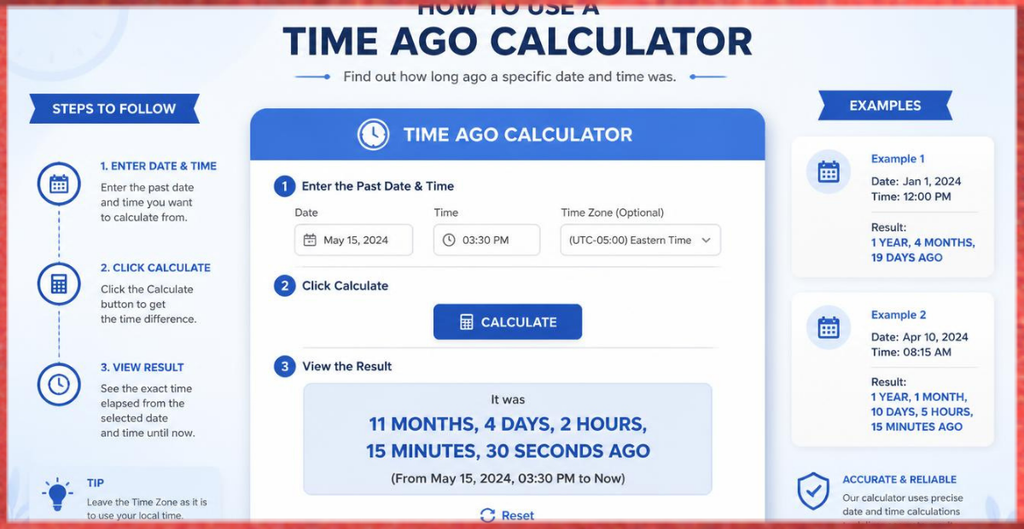
For reliable results, begin with a precise current date and time rather than a rough estimate. If the calculator accepts seconds, include them when the situation requires exactness.
Then check these details:
- Confirm the initial time.
- Enter the correct number of hours.
- Add minutes when necessary.
- Confirm whether the clock uses AM/PM or 24 hour time.
- Check the calendar date.
- Pay attention to midnight.
- If multiple locations are involved, confirm the relevant time zone.
For ordinary questions, this takes only seconds. For anything involving official records, deadlines, travel, financial transactions, or technical logs, precision is worth the extra moment.
A Few Examples to Make It Crystal Clear
Let’s take several practical examples.
If the current time is 10:23 PM on August 30, 2026:
1 hour ago: 9:23 PM, August 30
2 hours ago: 8:23 PM, August 30
12 hours ago: 10:23 AM, August 30
24 hours ago: 10:23 PM, August 29
25 hours ago: 9:23 PM, August 29
48 hours ago: 10:23 PM, August 28
50 hours ago: 8:23 PM, August 28
72 hours ago: 10:23 PM, August 27
96 hours ago: 10:23 PM, August 26
100 hours ago: 6:23 PM, August 26
Notice how the clock time stays familiar when subtracting complete blocks of 24 hours. The date does the traveling instead. Once you see that pattern, larger calculations become much easier.
Hours From Now Versus Hours Ago
There is a useful mirror image to all of this: hours from now.
If “hours ago” means moving backward from the current moment, “hours from now” means moving forward.
For instance, if it is 8:00 PM:
- 2 hours ago = 6:00 PM
- 2 hours from now = 10:00 PM
If it is 11:00 PM:
- 3 hours ago = 8:00 PM today
- 3 hours from now = 2:00 AM tomorrow
The second example shows that date rollover works in both directions. A time from now calculator simply adds the specified interval instead of subtracting it.
Understanding both makes it easier to calculate time from now, schedule future events, or work backward from a known timestamp.
How to Write Down a Time Calculation Clearly
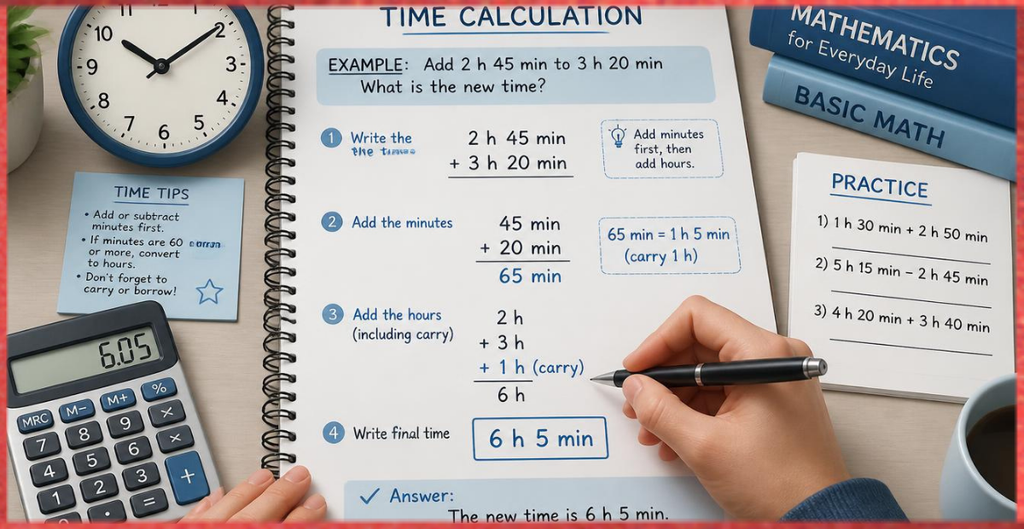
If you’re explaining a result to someone else, include the date rather than only the clock time. “It was 9:30 PM” may be technically correct but not terribly useful if the calculation crossed midnight.
A clearer statement would be:
“It was 9:30 PM on August 29, 2026.”
For technical records, you may prefer the 24-hour format:
“2026 08 29 21:30.”
This is especially helpful when several days are being compared. A clear date and time is harder to misunderstand than a lonely clock reading floating around without context.
Frequently Asked Question
what was 10 hours ago from now
To find what was 10 hours ago from now, simply subtract 10 hours from the current time. If the calculation crosses midnight, the answer will fall on the previous date.
what time was 10 hours ago
The time 10 hours ago is the current time minus 10 hours. This simple calculation helps you quickly find the exact past time without manually counting around the clock.
what time was it 9 hours ago central time
To know what time it was 9 hours ago in Central Time, subtract 9 hours from the current Central Time. Remember that crossing midnight can also change the calendar date.
6 hours ago from now
Six hours ago means moving six hours backward from the current time. For example, if it is 8:00 PM now, 6 hours ago it was 2:00 PM.
Final Thoughts on Calculating Time Ago
Time is peculiar in the nicest way. We spend our entire lives watching it move forward, yet many everyday questions ask us to turn around and walk backward through it for a moment.
An Hours Ago Calculator makes that backward journey simple, whether you need to find one hour ago, 100 hours ago, or a precise combination of hours and minutes.
The core idea never changes: take the reference point, subtract the desired time interval, account for date rollover, and read the resulting past time.
For straightforward calculations, you can do it mentally. For complicated intervals, an automatic calculator is faster and less prone to those irritating little mistakes.
If you regularly work with timestamps, schedules, deadlines, travel plans, or historical events, learning this basic form of time calculation is surprisingly valuable.
It also helps you understand the relationship between hours, minutes, days, dates, and elapsed time without turning every question into a mini arithmetic crisis.
So the next time you find yourself wondering, “What time was it 50 hours ago?” don’t stare at the clock as if it personally owes you an explanation. Start with the current time, subtract the hours, check the date, and you’re there.
And if you’ve got a favorite trick for calculating time mentally or a particularly ridiculous situation where you needed to know what date was it X hours agoshare it. Sometimes the smallest time questions come with the best stories.
This can also be adapted into a more SEO-aggressive calculator landing page, a more conversational blog style, or a version with FAQ schema-style questions and answers for search visibility.