There are moments when time feels strangely personal. A baby girl arrives, a family waits for a loved one to reach home, or someone simply sits watching the clock because an important moment is getting closer.
In all these little situations, knowing what time comes next can make waiting feel a bit easier. A simple Hours From Now Calculator does exactly that it takes the current time, adds the number of hours you choose, and shows the resulting future time without making you wrestle with mental arithmetic.
You might wonder, “What time will it be five hours from now?” It sounds easy until the calculation crosses midnight, changes the date, or involves both hours and minutes.
Thats where a calculator becomes surprisingly handy. Whether you’re planning work, setting a reminder, organizing travel, preparing an event, or simply curious about tomorrow’s time, a quick calculation can remove that tiny bit of confusion.And yes, time has a funny habit of becoming complicated precisely when we need a straight answer.
| Hours From Now | Equivalent Time |
|---|---|
| 1 hour | 60 minutes |
| 2 hours | 120 minutes |
| 6 hours | 360 minutes |
| 12 hours | 720 minutes |
| 24 hours | 1 day |
| 36 hours | 1 day 12 hours |
| 48 hours | 2 days |
| 72 hours | 3 days |
| 100 hours | 4 days 4 hours |
What Is an Hours From Now Calculator?
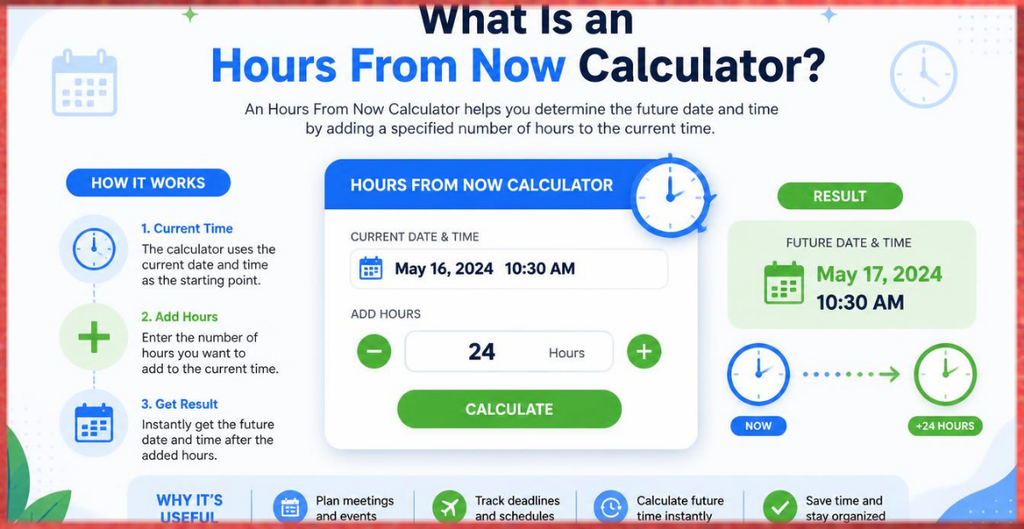
An Hours From Now Calculator is an online time calculator that determines a future time by adding a chosen number of hours to the current time. Instead of manually counting clock hours, the tool performs the calculation automatically and gives you the exact time.
For example, if the current time is 10:00 AM and you add 4 hours, the answer is 2:00 PM. But if you add 15 hours, the calculation moves into the next day, which means the future date matters too. A calculator handles this date change automatically, so you dont have to stop and count on your fingers.
The same basic idea can also be used in reverse. An hours ago calculator can tell you what time it was several hours earlier, while an hours calculator can help measure or compare longer periods.
How Does the Hours From Now Calculator Work?
The basic process is beautifully simple. First, the calculator identifies the current time and, when needed, the current date. Then it adds your chosen number of hours and determines the resulting future timestamp.
For instance, if your starting point is August 28, 2026, at 8:00 PM and you calculate 6 hours from now, the result becomes 2:00 AM on August 29, 2026. Notice how the calculation doesn’t just change the clock—it changes the calendar date too.
A good calculator can perform this automatic calculation instantly. Some tools also support minutes from now, allowing you to calculate more precise time intervals rather than working with whole hours only.
Hours From Now Calculator for Everyday Planning
Time calculations appear everywhere, often hiding inside ordinary activities. You may need to know when a meeting will end, when a trip reaches a certain stage, when a break finishes, or when an online event begins.
Using an hours from now calculator online can make these tiny planning jobs almost effortless. You enter the number of hours, check the displayed result, and move on with your day. No complicated formula, no staring at the clock like it owes you money.
It can be especially useful when the calculation crosses midnight. Adding 10 hours to an evening time doesn’t simply produce a later clock number—it produces a time on the next calendar day.
What Time Is X Hours From Now?
One of the most common searches is what time will it be X hours from now. The answer depends on the starting time and the number of hours being added.
For example, if the starting time is 9:00 AM:
- 1 hour from now = 10:00 AM
- 2 hours from now = 11:00 AM
- 3 hours from now = 12:00 PM
- 4 hours from now = 1:00 PM
- 5 hours from now = 2:00 PM
- 6 hours from now = 3:00 PM
- 7 hours from now = 4:00 PM
- 8 hours from now = 5:00 PM
- 9 hours from now = 6:00 PM
- 10 hours from now = 7:00 PM
This is straightforward while the calculation remains on the same day. Once the number becomes larger, the date and time from now become equally important.
What Time Is 1 Hour From Now?
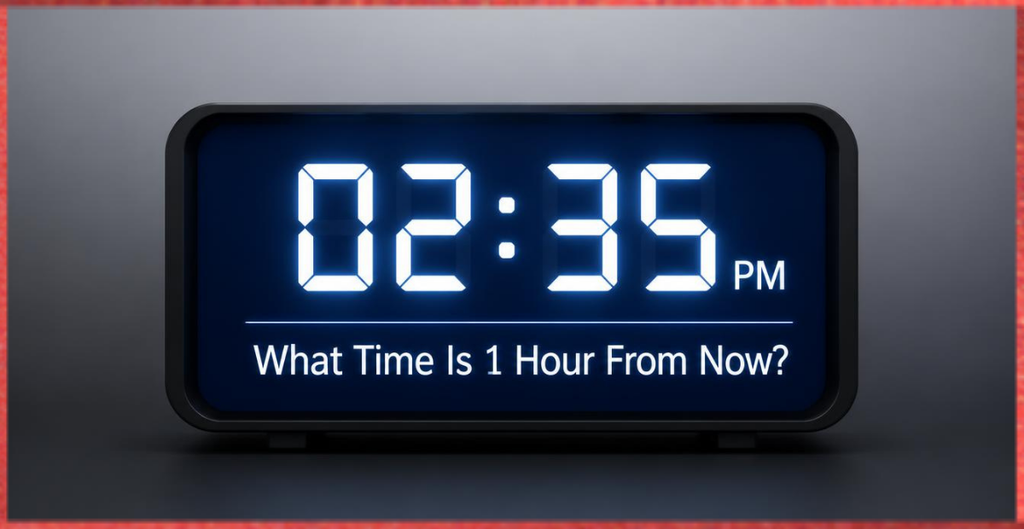
To find what time is 1 hour from now, simply add 60 minutes to the current clock time. If it’s 10:30 AM, one hour later is 11:30 AM.
This is one of those calculations that seems almost too easy for a calculator, yet it becomes useful when you’re checking schedules quickly. A tool can give the answer instantly, particularly when you’re working with a live current time.
What Time Is 2 Hours From Now?
For what time is 2 hours from now, add two complete hours to the starting point. If the current time is 6:15 PM, two hours later is 8:15 PM.
The minutes stay the same when you’re adding whole hours. Only the hour value changes, unless the calculation passes midnight and enters another day.
What Time Is 10 Hours From Now?
Finding what time is 10 hours from now becomes more interesting because the answer can easily fall on the following day.
Suppose the starting point is 7:00 PM. Ten hours later is 5:00 AM the next day. The clock moves forward, but the calendar quietly turns over while you’re not looking.
What Time Is 12 Hours From Now?
When you ask what time is 12 hours from now, the result is generally the same clock time with the AM/PM designation reversed.
For example, 8:30 AM plus 12 hours equals 8:30 PM. Likewise, 8:30 PM plus 12 hours becomes 8:30 AM on the following day.
This makes 12 hours a particularly useful interval when planning shifts, overnight schedules, travel, or events.
What Time Is 24 Hours From Now?

What time is 24 hours from now is another simple but useful calculation. Exactly 24 hours equals one complete day, so the clock time normally remains unchanged while the date advances by one day.
If it is 4:45 PM on August 28, 2026, then 24 hours later is 4:45 PM on August 29, 2026.
Hours From Now and Date Changes
A time calculation isn’t always just a clock calculation. When enough hours pass, the answer crosses into another date.
Consider these dates:
| Starting Date | Hours Added | Resulting Date |
|---|---|---|
| August 28, 2026 | 5 hours | August 28 or August 29, depending on start time |
| August 29, 2026 | 12 hours | August 29 or August 30, depending on start time |
| August 30, 2026 | 24 hours | August 31, 2026 |
| August 31, 2026 | 24 hours | September 1, 2026 |
| September 1, 2026 | 24 hours | September 2, 2026 |
The important lesson is that the current date and current clock time work together. You can’t always calculate one correctly while ignoring the other.
Time From Now Table
A time from now table provides a quick reference for common hour intervals. The exact clock result depends on your starting time, but the duration itself remains constant.
| Time Interval | Equivalent Duration |
| 1 hour from now | 60 minutes |
| 2 hours from now | 120 minutes |
| 5 hours from now | 300 minutes |
| 10 hours from now | 600 minutes |
| 12 hours from now | 720 minutes |
| 24 hours from now | 1 day |
| 48 hours from now | 2 days |
| 72 hours from now | 3 days |
| 100 hours from now | 4 days + 4 hours |
This is useful for anyone searching for a quick 1 hour to 100 hours reference without wanting to perform every conversion themselves.
Calculating Hours and Minutes From Now
Sometimes whole hours aren’t enough. You may need to calculate hours and minutes from now, such as 3 hours and 45 minutes.
Imagine the current time is 2:20 PM. Add 3 hours and 45 minutes:
2:20 PM + 3 hours = 5:20 PM
5:20 PM + 45 minutes = 6:05 PM
The final result is 6:05 PM.
This type of time calculation becomes more useful when planning appointments, travel, study sessions, work shifts, cooking times, or exercise routines. Tiny differences in minutes can matter more than people expect.
Minutes From Now vs. Hours From Now
There is a simple relationship between these two calculations. One hour equals 60 minutes, so adding 180 minutes produces the same result as adding 3 hours.
For example:
- 30 minutes from now = half an hour later
- 60 minutes from now = 1 hour later
- 90 minutes from now = 1 hour 30 minutes later
- 120 minutes from now = 2 hours later
- 180 minutes from now = 3 hours later
A calculator that supports both units can be especially useful when you need an exact result rather than a rough estimate.
12-Hour Format and AM/PM
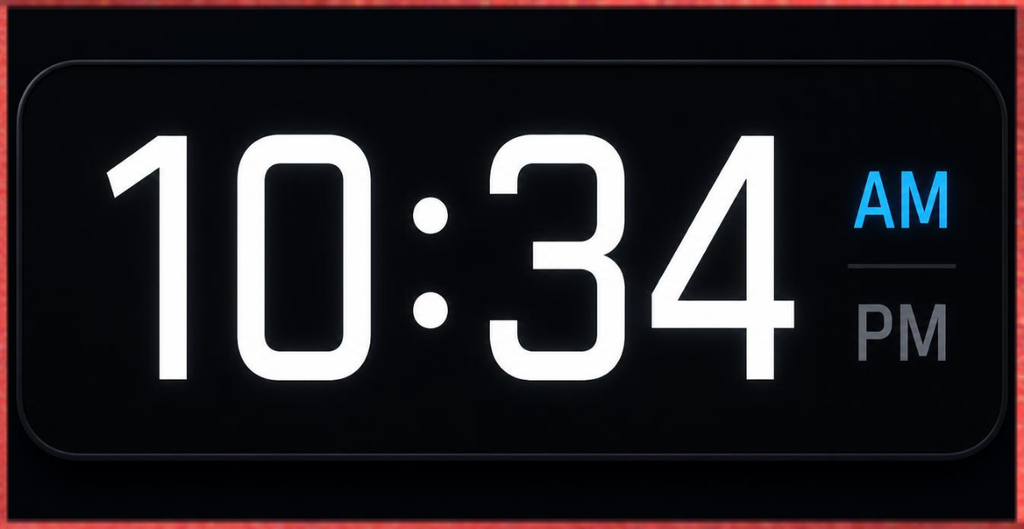
Many people use the 12-hour format, where the clock runs from 1 through 12 twice each day. The labels AM/PM distinguish morning from afternoon and evening.
For example:
- 7:00 AM = morning
- 12:00 PM = noon
- 5:00 PM = afternoon/evening
- 12:00 AM = midnight
When using an online calculator, checking the AM/PM label is important. Accidentally treating 8:00 PM as 8:00 AM can send your calculation wandering into an entirely different part of the day, which is not a very helpful adventure.
24-Hour Format and Time Conversion
The 24-hour format uses numbers from 00:00 through 23:59. It is common in transportation, military settings, healthcare, technology, and international scheduling.
Examples include:
- 01:00 = 1:00 AM
- 08:30 = 8:30 AM
- 12:00 = 12:00 PM
- 15:00 = 3:00 PM
- 20:30 = 8:30 PM
- 23:45 = 11:45 PM
A reliable time conversion feature can switch between these formats, making it easier to understand schedules written in unfamiliar notation.
Time Difference and Elapsed Time
An Hours From Now Calculator is slightly different from a tool designed specifically for time difference. When calculating time from now, you start with the present and move forward.Elapsed time, however, measures how much time has passed between two points.
For example, if a class starts at 9:15 AM and ends at 11:45 AM, the elapsed time is 2 hours and 30 minutes. That’s not exactly a future-time question; it’s a duration question.Still, these concepts overlap enough that many people use an hours calculator or time calculator for both.
Hours From Now Calculator for Work and Study
Students can use future-time calculations to plan revision blocks, breaks, online classes, and assignment deadlines. If you begin studying at 4:00 PM and want a three-hour session, the finishing time is 7:00 PM.
Workers can use the same idea for shifts, meetings, deadlines, and scheduled calls. A simple calculation can prevent the classic “I thought that was later” problem.
For remote teams, the calculator can also help when converting times between locations. However, when different countries are involved, you should consider time zones separately rather than assuming that adding hours alone performs a complete international conversion.
Hours From Now Calculator for Travel
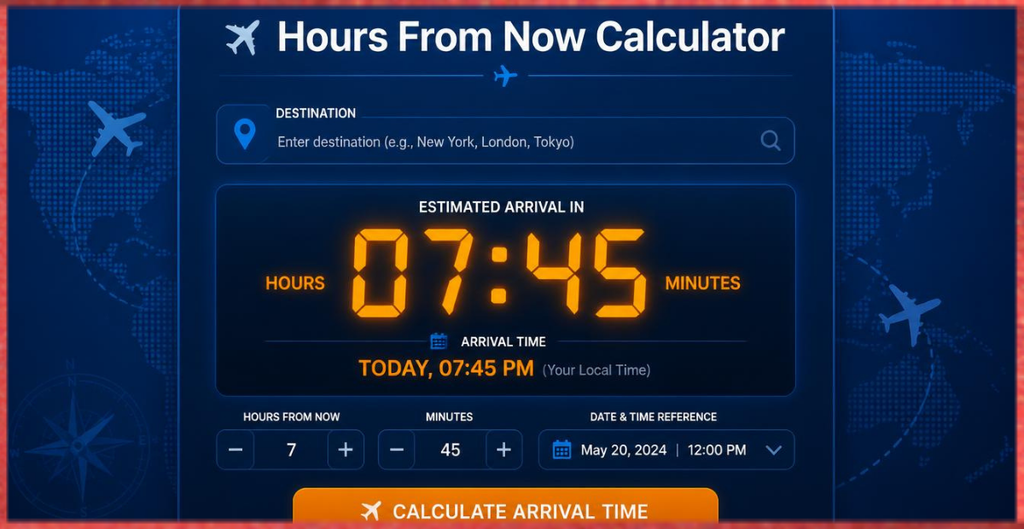
Travel planning is full of time calculations. You might need to know when you’ll arrive after a certain journey duration, when a connection begins, or what local time a future event occurs.
Suppose a journey begins at 6:40 AM and takes 8 hours. Adding the duration gives 2:40 PM, assuming no time-zone adjustment is involved.
For international travel, however, the situation gets trickier. A time and date calculation may need to account for a change in local time, daylight-saving rules, or crossing the International Date Line. Thats when a specialized world-time tool is usually better than a basic hours calculator.
Hours From Now Calculator and Countdown Planning
A countdown is essentially time moving toward a particular target. Whether you’re waiting for a birthday, event, deadline, vacation, appointment, or midnight, knowing the exact remaining hours can make the wait feel more concrete.
For example, instead of saying “the event is sometime tomorrow,” you can determine the exact remaining duration and see the exact future time.There is something oddly satisfying about this. A vague wait becomes a number, and a number feels manageable.
Current Time Plus Hours
The phrase current time plus hours describes the core operation behind the calculator.
The basic formula is:
Future time = current time + added hours
If minutes are included:
Future time = current time + hours + minutes
The calculator then checks whether the result passes midnight. If it does, the future date is advanced accordingly.
For everyday use, you don’t need to understand complicated mathematics. The machine does the arithmetic; your job is simply to enter the correct starting information.
How to Calculate Hours From Now Manually
You can manually calculate hours from now with a few simple steps.
Step 1: Identify the current time.
Write down the exact hour and minutes, including AM or PM.
Step 2: Add the requested hours.
Move forward one hour at a time or add the number directly.
Step 3: Watch for midnight.
If the calculation passes 12:00 AM, move the date forward by one day.
Step 4: Check the final result.
Make sure the AM/PM designation is correct and verify the date if the calculation crossed midnight.
For a small calculation this works perfectly well. For larger intervals, an automatic tool is usually faster and less prone to silly mistakes.
Why Automatic Calculation Is Useful
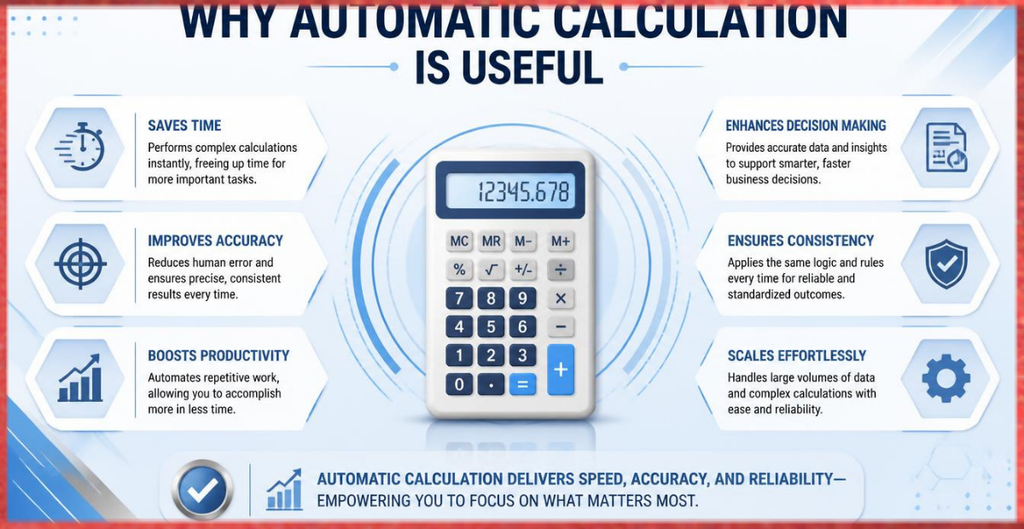
Human beings are surprisingly bad at doing simple calculations when they’re distracted, tired, rushed, or halfway through three other tasks. An automatic calculation removes that little mental burden.
A digital calculator can process hours, minutes, date changes, and formatting in seconds. It can also provide a consistent result when you repeat the calculation with different intervals.
This is particularly helpful for people managing schedules where a five-minute mistake can become a much bigger headache later.
Hours From Now Calculator vs. Hours Ago Calculator
These tools perform opposite operations.
An hours from now calculator moves forward from the current moment:
Current time + hours = future time
An hours ago calculator moves backward:
Current time hours = past time
For example, if the current time is 6:00 PM:
- 4 hours from now = 10:00 PM
- 4 hours ago = 2:00 PM
The concept is simple, but both tools are useful for different situations. You might use one to plan a future event and the other to figure out when something happened earlier.
Date Calculator vs. Time Calculator
A date calculator generally focuses on calendar-based calculations such as days, weeks, or months between dates. A time calculator focuses more closely on hours, minutes, seconds, and clock times.
There is some overlap. Adding 48 hours to a date is effectively two days, while adding 36 hours crosses from one day into another.
For precise planning, a tool that combines time and date calculations can be the most convenient choice.
Common Mistakes When Calculating Future Time
Even simple calculations can go wrong. The most common mistake is forgetting the AM/PM designation.
Another mistake is ignoring the date when crossing midnight. Someone might correctly calculate 3:00 AM but accidentally write today’s date instead of tomorrow’s.
People also sometimes confuse 12:00 AM and 12:00 PM. Remember:
- 12:00 AM = midnight
- 12:00 PM = noon
Finally, don’t confuse duration with clock time. “Five hours later” describes an interval, while “5:00 PM” describes a position on the clock. They are connected, but they’re not the same thing.
Practical Examples of Future Time Calculations
Here are some ordinary situations where future-time calculations can help.
Example: Cooking
A meal goes into the oven at 5:15 PM and needs 2 hours. It should be ready at 7:15 PM.
Example: Studying
You begin at 8:30 AM and study for 4 hours. Your planned finish time is 12:30 PM.
Example: Work shift
A shift starts at 10:00 PM and lasts 8 hours. It ends at 6:00 AM the following day.
Example: Overnight travel
A journey starts at 9:00 PM and lasts 10 hours. The arrival time is 7:00 AM the next day, assuming no time-zone changes.
Example: Reminder planning
If you want to check something 6 hours later and it’s currently 11:30 AM, your target time is 5:30 PM.
These examples show why a seemingly tiny tool can quietly become useful in many parts of everyday life.
Using an Hours From Now Calculator Online
An hours from now calculator online is generally designed for quick, no-fuss calculations. You provide the starting time or allow the tool to use the current time, enter the number of hours, and receive the answer.
Some calculators also display the exact date, making them particularly helpful when the calculation passes midnight.
Others may support minutes, seconds, different clock formats, and related calculations. The best choice depends on how detailed your planning needs to be.
When You Need an Exact Time From Now
There are situations where an approximate answer isn’t enough. If you have a flight, online meeting, medication reminder, appointment, deadline, or scheduled event, you may need the exact time from now.
In those situations, include the minutes rather than rounding them away. “About three hours” and “three hours and twenty minutes” can lead to very different outcomes when you’re working against a deadline.
If the calculation involves another location, verify the time zone too. Otherwise, even perfect arithmetic can produce the wrong practical answer.
A Simple Way to Think About Future Timestamps

A future timestamp is simply a precise representation of a moment that will happen later. It can contain both a date and a time.
For example:
August 28, 2026, 10:00 AM
is a specific moment. Adding 15 hours creates another timestamp:
August 29, 2026, 1:00 AM
The clock has moved forward 15 hours, while the calendar has moved forward one day. This is the reason combining date and time is important for longer calculations.
Frequendly Asked Question
23 hours from now
23 hours from now means adding 23 hours to the current time, which usually puts the result on the same day or the following day, depending on when you start.
when is 72 hours from now
72 hours from now is exactly 3 days from the current time, with the clock time generally staying the same.
when is 48 hours from now
48 hours from now is exactly 2 days from the current time, so the resulting clock time is usually unchanged.
what is 36 hours from now
36 hours from now means 1 day and 12 hours later than the current time, so it may fall on the second day after the starting date.
48 hours from now is what time
48 hours from now is the same clock time two days later. For example, 8:00 AM today becomes 8:00 AM two days from now.
Read This Blog https://avenzum.com/height-of-monster-can/
Final Thoughts on Hours From Now Calculators
Time calculations don’t usually look important until you actually need one. Then suddenly, knowing exactly what time is X hours from now becomes the difference between arriving early and arriving embarrassingly late.
An Hours From Now Calculator makes the process simple by combining the current time, hours, minutes, and date information to produce a clear future result.
It can help with work, study, travel, events, reminders, deadlines, cooking, exercise, and countless ordinary moments that quietly depend on knowing what comes next.
Whether you’re asking what time is 1 hour from now, what time is 10 hours from now, or what time is 24 hours from now, the underlying idea stays wonderfully simple: start with now, add the required duration, and check whether the calendar changes along the way.
And perhaps that’s the nicest thing about a time calculator. It doesn’t make time move any faster—it just makes the next moment easier to see.
If you use future-time calculations regularly, keep the starting time, date, AM/PM setting, and time zone in mind. Those tiny details make the difference between a rough guess and an exact future time.
Time keeps moving whether we calculate it or not, of course. But sometimes, putting a number on the next few hours makes the waiting, planning, and wondering feel a little more organized.