There is something oddly satisfying about knowing exactly where the clock will land after a certain number of hours. You look at the current time, perhaps while drinking tea, waiting for a meeting, planning a trip, or wondering when the long afternoon will finally be over, and suddenly the question appears:
what time is 9 hours from now? It sounds simple, and really it is, but clocks have a sneaky habit of becoming confusing around noon, midnight, and the AM-to-PM switch.
If your starting time is 8:57 AM, then adding nine hours gives you 5:57 PM on the same day. That is the commonly cited example associated with this calculation.
But if your actual starting time is 9:00 AM in GMT+5 on Saturday, October 3, 2026, then the answer is 6:00 PM on Saturday, October 3, 2026. So, yes, the exact answer depends on the moment you begin counting, which is a tiny detail but a pretty important one.
This guide explains how to calculate 9 hours from now, how AM and PM affect the answer, what happens when the calculation crosses midnight, and how 9 hours translates into smaller units such as 540 minutes, 32,400 seconds, and 32,400,000 milliseconds. It is basically a friendly map for a very ordinary clock question, without making the clock feel like a mathematics exam.
| Starting Time | 9 Hours From Now | Date |
|---|---|---|
| 8:57 AM | 5:57 PM | Saturday, October 3, 2026 |
| 9:00 AM | 6:00 PM | Saturday, October 3, 2026 |
What Time Is 9 Hours From Now?
Using the current reference time of 9:00 AM GMT+5, adding 9 hours takes us to 6:00 PM GMT+5.
The calculation is straightforward:
9:00 AM + 9 hours = 6:00 PM
Because the starting time is before noon, the first three hours take the clock to noon, and the remaining six hours move through the afternoon. So the result is an afternoon time, not the following morning, which is where people sometimes get tangled up.
For a different starting point, the answer changes immediately. For example, 8:57 AM + 9 hours = 5:57 PM. This is why a time calculator normally needs both the starting time and, when relevant, the time zone to give a useful answer.
The important thing is not memorizing one answer. It is understanding the small bit of time calculation behind it, because the clock doesn’t care what answer you memorized yesterday.
The Simple Rule for Adding 9 Hours
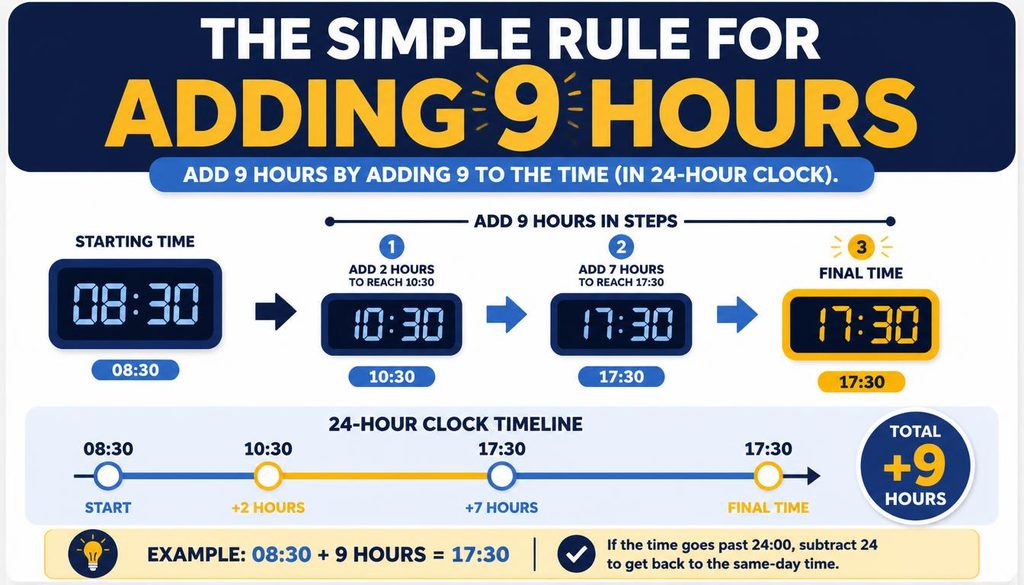
To find 9 hours from now, take the current hour and add nine. Keep the minutes exactly the same unless your calculation involves minutes separately.
For example, if the current time is 2:30 PM:
2:30 PM + 9 hours = 11:30 PM
If the current time is 4:15 PM:
4:15 PM + 9 hours = 1:15 AM the following day
Notice what happened in the second example. The calculation crossed midnight, so the resulting future time belongs to the next calendar day.
A useful little trick is to split the nine hours into smaller pieces. Add six hours first, then three more, or add the number needed to reach midnight and continue after that. It can feel less messy, specially when you’re doing it without a calculator.
What Time Is 9 Hours From Now in AM and PM?
The 12-hour clock is where the calculation can look more complicated than it really is. The letters AM and PM tell you which half of the day you’re talking about.
AM covers the hours before noon, while PM covers the hours after noon. At 12:00 noon, the notation changes from AM to PM, and at 12:00 midnight, the day begins again with 12:00 AM.
Here are some quick examples of 9 hours later:
- 7:00 AM + 9 hours = 4:00 PM, so the result stays on the same day.
- 8:00 AM + 9 hours = 5:00 PM, which lands neatly in the afternoon.
- 9:00 AM + 9 hours = 6:00 PM, the current example for October 3, 2026.
- 10:00 AM + 9 hours = 7:00 PM, still the same calendar day.
- 11:00 AM + 9 hours = 8:00 PM, a simple afternoon-to-evening rollover.
- 12:00 PM + 9 hours = 9:00 PM, because noon is already the start of PM.
- 3:00 PM + 9 hours = 12:00 AM, which is midnight and therefore the next day.
- 8:00 PM + 9 hours = 5:00 AM, meaning you have crossed into the following morning.
- 11:00 PM + 9 hours = 8:00 AM, again landing on the next day.
The odd-looking one is usually 12:00. People often treat noon and midnight like they are interchangeable, but they aren’t. That tiny distinction can throw an otherwise perfect calculation right off track.
What Time Is 9 Hours From Now Today?
If your question is specifically “what time is 9 hours from now today?”, first look at the exact current time.
At 8:57 AM, the answer is 5:57 PM.
At 9:00 AM, the answer is 6:00 PM.
At 10:30 AM, the answer is 7:30 PM.
At 1:45 PM, the answer is 10:45 PM.
At 4:30 PM, the answer is 1:30 AM the next day, so technically it is no longer “today.” Thats the part that matters when people are planning appointments, medication reminders, work shifts, travel, or simply trying to decide when something will happen.
The minutes don’t disappear when you add hours. They ride along with the hour, quietly doing their job.
How to Calculate 9 Hours From Now Manually
You don’t actually need an hours from now calculator for a nine-hour calculation. Your phone clock and a little patience are enough, though a calculator is handy when the starting time is awkward.
Start by writing down the exact current time. Suppose it is 6:20 AM.
Now add nine hours:
6:20 AM + 9 hours = 3:20 PM
The minutes remain 20, because you added whole hours rather than minutes.
For a time later in the day, say 7:45 PM, add the nine hours in two stages:
7:45 PM + 5 hours = 12:45 AM
Then:
12:45 AM + 4 hours = 4:45 AM
So:
7:45 PM + 9 hours = 4:45 AM the next day
This two-step method is especially useful when your brain is tired and the clock starts looking like it has personally offended you.
Why Midnight Makes Time Calculations Confusing
Midnight is the boundary where a simple time calculation becomes a date calculation too.
Imagine it is 10:15 PM on Saturday, October 3, 2026. Add nine hours. Three hours takes you to midnight, and the remaining six hours take you to 6:15 AM.
The final answer is therefore:
6:15 AM on Sunday, October 4, 2026
The date changed even though the duration was still exactly nine hours.
This is known as a time rollover, and it is one of the main reasons online calculators can be useful. They automatically account for the change from one calendar day to another, which is something people occasionally forget when doing the arithmetic in their head.
9 Hours in Minutes, Seconds, and Milliseconds
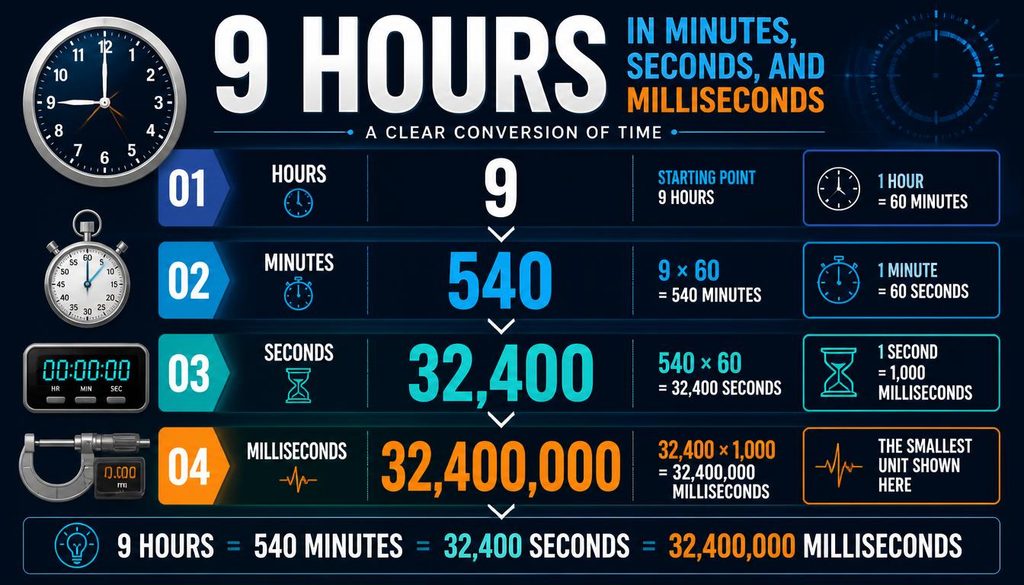
Sometimes the question is not about the clock at all. Maybe you want to know the exact duration represented by nine hours.
One hour contains 60 minutes, so:
9 hours × 60 = 540 minutes
Therefore, 9 hours in minutes = 540 minutes.
For seconds:
540 × 60 = 32,400 seconds
So 9 hours in seconds = 32,400 seconds.
And because one second contains 1,000 milliseconds:
32,400 × 1,000 = 32,400,000 milliseconds
So the complete conversion is:
- 9 hours = 540 minutes
- 9 hours = 32,400 seconds
- 9 hours = 32,400,000 milliseconds
It sounds almost comically precise when written in milliseconds, but thats still the same nine-hour duration. The clock just happens to have several smaller languages for describing it.
What Was 9 Hours Ago?
The reverse calculation is just as easy. Instead of adding nine hours, subtract nine hours from the current time.
If it is 6:00 PM, then:
6:00 PM − 9 hours = 9:00 AM
If it is 5:57 PM, then:
5:57 PM − 9 hours = 8:57 AM
That is why 9 hours ago and 9 hours from now are mirror-like expressions. One moves backward through the clock, while the other moves forward.
For a midnight example, if it is 4:00 AM, nine hours ago was 7:00 PM on the previous day. Again, the date needs attention because the calculation has crossed midnight.
A Quick Table for 9 Hours Later
Sometimes you don’t want an explanation, you just want to glance at a few examples and move along with your day.
| Starting Time | 9 Hours Later |
|---|---|
| 5:00 AM | 2:00 PM |
| 6:00 AM | 3:00 PM |
| 7:00 AM | 4:00 PM |
| 8:00 AM | 5:00 PM |
| 8:57 AM | 5:57 PM |
| 9:00 AM | 6:00 PM |
| 10:00 AM | 7:00 PM |
| 11:00 AM | 8:00 PM |
| 12:00 PM | 9:00 PM |
| 1:00 PM | 10:00 PM |
| 2:00 PM | 11:00 PM |
| 3:00 PM | 12:00 AM next day |
| 6:00 PM | 3:00 AM next day |
| 9:00 PM | 6:00 AM next day |
| 11:00 PM | 8:00 AM next day |
The table shows the pattern rather nicely. Once the result crosses midnight, you also need to move the calendar date forward. It seems obvious when you see it, but in the middle of a busy day, obvious things can become weirdly slippery.
How Time Zones Affect “9 Hours From Now”
A duration of nine hours does not change because of a time zone. Nine hours is nine hours in Pakistan, London, New York, or anywhere else.
What changes is the clock reading you see.
For example, if it is 9:00 AM in GMT+5, nine hours later locally is 6:00 PM. Someone in another time zone may see a different clock time for that same instant.
This matters when you’re arranging an international call or checking an online event. Saying “nine hours from now” is usually enough if everyone is talking about their own local clocks, but for shared plans it is safer to mention the time zone too.
A phrase such as “6:00 PM GMT+5” is much less mysterious than simply saying “six tonight,” specially when people are scattered across different places.
Using a Time Calculator
A time calculator or future time calculator is useful when you need more than a quick mental calculation.
An hours from now calculator can help when you need to add 10 hours, 11 hours, 12 hours, 13 hours, or 14 hours from a starting point, particularly when the calculation crosses several calendar boundaries or involves unusual dates.
The basic process remains the same:
- Enter the current time.
- Choose the number of hours to add.
- Check whether the result crosses noon or midnight.
- Confirm the resulting date.
- Confirm the time zone when another location is involved.
For ordinary nine-hour calculations, though, a calculator can sometimes be more machinery than you need. If the clock says 9:00 AM, adding nine hours to reach 6:00 PM is quicker than opening an app, waiting for it to load, and then wondering why you opened the app in the first place.
Common Mistakes When Adding Hours
One frequent mistake is treating 12:00 PM as midnight. It isn’t. 12:00 PM is noon, while 12:00 AM is midnight.
Another mistake is forgetting the date after midnight. If you calculate 9:00 PM + nine hours as 6:00 AM, you have the right clock time, but the correct answer also belongs to the next day.
People also sometimes change the minutes accidentally. If you start at 4:37 PM and add nine whole hours, the answer is 1:37 AM, not 1:00 AM. The minutes stay with you, like an annoying but loyal little passenger.
Finally, don’t confuse a duration with a clock reading. 540 minutes describes an interval of time, while 6:00 PM describes a particular position on the clock. They’re connected, but they aren’t the same type of information.
What If You Need 10, 11, 12, 13, or 14 Hours From Now?
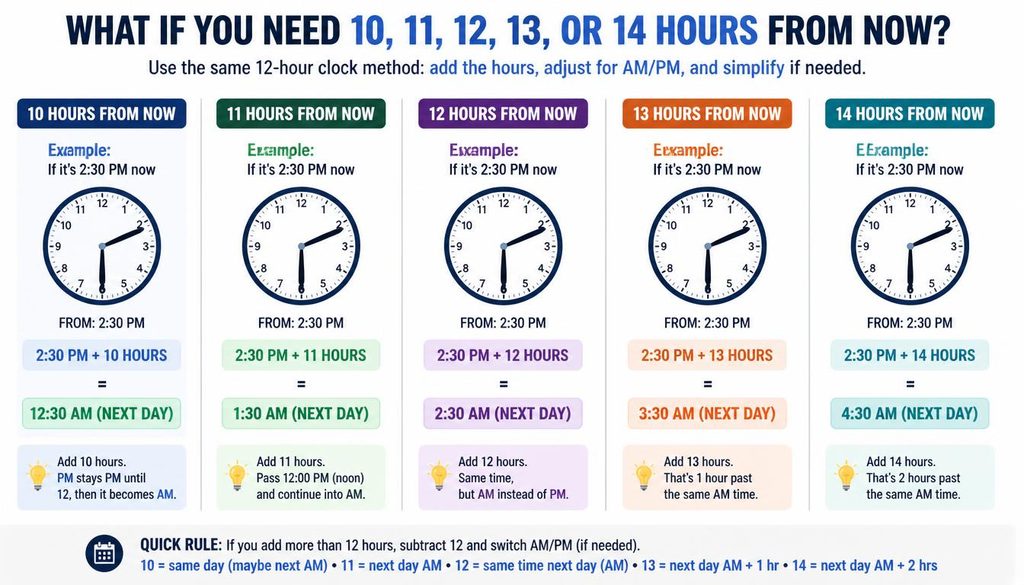
Once you’ve understood nine hours from now, the nearby calculations follow naturally.
If the starting time is 9:00 AM:
- 10 hours from now = 7:00 PM
- 11 hours from now = 8:00 PM
- 12 hours from now = 9:00 PM
- 13 hours from now = 10:00 PM
- 14 hours from now = 11:00 PM
This is essentially the same time addition each time. You’re just extending the interval.
A useful shortcut is to calculate nine hours first, then add one hour at a time. So if 9:00 AM + 9 hours is 6:00 PM, ten hours is 7:00 PM, eleven hours is 8:00 PM, and so on. Nothing dramatic is happening; the clock is simply walking forward one hour at a time.
A Simple Way to Remember the Calculation
If you frequently ask “what will the time be in nine hours?”, remember this tiny formula:
Starting time + 9 hours = future time
For the current example:
9:00 AM + 9 hours = 6:00 PM
For the commonly referenced 8:57 AM example:
8:57 AM + 9 hours = 5:57 PM
And for a late-night example:
11:00 PM + 9 hours = 8:00 AM the next day
That’s really the whole secret. The trick isn’t complicated mathematics. It is simply paying attention to AM, PM, noon, midnight, and the date when the clock passes 12:00.
Frequently Asked questions
hours from now is what time
To find out what time it will be a certain number of hours from now, simply add those hours to the current time. The result shows the exact future time.
what time will it be in 9 hours
In 9 hours, the time will be 9 hours later than the current time. Add 9 hours to the current time to get the exact result.
what is 9 hours from now
9 hours from now means adding nine hours to the current time. For example, if it is 8:57 AM now, 9 hours from now will be 5:57 PM.
what time was 9 hours ago
9 hours ago means subtracting nine hours from the current time. This gives you the exact time that occurred nine hours earlier.
what time will it be 9 hours from now
To calculate the time 9 hours from now, add 9 hours to the current time. If the calculation passes noon or midnight, the AM/PM period or date may change.
Read more: https://avenzum.com/2-weeks-from-today-2/
Final Answer: What Time Is 9 Hours From Now?
Using the current reference time of 9:00 AM GMT+5 on Saturday, October 3, 2026, the answer is:
6:00 PM on Saturday, October 3, 2026.
If the starting time were instead 8:57 AM, then 9 hours from now would be 5:57 PM on the same day. This explains why different examples of the question can show slightly different answers—the calculation is always tied to the exact moment when you begin.
In short, nine hours equals 540 minutes, 32,400 seconds, or 32,400,000 milliseconds. To calculate it yourself, simply add nine hours to the exact current time and watch for a crossing of noon or midnight.
Time is wonderfully ordinary in that way. Nine hours can sound like a huge stretch when you’re waiting for something, then suddenly it’s evening and you’re wondering where the afternoon disappeared to. Whether you’re checking a future appointment, planning a call, setting a reminder, or just satisfying a strangely persistent clock-question in your head, the method stays wonderfully simple: start with the exact time, add 9 hours, keep the minutes intact, and check whether the date has changed.
And if the answer lands at 6:00 PM, well, perhaps that’s a good moment to stop calculating and notice that the day has moved along quite nicely after all.