There is something oddly satisfying about asking a tiny question like what time is 15 hours from now. It sounds almost too simple, yet when you are planning a trip, setting a reminder, checking a deadline, or trying to figure out when tomorrow actually begins for your schedule, those fifteen hours suddenly become rather important. Time has this sneaky habit of looking simple until we try to add it in our heads.
If the current time is 7:31 AM on Sunday, October 4, 2026, in GMT+5, then adding 15 hours brings us to 10:31 PM on Sunday, October 4, 2026. The date does not change in this particular example, which is a small detail people often miss when doing mental time calculation.
So, in plain words: 15 hours from now is 10:31 PM today, assuming the reference time is 7:31 AM in GMT+5. If your local clock shows a different minute or you are in another time zone, your exact result will be different, naturally enough.
| Calculation | Result |
|---|---|
| Current time | 7:31 AM |
| Current date | Sunday, October 4, 2026 |
| Time zone | GMT+5 |
| 15 hours from now | 10:31 PM |
| Date 15 hours from now | Sunday, October 4, 2026 |
| 15 hours ago | 4:31 PM |
| Date 15 hours ago | Saturday, October 3, 2026 |
| 15 hours in minutes | 900 minutes |
| 15 hours in seconds | 54,000 seconds |
| 15 hours in milliseconds | 54,000,000 milliseconds |
What Time Is 15 Hours From Now?
Let’s make the main calculation pleasantly uncomplicated. Starting from 7:31 AM, first add 12 hours. That takes the clock to 7:31 PM. Then add the remaining 3 hours, and the result becomes 10:31 PM.
Therefore, 15 hours from now is 10:31 PM, when the starting point is 7:31 AM. Nothing mysterious is happening behind the curtain, it is simply adding a duration to a starting time.
The calculation looks like this:
7:31 AM + 15 hours = 10:31 PM
Because 15 hours is less than 24 hours, we have not completed a full day. The future date remains Sunday, October 4, 2026, which is useful to remember when someone asks not only “what time,” but also “what date will it be 15 hours from now?”
15 Hours From Now: The Quick Answer

For anyone who came here wanting the answer without wrestling with a paragraph of time arithmetic, here it is. Starting at 7:31 AM on Sunday, October 4, 2026, the time 15 hours from now is 10:31 PM on Sunday, October 4, 2026.
This assumes the starting point is GMT+5 and that the clock time is exactly 7:31 AM. If your current clock says 7:36 AM instead, the answer would be 10:36 PM. A five-minute difference at the beginning remains a five-minute difference at the end, which is almost reassuringly logical.
It is also worth noticing that 15 hours later is still the same calendar date here. If you started at 10:00 AM, for instance, adding fifteen hours would produce 1:00 AM the next day. So the answer depends on both the starting time and the date, not just the number 15.
How to Calculate 15 Hours From Now
The easiest method is to break the duration into smaller pieces. Rather than attempting to throw all fifteen hours onto the clock at once, add 12 hours first and then the remaining 3 hours. It feels less like arithmetic and more like walking across stepping stones.
Starting with 7:31 AM:
- Add 12 hours → 7:31 PM
- Add 3 more hours → 10:31 PM
- Final result → 10:31 PM on October 4, 2026
Another method uses the 24-hour clock. Convert 7:31 AM into 07:31, then add 15 hours. The calculation becomes 07:31 + 15:00 = 22:31. Converting 22:31 back into the 12-hour clock gives 10:31 PM.
The second method is especially handy when using schedules, computers, airports, hospitals, or international timetables. Twenty-two thirty-one looks a little stern at first, but it removes the AM/PM confusion quite nicely.
15 Hours From Now in AM and PM
When people ask what time will it be in 15 hours, the AM/PM part can sometimes cause more confusion than the actual calculation. The clock moves through noon and evening, so the final designation needs to be checked carefully.
At 7:31 AM, adding 15 hours takes us past noon and into the evening. The result is therefore 10:31 PM, not 10:31 AM. This is one of those tiny mistakes that can turn a perfectly good appointment into a rather dramatic misunderstanding.
A useful trick is to remember that adding 12 hours flips AM to PM or PM to AM while keeping the minutes unchanged. Then add the remaining three hours. So 7:31 AM becomes 7:31 PM, then 10:31 PM.
What Date Will It Be 15 Hours From Now?
The current date matters whenever you are adding hours. In our reference example, the starting date is Sunday, October 4, 2026, and the starting time is 7:31 AM.
After adding 15 hours, the clock reaches 10:31 PM on the same Sunday. So the answer is:
Sunday, October 4, 2026 at 10:31 PM GMT+5.
There is no date rollover because the resulting time remains before midnight. If we had started at 11:00 AM, however, fifteen hours would carry us into Monday morning. Time calculation becomes especially interesting around midnight, where the clock changes its face and the calendar changes with it.
15 Hours From Now in GMT+5
A time zone is essential when someone wants an exact answer. The phrase “15 hours from now” describes a duration, but “what time will that be?” requires a starting clock.
For a starting point of 7:31 AM GMT+5, adding fifteen hours gives 10:31 PM GMT+5. The UTC offset itself does not change merely because fifteen hours have passed.
GMT+5 is five hours ahead of Greenwich Mean Time. When working with another location, you should use that location’s actual local clock and account for any applicable daylight-saving rules. Otherwise, the calculation can be accurate mathematically and still be wrong for the person reading it, which is a slightly annoying kind of correct.
15 Hours From Now Calculator: A Simple Mental Method
You do not always need an online hours from now calculator. For a straightforward duration such as fifteen hours, your own clock and a few seconds of arithmetic can do the job perfectly well.
First, look at the current time. Then add 15 to the hour while keeping the minutes unchanged. If the resulting hour reaches or passes 24 in a 24-hour system, subtract 24 and move to the following date.
For example, 7:31 AM is 07:31. Add 15 hours and you get 22:31. Since 22 is less than 24, there is no date change. Convert 22:31 to the familiar 12-hour format and you get 10:31 PM.
For more complicated calculations involving several dates, changing time zones, or unusual durations, an online time calculator can be helpful. It is less about needing a calculator and more about avoiding a silly error when the stakes are higher.
15 Hours Later: Why the Date Sometimes Changes
The phrase 15 hours later means exactly the same duration as 15 hours from now, but the date may or may not change. That depends entirely on the starting hour.
Consider a starting time of 7:31 AM. Fifteen hours later is 10:31 PM on the same day. But start at 3:00 PM and fifteen hours later is 6:00 AM the following morning.
This is why a good time calculation should consider both the clock and calendar. Saying “just add fifteen” works for the hour value, but it is not enough if the resulting number crosses midnight.
The calendar is basically the quiet partner in every time calculation. We tend to ignore it until midnight arrives and suddenly it has opinions.
How Many Minutes Are in 15 Hours?
For anyone searching how many minutes are in 15 hours, the conversion is beautifully straightforward.
One hour contains 60 minutes. Therefore:
15 hours × 60 = 900 minutes
So, 15 hours = 900 minutes.
This is useful when a scheduling system asks for a duration in minutes rather than hours. A fifteen-hour period might look enormous when written as 900 minutes, but they describe precisely the same amount of elapsed time.
The conversion does not depend on the time zone, date, AM/PM, or calendar. It is simply a time duration conversion, which is refreshingly uncomplicated.
How Many Seconds Are in 15 Hours?

If minutes are not dramatic enough, we can go one level smaller. Fifteen hours contains 54,000 seconds.
The calculation is:
15 × 60 × 60 = 54,000 seconds
So, 15 hours = 54,000 seconds.
Every one of those seconds passes whether we notice it or not, which makes a fifteen-hour period feel strangely enormous and tiny at the same time. A person waiting for a flight may experience 54,000 seconds very differently from someone sleeping through most of them.
For technical applications, countdown systems, programming, and detailed time conversion, seconds are often more convenient than hours. The duration stays exactly the same, only the measuring unit changes.
How Many Milliseconds Are in 15 Hours?
Going even smaller, 15 hours equals 54,000,000 milliseconds. Yes, fifty-four million tiny ticks of time, more or less the sort of number that makes a simple question suddenly look like it belongs in a computer lab.
The calculation is:
15 hours × 60 × 60 × 1,000 = 54,000,000 milliseconds
Therefore:
15 hours = 900 minutes = 54,000 seconds = 54,000,000 milliseconds
This kind of duration conversion is particularly useful in software and technical systems, where milliseconds may be used for timers, delays, events, or performance measurements. For everyday planning, however, 15 hours is usually much easier on the brain.
What Time Was It 15 Hours Ago?
The same arithmetic can travel backward. If the reference time is 7:31 AM on October 4, 2026, then 15 hours ago was 4:31 PM on Saturday, October 3, 2026.
Notice that moving backward fifteen hours crosses midnight. This is the reverse of our earlier example, and it shows why the date cannot be forgotten.
The calculation can be checked by moving backward 7 hours from 7:31 AM to 12:31 AM, then another 8 hours to 4:31 PM on the previous day. It is a simple little journey through midnight, with the calendar quietly turning a page while we aren’t looking.
The Difference Between 15 Hours From Now and 15 Hours Ago
The phrases 15 hours from now and 15 hours ago describe equal durations in opposite directions. One points toward the future, while the other points into the past.
If now is 7:31 AM Sunday, then 15 hours from now is 10:31 PM Sunday. Fifteen hours ago is 4:31 PM Saturday. The two results are separated by 30 hours, because they sit fifteen hours on either side of the current moment.
This distinction sounds obvious, but it becomes useful when reading messages, appointment notices, delivery estimates, or system timestamps. “Ago” and “from now” are only two small words, yet swapping them changes everything.
16, 17, 18, 19, and 20 Hours From Now
Sometimes someone asking about fifteen hours is really trying to compare nearby durations. Once the starting point is known, the calculation can be extended without much fuss.
Using 7:31 AM on October 4, 2026 as the reference:
- 16 hours from now: 11:31 PM, October 4
- 17 hours from now: 12:31 AM, October 5
- 18 hours from now: 1:31 AM, October 5
- 19 hours from now: 2:31 AM, October 5
- 20 hours from now: 3:31 AM, October 5
Here we can see the calendar rollover happen after the 16-hour mark. At 17 hours, the result has crossed midnight into Monday, October 5.
This is a useful demonstration of why the exact starting time matters. The difference between 16 and 17 hours is only one hour, but that single hour changes the future date in this example.
Why the Current Time and Current Date Both Matter
A question like what time is 15 hours from now cannot be answered accurately from the duration alone. We need a starting point.
If two people ask the question at different moments, they will naturally receive different answers. Someone asking at 7:31 AM and another person asking at 10:00 AM are both adding fifteen hours, but their resulting times are not the same.
The same is true across time zones. Fifteen hours is always fifteen hours, yet the displayed local time can differ. This is why an accurate date and time calculator usually needs the starting date, starting time, and sometimes the time zone as well.
A Quick Reference Table for 15 Hours
For easy checking, here is the essential information gathered in one place. Tables are rather less poetic than clocks, but they do get the job done.
| Item | Result |
|---|---|
| Starting time | 7:31 AM |
| Starting date | Sunday, October 4, 2026 |
| Time zone | GMT+5 |
| Duration | 15 hours |
| Duration in minutes | 900 minutes |
| Duration in seconds | 54,000 seconds |
| Duration in milliseconds | 54,000,000 milliseconds |
| Time 15 hours later | 10:31 PM |
| Date 15 hours later | Sunday, October 4, 2026 |
| Time 15 hours ago | 4:31 PM |
| Date 15 hours ago | Saturday, October 3, 2026 |
The most important line is still the simplest one: 7:31 AM + 15 hours = 10:31 PM. Everything else is simply another way of looking at the same time duration.
How to Calculate 15 Hours From Now Yourself
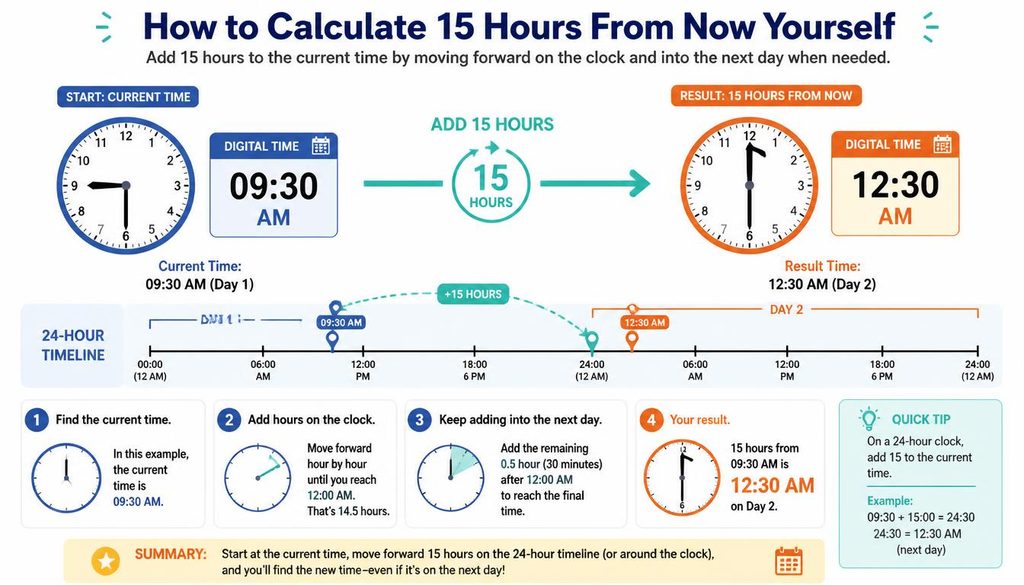
If you want to calculate 15 hours from now without a dedicated tool, start by writing down your exact local time. Do not rely on memory, because even a few minutes can change the final answer.
Next, add 12 hours, then add the remaining 3 hours. If the calculation crosses midnight, move the date forward by one day. If you are calculating backward, subtract the hours and move the date backward whenever you cross midnight.
For people who regularly need these calculations, a time calculator or hours from now calculator can make the process quicker. Still, understanding the arithmetic yourself is valuable because you can spot mistakes instead of blindly trusting a result.
Frequently Asked Qeustions
when was 15 hours from now
Fifteen hours from now refers to the time that will occur 15 hours after the current time. The exact time depends on your current time and time zone.
time in 15 hours
To find the time in 15 hours, simply add 15 hours to the current time. If the calculation passes midnight, the resulting time will be on the following day.
what time is 15 hours from now
The time 15 hours from now can be calculated by adding 15 hours to the current time. For example, if it is 7:00 AM now, it will be 10:00 PM after 15 hours.
what time will it be in 15 hours from now
In 15 hours, the time will be 15 hours later than the current time. You may also need to account for a change to the next day if the calculation passes midnight.
15 hrs from now
15 hrs from now means calculating the exact time that occurs 15 hours after the present time. Add 15 hours to your current time to get the result.
Read More: https://avenzum.com/what-time-is-9-hours-from-now/
Final Thoughts on 15 Hours From Now
Time calculations are tiny acts of prediction. We look at the clock right now and ask it to tell us where we will be fifteen hours later, as if the future is hiding neatly inside those two hands. In reality, the answer is simple arithmetic, but the reason we ask can be anything from practical planning to pure curiosity.
With the reference point of 7:31 AM on Sunday, October 4, 2026, GMT+5, the answer is 10:31 PM on Sunday, October 4, 2026. Fifteen hours is also 900 minutes, 54,000 seconds, or 54,000,000 milliseconds, depending on how closely you want to watch the clock.
The nicest thing about understanding 15 hours from now is that you no longer have to guess. Look at your current time, add the duration, check whether midnight has been crossed, and confirm the date. That’s the whole little trick, no grand mystery required.
And perhaps there is something comforting in that. Fifteen hours may feel long when you’re waiting for something, and surprisingly short when you’re busy living through it. Either way, the clock keeps moving with its usual stubbornness. By the time you check again, that future moment you were calculating will already be here.