There is something oddly satisfying about asking a calendar a simple question and getting one very specific answer back. What date is 2 weeks from today? sounds almost too easy, yet when plans, appointments, deadlines, trips, reminders, or important events are involved, being off by even one day can create a little mess, so it’s worth getting the calculation right.
As of October 3, 2026, the date 2 weeks from today is October 17, 2026. That date falls on a Saturday, which makes the answer especially easy to remember for anyone planning something around the weekend. It’s a straightforward date calculation, but understanding how it works helps when the starting date changes later on.
The basic idea is pleasantly simple: 2 weeks = 14 days. Add those 14 days to the start date, and you arrive at the target future date. No mysterious calendar magic involved, though calendars do have a funny way of making simple things look complicated.
| Calculation | Result |
|---|---|
| Today | October 3, 2026 |
| 2 weeks from today | October 17, 2026 |
| Day of the week | Saturday |
| 2 weeks in days | 14 days |
| 2 weeks in hours | 336 hours |
| 2 weeks in minutes | 20,160 minutes |
| 2 weeks in seconds | 1,209,600 seconds |
What Date Is 2 Weeks From Today?
If today is October 3, 2026, then adding 2 weeks means moving forward exactly 14 days.
The calculation looks like this:
October 3, 2026 + 14 days = October 17, 2026
So, the direct answer to what date is 2 weeks from today is:
October 17, 2026
And yes, October 17, 2026 is a Saturday. If you are checking the date for an appointment, event, payment reminder, travel plan, or another commitment, Saturday may be an important detail to notice.
A small thing to remember: “from today” normally means you begin counting forward from the current date rather than treating today itself as day one. This distinction sounds tiny, but it’s exactly where off-by-one-day mistakes tend to sneak in.
2 Weeks From Today: The Quick Calendar Calculation
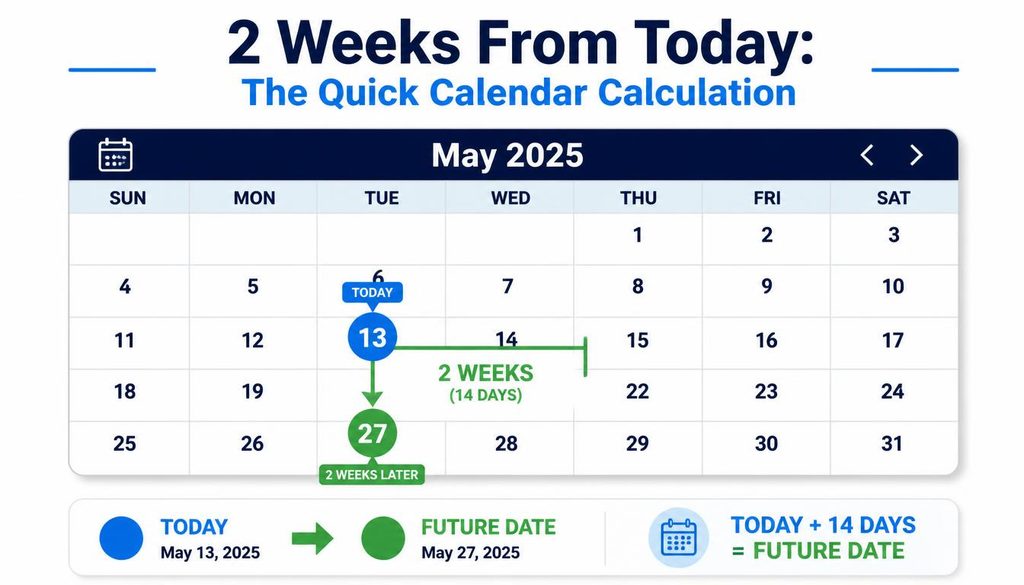
The easiest way to calculate 2 weeks from today is to think in weeks rather than individual dates.
One week after October 3, 2026 is October 10, 2026. Add one more week, and you reach October 17, 2026. That gives us:
October 3 → October 10 → October 17
In other words, the calendar moves forward two complete seven-day periods. It’s a cleaner approach than counting fourteen individual boxes on a calendar, especially when you’re doing the calculation quickly in your head.
Another useful shortcut is simply to remember that two weeks from now = 14 days from now. Once that relationship becomes familiar, many ordinary date calculation questions become almost automatic, which is rather handy.
What Is the Date 2 Weeks From Now?
If someone asks, “What is the date 2 weeks from now?”, they are asking essentially the same thing as “What date is 2 weeks from today?”
Using the current reference date of October 3, 2026, the answer remains:
October 17, 2026
The phrase “from now” can sometimes feel connected to an exact time of day, but for an ordinary calendar calculation, the important reference is the date. Whether you ask at 8:30 in the morning or later in the evening, the calendar date two weeks ahead remains October 17, 2026.
Of course, if you were calculating an exact duration down to the hour, then the time would matter. For ordinary planning, though, the future date is what most people actually need, and thats the useful bit.
How Many Days Are in 2 Weeks?
There are 14 days in 2 weeks.
The calculation is very simple:
1 week = 7 days
2 weeks = 7 × 2 = 14 days
That means 14 days from today and 2 weeks from today describe the same calendar interval. You can use either expression when planning a date, depending on which feels clearer.
For example, if today is October 3, adding seven days takes you to October 10. Adding another seven days takes you to October 17. The two-week period is therefore a complete fourteen-day stretch, not merely “around half a month,” which is a different and less precise idea.
How Many Hours Are in 2 Weeks?
Once you know that two weeks contain 14 days, converting the time duration into hours is easy.
Each day has 24 hours, so:
14 × 24 = 336 hours
Therefore:
2 weeks = 336 hours
This kind of time conversion can be useful when a schedule is expressed in hours rather than calendar dates. For example, a system might say something must happen 336 hours after a particular starting point, while a person might naturally describe the same interval as two weeks.
The two expressions represent the same duration under normal calendar-time assumptions, although exact elapsed-time calculations can sometimes require attention to daylight-saving changes in places where clocks change. That little calendar wrinkle is easy to forget.
How Many Minutes Are in 2 Weeks?
Taking the calculation one step further, 2 weeks equals 20,160 minutes.
Here’s the math:
2 weeks × 7 days × 24 hours × 60 minutes = 20,160 minutes
So the complete conversion is:
2 weeks = 14 days = 336 hours = 20,160 minutes
This may be more precision than you need for choosing a date on a calendar, but it demonstrates an important point: a time duration can be expressed in different units without changing the underlying interval.
For ordinary planning, use days or weeks. For technical schedules, countdowns, or systems that operate in minutes, the minute figure becomes more useful. Different tool, same stretch of time, more or less.
How Many Seconds Are in 2 Weeks?
If you continue the same calculation, 2 weeks contains 1,209,600 seconds.
The calculation is:
14 days × 24 hours × 60 minutes × 60 seconds = 1,209,600 seconds
That gives the full conversion:
2 weeks = 14 days = 336 hours = 20,160 minutes = 1,209,600 seconds
Nobody normally wakes up and says, “I’ll see you in 1,209,600 seconds,” which would sound a little theatrical, honestly. Still, the conversion is useful when understanding how different units describe the same elapsed period.
For a normal date calculator task, however, you generally only need the starting date and the number of days or weeks you want to add.
Starting Date Examples: What Date Is 2 Weeks Later?
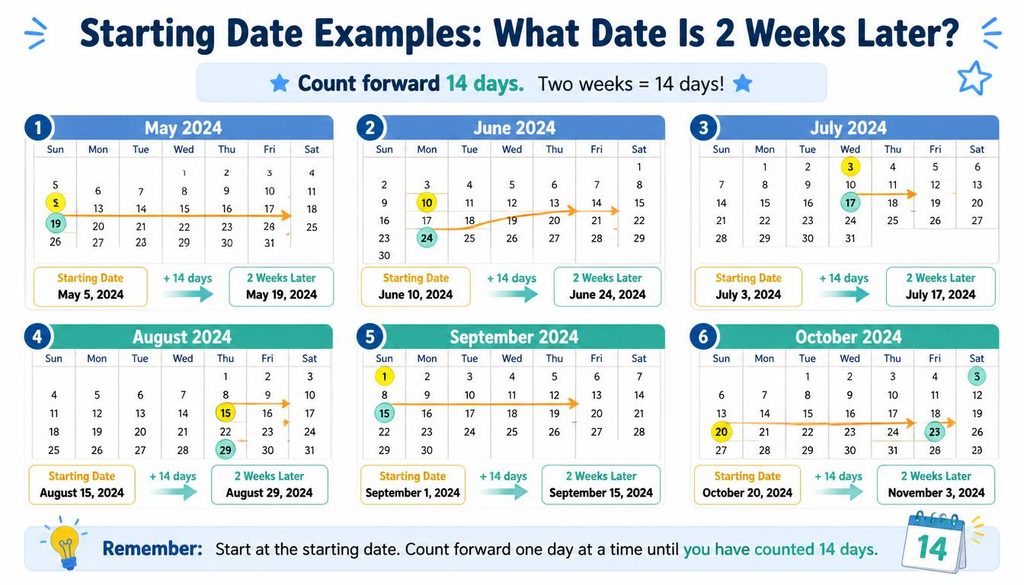
The answer changes whenever the starting date changes. That sounds obvious, but it’s the most important rule in relative-date calculations: the target date always depends on the reference date.
Here are several examples:
- September 29, 2026 + 2 weeks = October 13, 2026
- September 30, 2026 + 2 weeks = October 14, 2026
- October 1, 2026 + 2 weeks = October 15, 2026
- October 2, 2026 + 2 weeks = October 16, 2026
- October 3, 2026 + 2 weeks = October 17, 2026
- October 4, 2026 + 2 weeks = October 18, 2026
- October 5, 2026 + 2 weeks = October 19, 2026
- October 6, 2026 + 2 weeks = October 20, 2026
- October 7, 2026 + 2 weeks = October 21, 2026
Notice the pattern? Every time the start date moves forward by one day, the target date also moves forward by one day. It’s a simple relationship, but seeing it laid out makes the calendar calculation much easier to grasp.
What Date Is 2 Weeks From Today If Today Changes?
Relative dates are temporary by nature. “Today” is not a fixed date forever; it moves forward every morning when the calendar flips over.
For example, on October 3, 2 weeks from today is October 17. But on October 4, the answer becomes October 18. On October 5, it becomes October 19. The phrase stays exactly the same while the answer changes.
That is why websites, forms, reminders, and scheduling tools often use a specific reference date behind the scenes. Without a starting date, “two weeks from today” cannot produce one permanent answer.
So whenever you see a relative-date question, first identify today’s date, then add the requested time interval. Thats the whole trick.
What Date Was 2 Weeks Ago?
The same method works backward.
If today is October 3, 2026, then 2 weeks ago was September 19, 2026.
The calculation is:
October 3, 2026 − 14 days = September 19, 2026
This is simply the past-date counterpart of calculating a date in the future. Instead of adding fourteen days to the original date, you subtract fourteen days.
You can think of the calendar as having two directions: weeks from now move forward, while weeks ago move backward. Once that mental picture clicks, relative dates become much less annoying to calculate.
How to Calculate 3, 4, 5, or 6 Weeks From Today
The same approach works for longer periods. If the starting date is October 3, 2026, each additional week adds another seven days.
- 3 weeks from today: October 24, 2026
- 4 weeks from today: October 31, 2026
- 5 weeks from today: November 7, 2026
- 6 weeks from today: November 14, 2026
The pattern is wonderfully predictable because every week contains seven days. You simply continue moving seven calendar days forward for each additional week.
This is where a weeks calculator or ordinary calendar becomes particularly helpful. When several future dates are involved, writing them down prevents the brain from doing that strange thing where October suddenly feels like it has 35 days.
Why the Day of the Week Matters
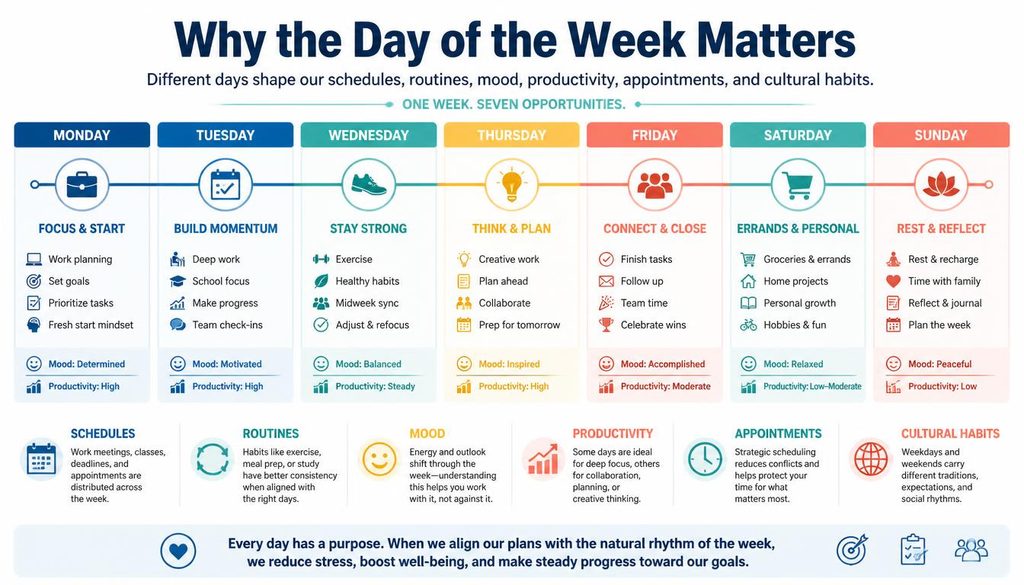
A date is more than a number on a calendar. The day of the week can affect appointments, work schedules, travel plans, school activities, deadlines, and events.
For the current calculation:
October 3, 2026 → Saturday
October 10, 2026 → Saturday
October 17, 2026 → Saturday
That means the weekday stays the same when you move forward by a whole number of weeks. This is one of the nicest shortcuts in a date calculation: two weeks after a Saturday is also a Saturday.
The same principle works for every weekday. Two weeks after a Monday is Monday, two weeks after a Thursday is Thursday, and so on. The calendar repeats its seven-day rhythm in a very dependable way.
Using a Calendar to Find a Future Date
A physical or digital calendar is often all you need to calculate a date in the future.
Start by locating the original date. Then move forward by two complete rows or seven-day intervals, depending on how the calendar is displayed. After those two weeks, the date you land on is your answer.
Digital calendars can make this even simpler because many scheduling applications allow you to jump directly to a date or create an event a certain number of days or weeks in advance.
Still, knowing the manual method is worthwhile. Technology is helpful, but it’s nice to know the answer even when your phone is at 2% battery and behaving like it has already given up on life.
Date Calculator vs. Manual Calculation
A date calculator is useful when you need to calculate many dates, handle longer intervals, or avoid mistakes with months of different lengths.
For a simple two-week question, manual calculation is usually enough:
Start date + 14 days = target date
For more complicated calculations, a calculator can be convenient. You might need to determine a date several months ahead, calculate a date range, or work backward from a deadline.
The key is still the same: provide an accurate starting date and an accurate interval. A calculator can perform the arithmetic quickly, but it cannot magically know which starting date you intended.
Common Mistakes When Calculating 2 Weeks From Today
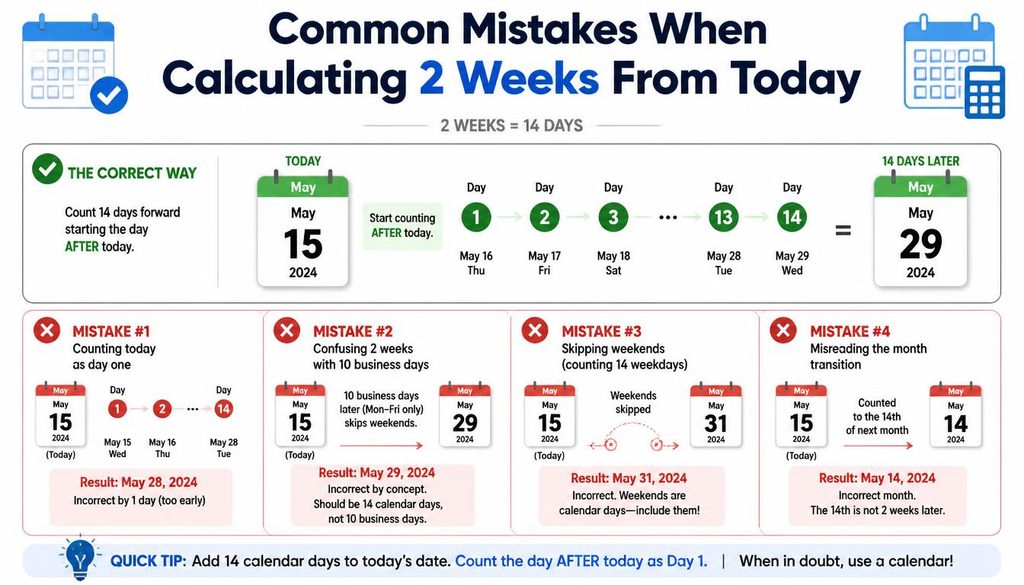
One common mistake is counting today as the first of the fourteen days. When someone says “14 days from October 3,” the usual interpretation is to move forward fourteen days, resulting in October 17.
Another mistake is confusing two weeks with a calendar month. Two weeks is exactly 14 days, while a month can contain 28, 29, 30, or 31 days. They are not interchangeable, even though people sometimes use them loosely in conversation.
A third mistake is forgetting to check the weekday. If you know today is Saturday, then two weeks from today should also be Saturday. This gives you a quick sanity check when doing the calculation yourself.
Frequently Asked Questions About 2 Weeks From Today
What date will it be in two weeks?
From October 3, 2026, it will be October 17, 2026. The date falls on a Saturday, so it can be useful to keep the weekday in mind too.
How do I calculate 2 weeks from today?
Add 14 days to today’s date. Since one week contains seven days, two weeks means seven plus seven, giving you fourteen days. It’s a very small bit of arithmetic, really.
How many days are in two weeks?
There are 14 days in two weeks. This is the standard conversion used for ordinary calendar and date calculation purposes.
How many hours are in two weeks?
There are 336 hours in two weeks, calculated as 14 days multiplied by 24 hours. Thats the straightforward duration conversion.
How many minutes are in two weeks?
There are 20,160 minutes in two weeks. The calculation is 14 × 24 × 60.
How many seconds are in two weeks?
There are 1,209,600 seconds in two weeks, using the standard 24-hour-day calculation.
What was the date 2 weeks ago?
If today is October 3, 2026, then two weeks ago was September 19, 2026. Simply subtract 14 days from the current date.
How do you find a date on a calendar?
Locate the start date, then move forward or backward by the required number of days or weeks. For two weeks forward, move fourteen days ahead, or simply move the same weekday forward by two weeks.
Read more: https://avenzum.com/what-date-is-8-weeks-from-today-2/
A Simple Formula to Remember
You don’t need a complicated formula to handle ordinary relative dates.
For dates in the future:
Future date = Starting date + number of days
Since:
2 weeks = 14 days
the calculation becomes:
Future date = Starting date + 14 days
For dates in the past:
Past date = Starting date − 14 days
This little formula works across months and even across the end of a year. The calendar handles the month lengths for you, provided you count correctly.
Final Answer: What Date Is 2 Weeks From Today?
As of October 3, 2026, the answer is clear:
2 weeks from today is October 17, 2026.
That is 14 days, 336 hours, 20,160 minutes, or 1,209,600 seconds after the reference date. The target date falls on a Saturday, giving us another quick way to confirm the calculation.
The bigger lesson is simple: whenever you need a date in 2 weeks, identify the today’s date, convert two weeks into fourteen days, and move forward on the calendar. If you are calculating a date 3, 4, 5, or 6 weeks from today, just continue adding seven days for every additional week.
Relative dates can seem slippery because the word “today” keeps changing, but the underlying calculation never really does. Find your starting date, identify the time interval, count the days, and you’ll have your target date.
And perhaps that is the nicest thing about a calendar: even when life is busy and dates start tumbling around in your head, fourteen days is still fourteen days. Sometimes a tiny bit of calendar math is all you need to turn “sometime in two weeks” into one definite Saturday: October 17, 2026.