There is something oddly satisfying about asking a simple calendar question and watching a distant day suddenly become real. What date is 20 weeks from today?
If Today is September 20, 2026, the answer is Sunday, February 7, 2027. It sounds far away when written as a number, but 20 weeks is really just 140 ordinary days quietly lined up one after another.
For anyone planning an event, checking a deadline, counting toward a personal milestone, or simply wondering where the Calendar will place a particular day, this little piece of Date calculation can be surprisingly useful.
The trick is not mysterious either; you simply begin with the Start Date, add the requested Duration, and arrive at the Future Date. Easy enough, though calendars do enjoy making us count twice sometimes.
| Calculation | Result |
|---|---|
| Today / Start Date | September 20, 2026 |
| Duration | 20 weeks |
| 20 weeks in days | 140 days |
| 20 weeks in hours | 3,360 hours |
| 20 weeks in minutes | 201,600 minutes |
| 20 weeks in seconds | 12,096,000 seconds |
| Date 20 weeks from today | February 7, 2027 |
| Day of the week | Sunday |
| 20 weeks ago | May 3, 2026 |
| 21 weeks from today | February 14, 2027 |
| 22 weeks from today | February 21, 2027 |
| 23 weeks from today | February 28, 2027 |
| 24 weeks from today | March 7, 2027 |
The Short Answer: What Date Is 20 Weeks From Today?
Using September 20, 2026 as the reference date, 20 weeks from today is Sunday, February 7, 2027. The calculation works because one week contains seven Days, so 20 weeks contains 140 days altogether.
In other words:
- Today: September 20, 2026
- Duration: 20 weeks
- 20 weeks in days: 140 days
- Target date: February 7, 2027
- Day of the week: Sunday
- Date in 20 weeks: February 7, 2027
So if someone asks, “What is the date 20 weeks from today?”, you can give them the answer without pulling out a calculator and squinting at twelve different calendar pages. The answer is February 7, 2027.
How the 20-Week Date Calculation Works
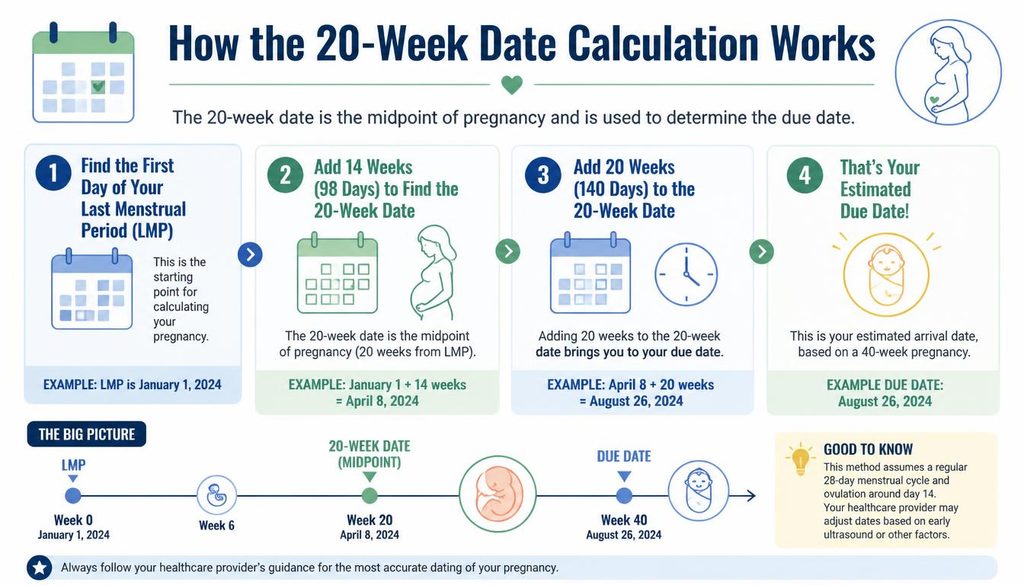
A 20-week date calculation is basically simple Date arithmetic. Start with the current date, convert the number of weeks into days, and then move forward that many days on the Calendar. There is no special trick hiding underneath it, thankfully.
Because one week equals seven days:
20 × 7 = 140 days
Therefore, the 20 weeks from today calculation becomes:
September 20, 2026 + 140 days = February 7, 2027
The useful part about thinking in days is that it gives you a second way to validate date results. If a website or Date Calculator says February 7, 2027, you can check whether exactly 140 days have been added. It is a tiny bit old-school, but it works.
20 Weeks From September 20, 2026
If your Starting Date is specifically September 20, 2026, the result remains February 7, 2027. This is the precise calendar relationship requested by the phrase 20 weeks from September 20, 2026.
Here is the calculation in a compact form:
- Start Date: September 20, 2026
- Weeks added: 20 weeks
- Week-to-day conversion: 20 × 7
- Days added: 140 days
- Target Date: February 7, 2027
- Sunday date: February 7, 2027
The weekday stays easy to verify too. Adding a complete number of weeks does not change the weekday, because every seven-day block lands on the same weekday where it began. So a Sunday followed by 20 weeks is another Sunday, which is a neat little feature of calendar arithmetic, really.
What Date Is 20 Weeks From Today in Simple Terms?
If calculations make your eyes glaze over, here is the friendly version: take September 20, 2026, move forward one week at a time, and stop after 20 total weeks. You land on February 7, 2027.
You don’t need to count every single day manually. A weeks calculator usually handles this instantly, while a regular date calculator can perform the same task by adding 140 days. Both approaches are simply different ways of expressing the same Calendar calculation.
Imagine placing a small mark on the calendar every Sunday. The starting mark is September 20. After one mark comes September 27, then October 4, and so on. Eventually, after 20 jumps, February 7 appears. Thats the whole puzzle.
20 Weeks in Days, Hours, Minutes, and Seconds
Sometimes knowing the calendar date isn’t quite enough. You may also want to understand the Time Duration represented by 20 weeks. Once converted, the number becomes much larger, almost comically so.
Here are the standard conversions:
- 20 weeks: 140 days
- 20 weeks in hours: 3,360 hours
- 20 weeks in minutes: 201,600 minutes
- 20 weeks in seconds: 12,096,000 seconds
The calculations are straightforward. There are 24 Hours in a day, 60 Minutes in an hour, and 60 Seconds in a minute. Therefore, 140 days becomes 3,360 hours, then 201,600 minutes, and finally 12,096,000 seconds.
These figures describe elapsed clock time under the usual calendar assumption of 24-hour days. In real-world clock calculations, local time changes such as daylight-saving adjustments can matter for certain locations, so a Time Duration Calculator may behave slightly differently when calculating exact timestamps rather than dates. For a simple date-only question, however, 140 days is the useful answer.
20 Weeks From Today: A Week-by-Week View
Counting Weeks From Today can feel easier when you see the progression rather than one giant jump. The calendar moves through several months, but the calculation itself remains wonderfully boring, which is exactly what you want from arithmetic.
Starting at September 20, 2026:
- Week 1: September 27, 2026
- Week 2: October 4, 2026
- Week 3: October 11, 2026
- Week 4: October 18, 2026
- Week 5: October 25, 2026
- Week 6: November 1, 2026
- Week 7: November 8, 2026
- Week 8: November 15, 2026
- Week 9: November 22, 2026
- Week 10: November 29, 2026
- Week 11: December 6, 2026
- Week 12: December 13, 2026
- Week 13: December 20, 2026
- Week 14: December 27, 2026
- Week 15: January 3, 2027
- Week 16: January 10, 2027
- Week 17: January 17, 2027
- Week 18: January 24, 2027
- Week 19: January 31, 2027
- Week 20: February 7, 2027
Notice how every result remains a Sunday. That’s because we’re adding complete seven-day blocks, not because the calendar has suddenly become unusually cooperative.
What About 21, 22, 23, and 24 Weeks From Today?
Once you know the 20 weeks result, nearby calculations are almost effortless. Each additional week simply adds another seven days to the previous result.
Using September 20, 2026 as the reference point:
- 21 weeks from today: February 14, 2027
- 22 weeks from today: February 21, 2027
- 23 weeks from today: February 28, 2027
- 24 weeks from today: March 7, 2027
This is also why a date calculator can be handy for planning several milestones. Instead of starting over for every calculation, you can move forward in seven-day steps. It is basically calendar dominoes, one date nudging the next.
The same principle works backward. If you need 20 weeks ago, subtract 140 days from September 20, 2026. That gives May 3, 2026. Likewise, 21 weeks ago, 22 weeks ago, 23 weeks ago, and 24 weeks ago can be found by subtracting seven additional days each time.
20-Week Date Calculation Works
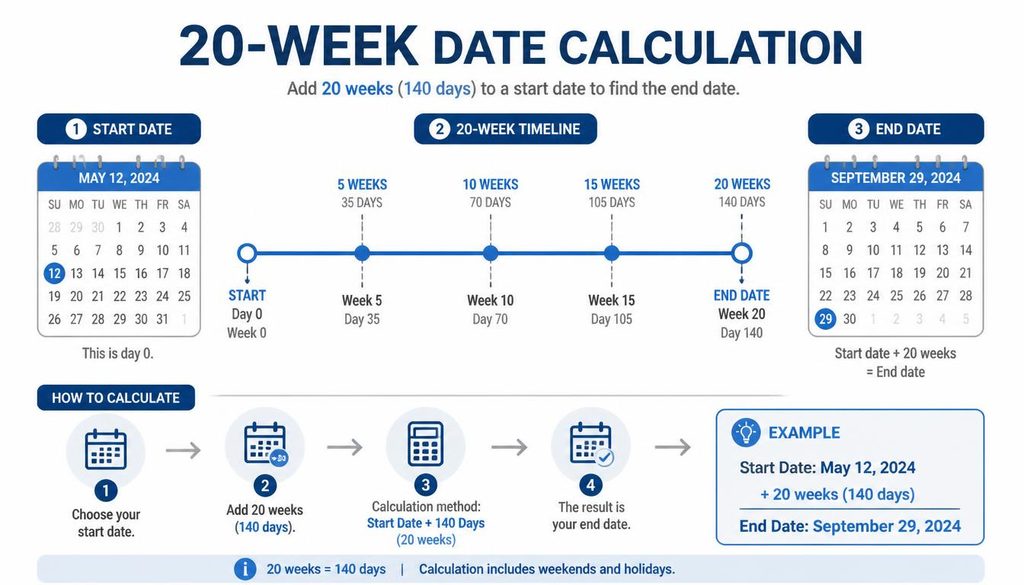
The phrase 20 weeks ago describes a Past Date, so the arithmetic works in reverse. Starting from September 20, 2026, subtract 140 days rather than adding them.
The result is May 3, 2026.
That means the relationship looks like this:
- 20 weeks ago: May 3, 2026
- Today: September 20, 2026
- 20 weeks from today: February 7, 2027
This three-point view is useful because it shows how a single Reference Date can be used to calculate both past and future dates. Add the Duration for a future result; subtract it for a past result. Simple, but very handy when memory says “sometime around spring” and the calendar says “let’s be more specific.”
How to Calculate the Date 20 Weeks From Now
If you want to perform the calculation yourself rather than use a Future Date Calculator, there are two common methods. The first is to convert weeks into days, while the second is to move through the calendar one week at a time.
For the first method, multiply 20 by seven:
20 × 7 = 140 days
Then add 140 days to your Starting Date. For September 20, 2026, the result is February 7, 2027.
The second method is particularly useful if you only have a paper Calendar nearby. Find today’s date, then move to the same weekday in the next row or week. Repeat this 20 times. It takes longer, sure, but sometimes the slow method makes the answer feel more trustworthy.
September 2026 Calendar and February 2027 Calendar
The September 2026 calendar provides the starting point for this calculation. September 20, 2026 falls on a Sunday, and the date begins the 20-week period.
The corresponding February 2027 calendar contains the destination. February 7, 2027 also falls on a Sunday, completing the full 20-week interval. Looking at both monthly calendars together makes the movement across the year much easier to visualize, especially for people who prefer seeing dates rather than doing arithmetic in their head.
There is also a small practical detail worth remembering: September and February belong to different calendar years in this calculation. The date crosses from 2026 into 2027, which is why casually counting month numbers can produce a wrong answer pretty quick.
Why 20 Weeks Equals 140 Days
The relationship between Weeks and Days is fixed: every week has seven days. Therefore, 20 weeks always represents 140 days when measuring ordinary date intervals.
That means you can confidently use 20 weeks in days = 140 days as the foundation for this calculation. From there, the other time units follow naturally.
For example, 140 days × 24 equals 3,360 Hours. Multiply again by 60 and you get 201,600 Minutes. Another multiplication by 60 gives 12,096,000 Seconds. The numbers get huge, but the underlying idea stays tiny and manageable.
Start Date, Target Date, and Reference Date
Three terms make date questions much easier to understand: Start Date, Reference Date, and Target Date. They sound rather technical, but they’re really just labels for ordinary calendar points.
The Start Date is where you begin. Here, it is September 20, 2026. The Duration is 20 weeks. The Target Date is February 7, 2027. The Reference Date is the date you are using as the basis for your calculation, which in this case is also September 20, 2026.
Once those three pieces are clear, almost any similar question becomes easier. You can add weeks, subtract weeks, or convert the interval into days and other units without getting tangled up in terminology.
Does the Exact Time of Day Matter?
For a basic question about a calendar date, no. The Time of day generally doesn’t change the answer when you’re simply asking what calendar date occurs 20 weeks later.
If you start at September 20, 2026 at 8:00 a.m. and add exactly 20 seven-day periods, you arrive at February 7, 2027 at 8:00 a.m., assuming no unusual clock adjustment affects the local-time calculation. The calendar date remains February 7.
This distinction becomes more important when you’re calculating exact time duration, deadlines, appointments, or timestamps. A Time Duration Calculator may need the precise hour, minute, time zone, and sometimes daylight-saving rules. For ordinary weeks from today questions, the date itself is usually all you need.
A Note About “Today” in Date Calculations
The word Today sounds permanent, but it isn’t. Today’s date changes every 24 hours, which means the answer to “20 weeks from today” also changes every day.
For this article, the stated current date is September 20, 2026. Therefore, all calculations use September 20, 2026 as the reference. If you’re reading this on another day, your own answer will be different.
This is why online calculators often ask you to enter a Starting Date rather than automatically assuming what “today” means. It removes ambiguity and makes the calculation easier to check later, which is especially useful when saving dates for future planning.
What About the September 16–24, 2026 Range?
A nearby range such as September 16–24, 2026 produces a corresponding range of dates February 3–11, 2027 when exactly 20 weeks are added.
That relationship follows the same seven-day rule. September 16 plus 140 days reaches February 3, while September 24 plus 140 days reaches February 11. The whole range simply shifts forward by the same 20-week duration.
This can be useful when a starting date is uncertain by several days. Rather than pretending there is one exact answer, you can calculate a corresponding date range. Thats often much more honest and practical.
Using a Date Calculator for 20 Weeks From Today
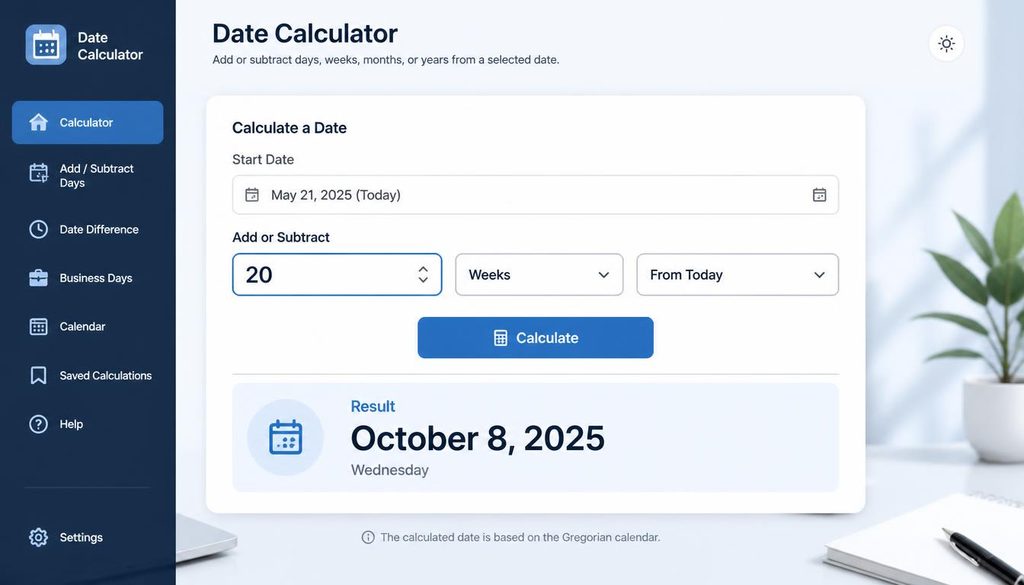
A Date Calculator or Weeks-from-today calculator is useful when you need an answer quickly or when several dates have to be checked. Most calculators ask for a starting date and then let you add or subtract a number of weeks or days.
For this particular calculation, enter:
- Starting date: September 20, 2026
- Operation: Add
- Duration: 20 weeks
- Result: February 7, 2027
A future date calculator is especially helpful when you need to repeat the calculation for 21, 22, 23, or 24 weeks. A past date calculator works in the opposite direction when you need to know the date 20 weeks ago.
The important thing is to check whether the tool interprets “weeks” as seven-day periods. Most standard date tools do, but checking the settings is a sensible little habit.
Common Mistakes When Counting 20 Weeks
One common mistake is treating 20 weeks as “about five months” and then simply adding five calendar months. That isn’t the same thing. Months have different numbers of days, while 20 weeks has exactly 140 days.
Another mistake is counting the starting day as the first completed day. In ordinary date arithmetic, adding 140 days to September 20 means moving forward 140 days; it does not mean labeling September 20 as day one of the 140-day interval.
People also sometimes confuse 20 weeks from today with 20 weeks ago. One points forward toward a Future Date, while the other points backward toward a Past Date. The direction matters, rather more than you’d think.
Frequetnly asked Questions
what is 20 weeks from today
Find out the exact date that falls 20 weeks from today. This simple calculation helps you plan future events, deadlines, or important dates.
20 weeks from now
20 weeks from now is a specific future date calculated by adding 20 weeks to today’s date. You can also convert 20 weeks into days, hours, and other time units.
when is 20 weeks from now
Wondering when 20 weeks from now will be? Calculate the future date quickly by counting forward 20 weeks from today.
20 weeks from today
The date 20 weeks from today can be found by adding 140 days to the current date. This gives you the exact calendar date and day of the week.
what day will it be in 20 weeks
In 20 weeks, it will fall on a specific day of the week and calendar date. Use today’s date as the starting point to calculate the exact result.
Read this Blog; https://avenzum.com/cost-to-install-a-water-softener/
The Final Answer
So, what date is 20 weeks from today? With September 20, 2026 as Today, the answer is:
Sunday, February 7, 2027.
The complete conversion is 20 weeks = 140 days = 3,360 hours = 201,600 minutes = 12,096,000 seconds. Those numbers describe the same duration in different units, although exact clock-time calculations can require additional information about time zones and clock changes.
If you need to remember just one thing, remember the pairing: September 20, 2026 → February 7, 2027. Twenty full weeks separate those two dates, neatly and without any calendar gymnastics.
Final Thoughts on Counting Weeks From Today
Date questions look tiny until you’re the person who needs the exact answer for a deadline, appointment, trip, project, celebration, or personal milestone. Then suddenly knowing how to calculate date 20 weeks from today becomes oddly valuable.
The method is wonderfully repeatable: identify Today, establish the Start Date, convert Weeks into Days, add or subtract the Duration, and check the resulting Target Date against a calendar. For this example, the calculation lands on February 7, 2027, a Sunday that sits exactly 20 weeks after September 20, 2026.
And if you ever forget the arithmetic, don’t worry about making the calendar carry the whole burden. A reliable date calculator, weeks calculator, or time duration calculator can do the heavy lifting in seconds. Sometimes the smartest calendar skill is simply knowing when to let the calendar do its own job.