There is something almost quietly magical about choosing a name for a child. Before the tiny fingers can hold a toy, before the first day of kindergarten arrives, and long before anyone knows what kind of person that little one will become, a name is already waiting for them.
Baby names can carry family history, hopes, memories, culture, or sometimes simply a sound that makes the heart say, “yes, thats the one.”
For parents considering Worth, the question is a little different from simply asking whether they like the name. They may wonder, how common is the name Worth, how many babies have received it, and whether their child is likely to meet another Worth during childhood.
That is where a Baby Name Uniqueness Analyzer becomes genuinely interesting.A name can feel uncommon without being completely unheard of, and Worth sits in that fascinating middle ground.
Looking at name uniqueness, name popularity, and name frequency gives parents a better sense of what the name may feel like in everyday life. Numbers don’t tell the whole story, of course, but they can add a surprisingly useful little piece to the naming puzzle.
| Metric | Worth |
|---|---|
| Gender | Boy |
| Birth Year | 2021 |
| Popularity Rank | 5,297th |
| Baby Boys Named Worth | 17 |
| Frequency | 1 in 109,450 boys |
| Expected in 10,000 People | 0 |
| Lifetime Chance of Meeting Another Worth | 4.562% |
| Elementary School Class Size | 482 |
| Chance of Having a Classmate Named Worth | 0.224% |
| Overall Uniqueness | Very Rare |
What Does the Baby Name Uniqueness Analyzer Say About Worth?
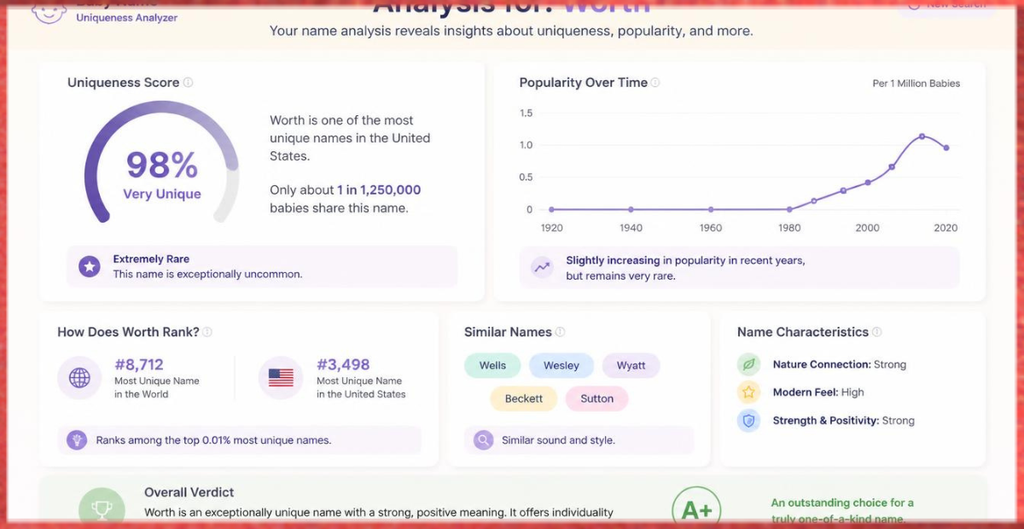
The Baby Name Uniqueness Analyzer is designed to turn baby-name statistics into something easier for parents to understand. Instead of looking only at a ranking, a name analyzer can help put a given name into perspective by considering how often it appears among births.
For Worth, the available 2021 statistics show that the name ranked around 5,297th among baby boys, with only 17 boys receiving the name that year. That makes Worth baby name statistics quite different from those of highly popular names.
A ranking by itself can sometimes look rather abstract. Seventeen births, however, paints a clearer picture: Worth was a very uncommon choice among boys born in that year.
So when parents search for Worth name popularity, they’re really looking at a name that lived far away from the crowded end of the popularity chart.
Worth Name Popularity and Name Ranking
Worth name popularity is best understood by comparing it with familiar names that appear near the top of annual baby-name lists. Names such as Liam, Michael, and other long-running favorites have historically been chosen by far more families in the United States.
The same idea applies to girls’ names. Olivia, Emily, Sara, and Sarah illustrate how spelling and popularity can vary even when names sound similar or belong to the same naming family.
Worth has a very different statistical footprint, and that difference is one reason it may appeal to parents seeking something less ordinary.
The Worth name ranking is therefore more than just a number. It suggests that a child named Worth is unlikely to have a name that blends into a list of several classmates with identical first names. Thats a small detail, perhaps, but many parents care about exactly this sort of everyday experience.
How Common Is the Name Worth?
The simplest answer to how common is the name Worth is: quite uncommon.
In 2021, only 17 baby boys were recorded with the name Worth in the statistics referenced for this analysis. In a country with millions of births, that is a very small number, which places Worth firmly among rare baby names for that year.
It is important, though, not to confuse “rare” with “strange.” A rare name can be perfectly familiar to the ear while still being statistically unusual. Worth is a good example of this. It is an established English word and surname-style given name, yet relatively few parents choose it for their sons.
That combination gives Worth an unusual advantage: it can feel distinctive without requiring a completely invented spelling or an extremely complicated pronunciation.
Why Parents Search for Rare and Unique Names

The search for unique baby names has become a major part of modern naming culture. Some parents want their child to have a name that stands apart, while others simply want to avoid hearing the same name repeated several times during school years.
There is also a middle path. Parents may not want an ultra-unusual name that requires constant explanation, but they also don’t want one of the top baby names of the year. Names like Worth can occupy that middle territory rather nicely.
A parent might choose Worth because it is short, recognizable, and uncommon. Another might like its word-name quality. Someone else could connect with its surname tradition or simply enjoy the firm sound of it. The reason doesn’t need to be complicated.
Worth as a Choice Among Boys’ Names
When placed beside common boys’ names, Worth has a noticeably different character. Many popular boys’ names are familiar because children encounter them repeatedly at daycare, school, sports practices, and family gatherings.
Worth is less likely to create that experience.
A child named Worth may be the only Worth in a kindergarten class or an elementary school year group. That cannot be guaranteed, because populations and local naming preferences vary, but the low national frequency makes repeated encounters less likely than they would be with a highly popular name.
For parents searching for rare names for boys, this is one of Worth’s strongest qualities.
Same-Name Probability and Name Encounter Probability
One of the most interesting ideas behind a baby name uniqueness calculator is the concept of same-name probability. In simple terms, this asks how likely it is that one person will encounter another individual with the same first name.
The answer depends on several things, including population size, birth rate, age group, geography, and the popularity of the name during different years.
A name given to only a handful of babies in one year has a very different statistical profile from a name given to thousands. Therefore, the probability of meeting someone with the same name is generally much lower for very uncommon names.
Worth’s small number of births in 2021 suggests a low name encounter probability for children born in that particular period. Still, parents should treat such calculations as estimates rather than promises carved into stone, because older generations may have different naming patterns.
Could Worth Be the Only One in the Class?

This is one of those questions parents often imagine while choosing a name: “Will my child have three classmates with the same name?”
With a name as uncommon as Worth, that scenario is much less likely than it would be with a name appearing near the top ten names.
Imagine a class size of 20 to 30 children. If a first name is extremely popular, two children may occasionally share it. If a name is exceptionally rare, the chance drops dramatically. The exact odds require assumptions about local birth patterns and age groups, but the basic principle is simple enough.
Worth’s low annual frequency makes it a strong candidate for parents who want their child’s name to feel individual rather than duplicated across the classroom.
Name Frequency Matters More Than a Ranking Alone
A name popularity ranking tells you where a name stands relative to other names. Name frequency tells you something more tangible: how many babies actually received it.
For Worth, the frequency figure of 17 births in 2021 is especially useful because it gives the ranking some emotional scale. Saying “5,297th” can feel distant. Saying “17 baby boys” makes the rarity much easier to picture.
This is why a good baby name analyzer should ideally show several pieces of information together, including ranking, frequency, year, and gender. One number rarely tells the complete story, and naming decisions deserve a little more context than that.
Worth Compared With Popular Names
Popular names such as Liam demonstrate the opposite end of the spectrum. A name that appears near the top of national statistics may be heard frequently among children born in the same period.
The contrast becomes even clearer when looking at popular names versus unusual names. A popular name offers familiarity and easy recognition. A rare name offers distinction and a stronger possibility of standing apart.
Neither approach is automatically better. Parents have different naming preferences, and even within one family, one person may love traditional names while another is drawn to uncommon choices.Worth simply gives parents another option, one that leans strongly toward individuality.
Unique Names Without Complicated Spelling
One benefit of Worth is its straightforward name spelling. Some parents searching for unusual names deliberately alter traditional spellings to create something more distinctive.
That can work beautifully, but it may also create practical issues. A child might repeatedly need to explain the spelling, correct forms, or clarify whether an alternate version is intended.
Worth doesn’t need much of that. Its spelling is short and visually simple. That means the name can be uncommon without depending on an alternate spelling to achieve uniqueness.In this way, Worth is unusual but not overly elaborate, which can be a useful balance.
Similar Names, Sound, and Phonetic Distance
Parents rarely consider a name in isolation. They may compare Worth with other short names, surname-inspired choices, or traditional word names.
A name explorer can help by identifying similar names, while a more technical tool might use phonetic distance, string distance, or edit distance to compare spellings and sounds. These concepts sound rather mathematical, but the practical idea is easy: how close is one name to another?
For example, two names might look different but sound almost identical. Others may share several letters but sound completely different. This matters when parents are searching for alternatives to Worth without losing its concise, distinctive character.
Nicknames and Name Syllables
Worth is already short, so it doesn’t naturally demand a nickname. Thats not necessarily a disadvantage.
Some parents love names that offer several nickname possibilities, while others prefer a name that arrives almost complete. The nickname question is therefore really about personal taste.
The number of name syllables also matters for families thinking about rhythm. Worth is a one-syllable given name, making it especially easy to pair with longer middle names. A long family surname may also create a pleasing contrast with the compact first name.
For example, parents might test the complete name aloud several times. It sounds silly, maybe, but this little rehearsal often reveals whether the rhythm feels natural.
The Meaning and Character of Worth

Beyond statistics, the word itself gives Worth an intriguing character.The English word “worth” is associated with value, merit, significance, and deservingness.
Parents who appreciate word names may find that association emotionally meaningful. It can suggest a child who is valuable simply because they are themselves, not because they have to prove something.
Of course, parents should be careful not to assume a name determines personality. A given name is not a personality prediction machine. Still, the meaning attached to a name can influence why a family feels connected to it.That emotional layer is often more important than any ranking.
Worth and the Broader World of Baby Name Data
Modern parents have access to more naming information than previous generations ever did. The Social Security Administration (SSA) provides widely used U.S. baby-name statistics, allowing people to explore popularity by year and gender.
Researchers and families may also encounter information from sources such as US Census Data and the National Center for Education Statistics (NCES) when thinking about population and school patterns. These sources answer different questions, so they should not be treated as interchangeable.
For example, birth-name statistics can tell us how frequently a name was given at birth, while education statistics can provide broader context about school populations and elementary school class size. Combining those ideas carefully can help parents understand the practical side of name uniqueness.
What About Names With Fewer Than Five Births?
The world of rare names with fewer than five births is even more unusual than Worth’s 17 births in 2021.Very small numbers can be fascinating, but they also require caution. Extremely low counts can make year-to-year changes look dramatic.
One year might show a name with fewer than five babies, while a handful of additional births the next year can produce a surprisingly large percentage change.
That is why parents interested in names with fewer than five babies should look at multiple years rather than treating one annual figure as the entire story.
Worth, with 17 births in the referenced year, is rare enough to feel distinctive while still having a measurable statistical footprint.
Name Popularity by Year Can Change
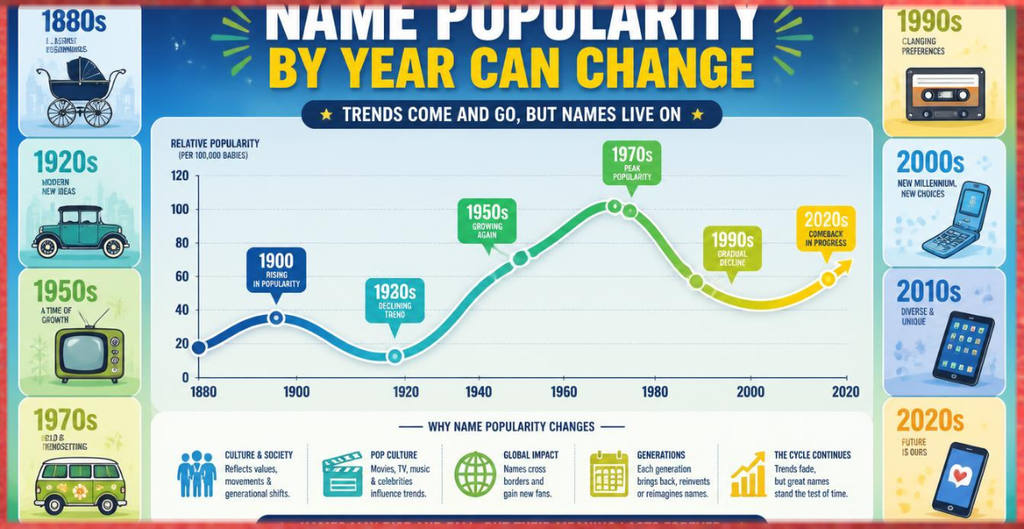
No baby-name ranking stays frozen forever. Name popularity by year changes as culture, entertainment, family traditions, historical events, and personal tastes change.
A name that feels rare today may become more fashionable later. Likewise, a name that once dominated the charts may gradually decline.
This is why baby name trends, trending baby names, and declining name popularity are worth considering when researching a choice. Parents don’t need to predict the future perfectly, thankfully.
They only need to understand that today’s ranking is a snapshot rather than a permanent label.For Worth, the low 2021 count suggests rarity in that specific year, but future statistics could always look different.
Worth, Individuality, and Identity
There is a gentle tension in choosing a rare name. Parents often want individuality, but they also want their child to feel comfortable carrying the name.
Worth offers an interesting compromise. It is unusual enough to stand out, yet it is short, pronounceable, and recognizable as a real English word and name.
That can matter throughout a person’s lifetime. A name appears on school records, invitations, certificates, email addresses, introductions, and eventually professional documents. The best name is not simply the rarest one; it is one the family can imagine belonging naturally to the child at every age.
How to Use a Baby Name Uniqueness Calculator
A name uniqueness calculator can be useful when parents want to move beyond instinct and explore the numbers.Start with the exact name and the birth year you’re interested in.
Then examine its ranking and frequency rather than focusing on only one statistic. If the tool offers a name uniqueness score, use that as a helpful indicator rather than an absolute measurement.
Next, compare the name with similar choices. A baby name generator, baby name explorer, or name blender can help families discover alternatives that preserve a particular sound, length, meaning, or style.
Finally, think about the real world. Ask whether the name is easy to pronounce, easy to spell, pleasant with the surname, and meaningful to the family. Statistics should support the decision, not make the decision for you.
How Parents Can Make a Name Research Session More Personal
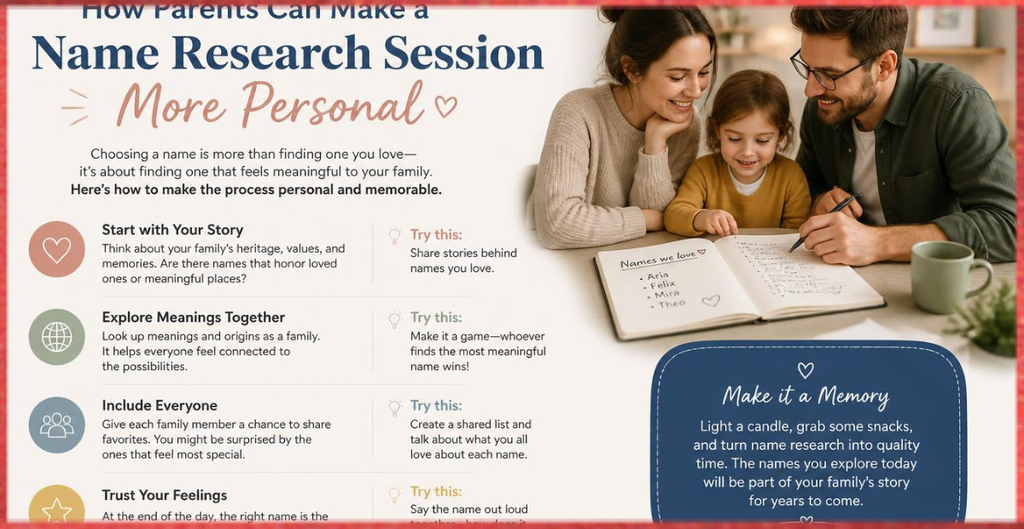
Numbers are useful, but naming a baby is not a spreadsheet exercise, even if parents sometimes turn it into one at 2 a.m.Write Worth beside the surname. Say the complete name out loud.
Try it with possible middle names. Imagine calling it across a playground, writing it on a birthday card, and seeing it printed on a graduation program years from now.
Then ask a simpler question: does it still feel right?That question has no statistical formula, and maybe thats exactly why it matters.
Worth as a Rare Baby Name
For families searching for rare baby names, Worth stands out because its uniqueness does not depend on novelty alone. It has a recognizable word form, a compact sound, and a very low recorded frequency in the 2021 data described above.
It also fits several modern naming preferences at once: short names, word names, uncommon boys’ names, and names that can stand independently without multiple nicknames.
Parents looking for unique boy names may therefore find Worth worth considering yes, the little wordplay is almost impossible to resist.
Frequently Asked Question
name value
Name value refers to the meaning, significance, and personal impression associated with a name. It can help parents understand what makes a name feel special or memorable.
Read this blog
Final Thoughts on the Name Worth
Choosing a baby name is one of those wonderfully strange parental decisions where statistics and emotion sit at the same table. One side talks about rankings, birth statistics, and name frequency; the other side simply says, “I love how it sounds.”Worth brings both sides together in an interesting way.
The available 2021 figures show only 17 baby boys receiving the name, placing it firmly in the uncommon category. That means parents interested in unique and unusual names can reasonably expect Worth to be far less frequently encountered than mainstream choices.
Still, the most important part of a name is not its ranking. A child is not a number in the US baby name data. They are an individual, with a life that will become much larger than the statistics used to describe their first few days.
If Worth feels meaningful to your family, its rarity can simply be an added bonus. And if you’re still exploring, compare it with other rare names, listen to how each one sounds, consider its meaning, and let the choice breathe a little.
Sometimes the right name doesn’t shout from the top of a popularity chart it waits quietly until someone recognizes it.A beautiful name doesn’t have to be everywhere to matter. Sometimes, being wonderfully uncommon is the whole point.