There is something almost magical about waiting for Summer 2026. The days begin to feel lighter, plans start appearing on calendars, and even an ordinary afternoon can suddenly seem like it belongs outdoors.
Maybe you are counting down to a holiday, a family trip, school break, wedding, beach day, or simply those warm evenings when nobody wants to go home yet. Summer has a funny way of making the future feel a little brighter.
If you have searched How Many Days Until Summer 2026, you are probably looking for one simple thing: the exact number of days between today and the beginning of summer.
But there is a small catch. There is more than one definition of when summer begins, and the answer can change depending on whether you follow the astronomical calendar or the meteorological calendar.
So, lets make the whole thing simple.
| Year | Summer Starts | Summer Ends | Summer Duration |
|---|---|---|---|
| 2026 | June 21, 2026 | September 23, 2026 | 94 days |
| 2027 | June 21, 2027 | September 23, 2027 | 94 days |
| 2028 | June 20, 2028 | September 22, 2028 | 95 days |
| 2029 | June 21, 2029 | September 22, 2029 | 94 days |
| 2030 | June 21, 2030 | September 22, 2030 | 94 days |
How Many Days Until Summer 2026?
The first day of summer 2026 in the Northern Hemisphere is associated with the Summer Solstice, which occurs around June 21. This marks the beginning of astronomical summer.
For 2026, the commonly used seasonal dates are:
| Summer Milestone | 2026 Date |
|---|---|
| Spring begins | March 20, 2026 |
| First day of astronomical summer | June 21, 2026 |
| Summer months | June, July, August |
| Meteorological summer ends | August 31, 2026 |
| Astronomical summer ends | September 22 or September 23, 2026, depending on location/time convention |
If you are checking how many days until summer from today, remember that the answer depends on the current date. On September 6, 2026, the astronomical summer season has already started and is still underway, so there are no days left to wait for its beginning.
In other words, summer isn’t waiting around the corner anymore. It is already here, slowly packing its bags for Autumn.
When Is Summer 2026?
When is summer 2026? In the Northern Hemisphere, astronomical summer begins with the summer solstice, around June 21, 2026. It continues until the September equinox, around September 22 or September 23 depending on the calendar and local time.
For everyday planning, however, many people use the meteorological definition. Under that system, summer consists of June, July, and August.
That gives us two useful ways of looking at summer 2026 dates:
- Astronomical summer: approximately June 21 through September 22/23.
- Meteorological summer: June 1 through August 31.
- Summer months: June, July, and August.
- Northern Hemisphere: June marks the beginning of the meteorological summer period.
- Southern Hemisphere: December is the beginning of meteorological summer.
This difference sounds technical at first, but it is actually pretty useful. A meteorologist might talk about summer temperatures using June, July, and August because these months are consistent for climate comparisons.
When Is the First Day of Summer 2026?
The first day of summer 2026 in the Northern Hemisphere is June 21, based on the astronomical definition.
This date is connected to the Summer Solstice, a celestial event caused by Earth’s tilt as our planet moves through its orbit around the Sun. The Northern Hemisphere reaches its greatest tilt toward the Sun around the June solstice.
That produces the longest daylight period of the year in many locations.
It is one of those strange moments where nothing seems to happen dramatically in the sky, yet the calendar quietly changes seasons.
For someone using a summer countdown, June 21 is therefore an important target date.
When Does Summer Start in 2026?
When does summer start in 2026? The answer depends on which seasonal system you mean.
Astronomical summer starts around June 21 in the Northern Hemisphere, at the Summer Solstice. Meteorological summer starts on June 1.
So if someone asks, “What date does summer start?” both June 1 and June 21 can be correct, just under different definitions.
The easiest rule is:
June 1 = meteorological summer.
June 21 = astronomical summer.
That little distinction can save you from wondering why two websites give different answers. They’re often using different calendars, not making an error.
What Is the Summer Solstice?
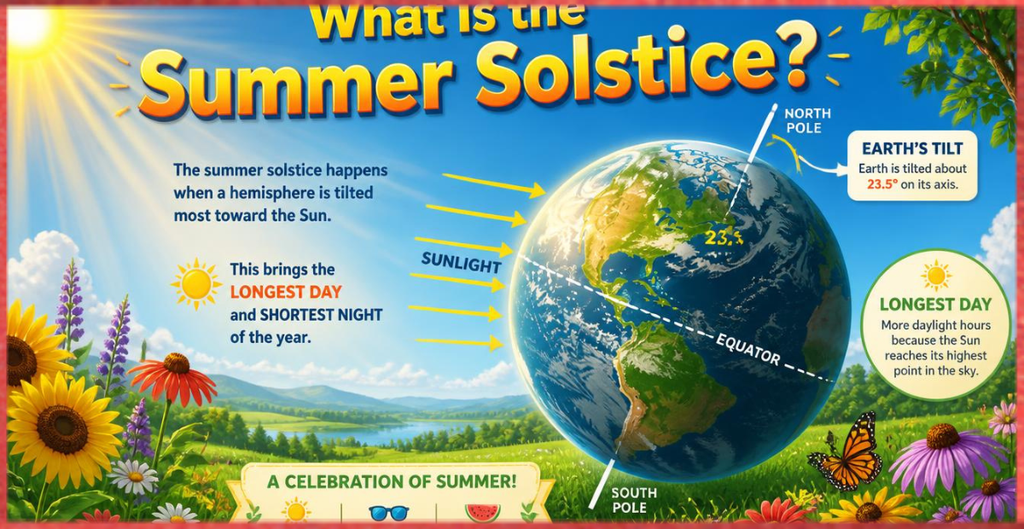
The Summer Solstice is the astronomical event that marks the beginning of astronomical summer in the Northern Hemisphere.
It happens because of the orientation of Earth relative to the Sun. Earth does not orbit the Sun perfectly upright; its axis is tilted. During the June solstice, the Northern Hemisphere is tilted toward the Sun more than at any other point in the annual cycle.
The result is the year’s longest daylight period for many places in the Northern Hemisphere.
The Southern Hemisphere experiences the opposite seasonal pattern. When the Northern Hemisphere is enjoying its longest days, the Southern Hemisphere is approaching its winter season.
So the Summer Solstice isn’t simply “the hottest day of the year.” That is a common misunderstanding. Temperatures often continue increasing after the solstice because land and oceans take time to warm.
How Many Days Are in Summer?
The answer to how many days are in summer depends on which definition you use.
Meteorological summer has three complete calendar months:
- June
- July
- August
Together, these contain 92 days in a typical year.
June has 30 days, July has 31, and August has 31:
30 + 31 + 31 = 92 days.
Astronomical summer is slightly different because it runs from the June solstice to the September equinox. Its exact duration can vary a little from year to year because Earth’s orbit isn’t a perfect circle and the seasons don’t all have exactly the same length.
So when someone asks about the days in summer, first ask yourself: “Do they mean meteorological summer or astronomical summer?”
It sounds like a tiny question, but it changes the answer.
When Does Summer End in 2026?
When does summer end in 2026? Again, there are two answers.
Meteorological summer ends on August 31, 2026.
Astronomical summer ends around September 22 or September 23, when the September equinox occurs.
This is why you may see different answers for the last day of summer 2026.
For weather and climate statistics, August 31 is the useful endpoint. For astronomy and the seasonal calendar, summer continues until the September equinox.
After that, Autumn begins in the Northern Hemisphere.
And suddenly the year starts feeling like it has moved much faster than it had any right to.
Astronomical Summer vs. Meteorological Summer
The difference between meteorological and astronomical summer is mainly about how the seasons are defined.
Astronomical summer is based on Earth’s position relative to the Sun. It begins and ends with astronomical events, specifically the solstices and equinoxes.
Meteorological summer is based on complete calendar months. Meteorologists and climatologists generally use June, July, and August as summer in the Northern Hemisphere.
The meteorological system makes it easier to compare temperature patterns, rainfall, and other climate information from year to year.
For example, a climatologist can compare the average temperature of June, July, and August across many decades without worrying about the precise time of a solstice.
Astronomical seasons, meanwhile, connect the calendar to Earth’s orbit and the Sun.
Neither system is “more correct.” They simply serve different purposes.
Summer 2026 in the Northern Hemisphere

For the Northern Hemisphere, summer 2026 brings the familiar sequence of June, July, and August, with astronomical summer extending into September.
During this season, many regions experience their warmest temperatures, longer daylight hours, and increased outdoor activity.
The exact experience of summer varies enormously, though. A person living in a hot desert region may experience summer very differently from someone near a cool coastline.
Temperature, precipitation, latitude, altitude, and local geography all affect what summer actually feels like.
So while the summer season has calendar dates, there isn’t one universal “summer weather.”
Summer 2026 in the Southern Hemisphere
The Southern Hemisphere experiences the seasons in the opposite order.
When it is summer in the Northern Hemisphere, the Southern Hemisphere is experiencing winter.
Southern Hemisphere summer begins around December under the astronomical definition, with the December Solstice. Meteorological summer is December, January, and February.
That means someone searching summer solstice Southern Hemisphere is looking for the December solstice rather than the June event.
The relevant months there are:
- December
- January
- February
So the phrase “summer 2026” needs a little geographic context. A June summer date makes sense for the Northern Hemisphere, while December represents the beginning of Southern Hemisphere summer.
How to Calculate Days Until Summer
If you want to calculate days until summer, the basic idea is very simple.
Take your target summer date and subtract today’s date.
For example:
Target date Current date = Days remaining
If today’s date is May 1 and your chosen first day of summer is June 21, you calculate the number of calendar days between May 1 and June 21.
A summer date calculator simply performs this date difference automatically.
This is particularly useful when you want to know:
- how many days until summer
- how long until summer
- days remaining until summer
- how many days until summer starts 2026
- how many days until the summer solstice 2026
- how many days until the first day of summer 2026
Instead of manually counting squares on a calendar, you let the calculation do the boring bit.
How to Calculate Days Until Summer in Excel
You can also create your own summer countdown calculator using Microsoft Excel.
Suppose cell A1 contains today’s date and you want to calculate the number of days until June 21, 2026.
A simple formula can subtract the current date from the target date.
For example:
=DATE(2026,6,21)-A1
If you want Excel to automatically use the current date, the Excel TODAY formula is handy:
=DATE(2026,6,21)-TODAY()
This gives the number of days between today’s date and June 21, 2026.
Keep in mind that once the target date has passed, the result becomes negative. That’s not Excel being dramatic; it is simply telling you that the target is already behind you.
How to Calculate Days Until Summer in Google Sheets
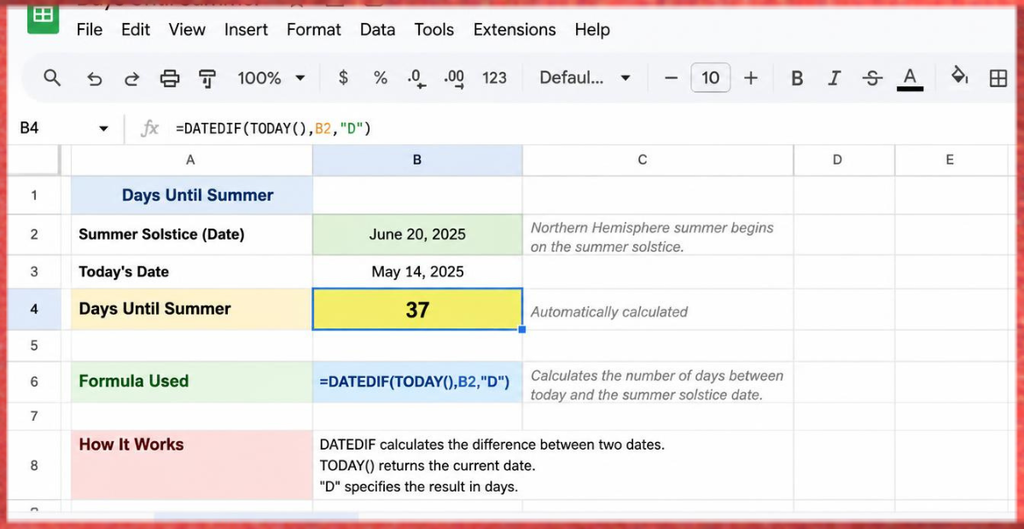
The same basic approach works in Google Sheets.
You can use:
=DATE(2026,6,21)-TODAY()
This creates a simple Google Sheets summer countdown.
You could also put the target date into another cell. For example, if B1 contains June 21, 2026, you could use:
=B1-TODAY()
This makes your spreadsheet easier to reuse for different years.
You could even build a small summer calendar with columns for the current date, target date, days remaining, and season.
It is a surprisingly satisfying little spreadsheet project, especially if you enjoy turning ordinary dates into neat numbers.
Summer Countdown and Seasonal Planning
A summer countdown timer isn’t only useful for curiosity. It can help with practical planning too.
Families might use a countdown to plan vacations. Students may count down to their summer break. Teachers can use a summer calendar when organizing academic schedules.
Businesses can also use seasonal countdowns for promotions, travel campaigns, outdoor events, and summer-related products.
Even personally, a countdown gives a vague idea a shape.
“Summer is coming” sounds distant.
“Thirty-two days left” suddenly feels real.
That is the funny power of dates.
Summer 2026 Dates at a Glance
Here is a simple overview of the important seasonal dates:
| Event | Northern Hemisphere 2026 |
|---|---|
| Spring | Begins around March 20 |
| Meteorological summer begins | June 1 |
| Summer Solstice | Around June 21 |
| June | Summer month |
| July | Summer month |
| August | Summer month |
| Meteorological summer ends | August 31 |
| September Equinox | Around September 22/23 |
| Astronomical summer ends | Around September 22/23 |
| Autumn begins | Around September 22/23 |
These dates are useful when you’re comparing summer start and end dates 2026.
How Many Days Until Summer From Today?
The question “How many days until summer from today?” cannot have one permanent answer because “today” changes every day.
If you check a countdown on May 1, the number will be different from the number shown on May 15. That’s exactly why countdown calculators use the current date dynamically.
For September 6, 2026, the beginning of astronomical summer 2026 has already passed. The same is true for meteorological summer’s June 1 start.
If you are looking ahead from September 6 to the next Northern Hemisphere summer, the next meteorological summer begins June 1, 2027, while astronomical summer begins around June 21, 2027.
So if a calculator tells you there are zero days until Summer 2026, it isn’t broken. You already made it there.
Why Summer Feels Longer Than It Really Is

Summer has an odd relationship with time.
A long school break can feel endless during the first week, then suddenly someone says August is almost over and everyone looks personally offended by the calendar.
The meteorological summer months last 92 days, but our experience of them can feel much shorter or longer depending on what we’re doing.
Busy travel weeks disappear quickly. Quiet afternoons can feel enormous. Childhood summers often seem especially long because unfamiliar experiences create more memorable moments.
That’s one reason a summer countdown can be more than a mathematical tool. It can become a little reminder to make plans while there is still time.
Making Your Summer Countdown Meaningful
Instead of simply watching the number decrease, attach something to it.
You could create one small goal for every week before summer. Plan a picnic. Call an old friend. Organize a family outing. Choose a book to read. Find a new walking route. Make a list of places you want to visit.
The countdown then becomes less about waiting and more about preparing.
A calendar is only paper, after all. The interesting part is what you decide to put inside those little boxes.
Common Questions About Summer 2026
When is summer 2026?
In the Northern Hemisphere, astronomical summer begins around June 21, 2026, while meteorological summer begins June 1.
When is the first day of summer 2026?
The astronomical first day of summer 2026 is around June 21, marked by the Summer Solstice.
When does summer start in 2026?
Summer starts June 1 under the meteorological definition and around June 21 under the astronomical definition.
When does summer end in 2026?
Meteorological summer ends August 31. Astronomical summer ends around September 22 or September 23 with the September equinox.
How many days are in summer?
Meteorological summer contains 92 days in the Northern Hemisphere: June, July, and August.
When is the summer solstice?
The Northern Hemisphere Summer Solstice occurs around June 21 each year.
What is the summer solstice?
It is an astronomical event associated with the longest daylight period of the year in the Northern Hemisphere and the beginning of astronomical summer there.
What is meteorological summer?
Meteorological summer is the three-month period of June, July, and August in the Northern Hemisphere.
How do you calculate days until summer?
Subtract today’s date from your chosen summer start date using a calendar, date calculator, Excel, Google Sheets, or a countdown tool.
Frequently Asked Question
how many days until the first day of summer
The number of days until the first day of summer depends on today’s date. Summer 2026 begins on June 21, 2026, in the Northern Hemisphere.
how many days to summer
The days to summer can be calculated by counting the days from today until the official start of summer. In the Northern Hemisphere, summer begins around June 20 or 21.
how many months until summer
Summer usually arrives within a few months after winter or spring, depending on the current date. In the Northern Hemisphere, the summer season begins in June.
days until summer 2026
Summer 2026 begins on June 21, 2026, in the Northern Hemisphere. Use a countdown calculator to find the exact number of days remaining from today.
how many months until summer 2026
Summer 2026 starts on June 21, 2026, so the number of months remaining depends on today’s date. A date calculator can give you the exact months and days.
Read this blog https://avenzum.com/how-many-days-left-in-2025/
Final Thoughts on How Many Days Until Summer 2026
Knowing How Many Days Until Summer 2026 is really more than knowing a number. It is about giving a future moment a place on today’s calendar.
For the Northern Hemisphere, Summer 2026 begins around June 21 astronomically, while meteorological summer begins June 1. The season then moves through June, July, and August before gradually giving way to Autumn.
If you’re checking the countdown today, September 6, 2026, you don’t need to wait for Summer 2026 anymore. You’ve already reached it, and the season is nearing its astronomical finish.
If what you really want is the next summer countdown, the next major target is Summer 2027.And maybe that’s the nicest thing about seasonal calendars: there is nearly always another date ahead.
A new summer will come with different plans, different weather, different people around the table, and probably a few plans that go completely sideways in the best possible way. Use the summer countdown, make the calendar useful, and don’t let the days simply disappear unnoticed.
If you have a favorite way to count down to summer, or a summer tradition your family never skips, share it. Sometimes the smallest seasonal rituals are the ones we remember longest.