A pile of gravel can look enormous until you discover it is only a few cubic yards. A flower bed can look modest until the supplier asks, “How much soil do you need?” Suddenly, a simple patch of ground becomes a small mathematics problem.
This is exactly where a Cubic Yard Calculator becomes useful, because it turns ordinary measurements into a practical estimate of how much material you actually need.
Whether you are preparing for a driveway, filling a garden bed, ordering mulch, or planning a concrete project, the basic question is nearly always the same: how much space needs to be filled? Once you know the length, width, and depth or height, the mystery starts becoming much less mysterious.
The nice thing is that cubic yardage is not some complicated contractor-only measurement. It is simply a way of describing volume. With a few measurements and the right cubic yard formula, you can work out the quantity yourself, check a supplier’s estimate, and avoid ordering way too much or awkwardly too little.
What Is a Cubic Yard?
A cubic yard is a unit used to measure three-dimensional volume. Imagine a box that is one yard long, one yard wide, and one yard high. The amount of space inside that box is one cubic yard, commonly written as yd³ or cu yd.
For practical projects, cubic yards are especially common because materials such as soil, gravel, mulch, dirt, fill, and concrete are frequently sold by the yard. Saying “I need 4.5 cubic yards of mulch” tells a supplier much more than saying “I need a big pile of mulch,” thankfully.
One cubic yard equals 27 cubic feet. That conversion is important because many people measure their project in feet, while suppliers sell the resulting material in cubic yards. So the familiar calculation is cubic feet ÷ 27.
There are also smaller unit equivalents. One cubic yard equals 36 × 36 × 36 inches, while in metric measurements it equals 0.9144 × 0.9144 × 0.9144 meters. In centimeters, that is 91.44 × 91.44 × 91.44 centimeters. These numbers look a little wild at first, but they are simply different ways of describing the same volume.
How Does a Cubic Yard Calculator Work?
A cubic yardage calculator takes the dimensions of a space and converts the resulting volume into cubic yards. The process sounds more dramatic than it really is: measure, multiply, convert, and check.
For a simple rectangular area, you need three measurements: length, width, and depth. If all three measurements are already in yards, multiply them together.
Cubic yards = length × width × depth
For example, suppose a flower bed is 6 yards long, 2 yards wide, and 0.25 yards deep. The volume is:
6 × 2 × 0.25 = 3 cubic yards
That means the space requires approximately 3 cubic yards of material before considering settling, waste, or extra material for uneven ground.
Most home projects are measured in feet rather than yards, though. That makes the other common cubic yards formula much more useful:
Cubic yards = length × width × depth ÷ 27
The “divide by 27” part is there because 1 cubic yard = 27 cubic feet. You first find the volume in cubic feet, then convert it to cubic yards.
Cubic Yard Calculator for Measurements in Feet
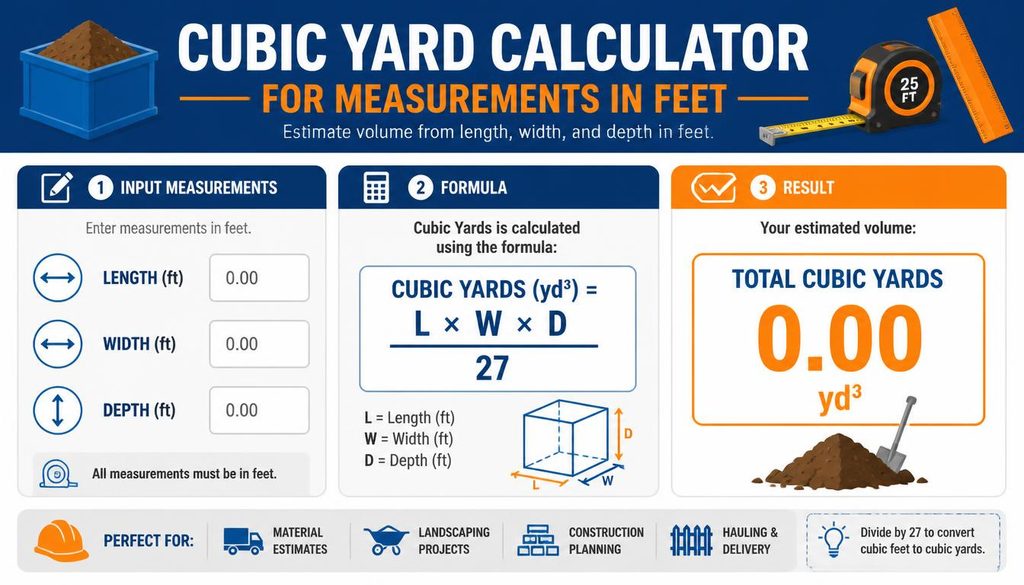
Let’s say you’re preparing an area that is 18 feet long, 7 feet wide, and 6 inches deep. You can’t simply multiply 18 × 7 × 6, because the measurements aren’t using the same unit. This is one of those tiny mistakes that can produce a surprisingly large ordering error.
First, convert the depth from inches to feet.
Six inches equals 0.5 feet.
Now calculate the volume:
18 × 7 × 0.5 = 63 cubic feet
Then convert cubic feet to cubic yards:
63 ÷ 27 = 2.33 cubic yards
So you need about 2.33 cubic yards of material.
The same process works with a depth of 9 inches. Since 9 inches = 0.75 feet, an area measuring 18 feet by 7 feet with a 9-inch depth would have:
18 × 7 × 0.75 = 94.5 cubic feet
Then:
94.5 ÷ 27 = 3.5 cubic yards
That’s the basic rhythm of a cubic yard measurement: get every dimension into compatible units, find the volume, then perform the conversion.
Cubic Yard Calculator for Landscaping Projects
Landscaping is probably where a Cubic Yard Calculator earns its keep most often. A garden may need fresh soil, a pathway may need gravel, and a flower bed may need mulch, all with different depths and quantities.
Imagine a rectangular flower bed measuring 20 feet long and 10 feet wide. You want 3 inches of mulch.
Three inches is 0.25 feet.
The calculation becomes:
20 × 10 × 0.25 = 50 cubic feet
Then:
50 ÷ 27 = 1.85 cubic yards
You would therefore need about 1.85 cubic yards of mulch based purely on the measured volume. Depending on how the supplier sells it, you may decide to order 2 cubic yards.
This same method can be used for landscaping material, compost, topsoil, decorative stone, gravel, and fill. The material changes, but the volume calculation doesn’t suddenly decide to become complicated just because it’s wearing a different hat.
For an irregular garden area, break it into smaller geometric areas. Calculate each section separately and add the results together. A strange L-shaped bed, for instance, can often be treated as two rectangular spaces rather than wrestling with one awkward measurement.
Cubic Yard Calculator for Concrete and Construction
Construction projects often involve materials where an incorrect estimate can be expensive. Concrete is a particularly good example because ordering too little may interrupt a pour, while ordering too much can leave you with a very heavy leftover problem.
For a rectangular slab, use the familiar length × width × height approach, with depth replacing height when you’re dealing with a horizontal surface.
Suppose a concrete slab is 30 feet long, 12 feet wide, and 4 inches thick. Four inches equals 1/3 of a foot, approximately 0.333 feet.
So:
30 × 12 × 0.333 ≈ 119.88 cubic feet
Then:
119.88 ÷ 27 ≈ 4.44 cubic yards
The practical order amount may be slightly higher depending on the project, site conditions, supplier recommendations, and expected material waste. Concrete work is not a place where pretending every measurement is perfect is particularly clever.
A concrete calculator or material calculator can make this faster, but understanding the calculation yourself lets you catch mistakes before the truck arrives.
Calculating the Volume of a Cylinder
Not every project is a neat rectangle. Some spaces are round, and that’s where the calculation changes.
For a cylinder, the basic formula is:
Volume = π × radius² × height
The radius is half the diameter. So if a round space has a diameter of 10 feet, its radius is 5 feet.
You can also use:
π × (diameter ÷ 2)² × height
For example, imagine a cylindrical hole with a radius of 3 feet and a depth of 2 feet.
Using π as approximately 3.14159265359:
3.14159265359 × 3² × 2 ≈ 56.55 cubic feet
Convert that to cubic yards:
56.55 ÷ 27 ≈ 2.09 cubic yards
That is why a good material volume calculator needs to know the shape involved. A rectangular prism and a cylinder don’t use exactly the same calculation, even though both are simply ways of measuring space.
Cubic Yard Conversion: Feet, Inches, and Metric Measurements
Unit conversion is often the part people dislike most, probably because inches have a talent for appearing innocent and then causing chaos.
If your dimensions are in feet, use the feet-based formula and divide by 27 after calculating cubic feet.
If your dimensions are in inches, you can first convert inches to feet by dividing by 12. For example, 18 inches becomes 1.5 feet.
You can also calculate directly in cubic inches, but then the conversion is different. Since one cubic yard is 36 × 36 × 36 inches, there are 46,656 cubic inches in one cubic yard.
Metric projects work in the same conceptual way. Convert your measurements into meters, calculate cubic meters, and then convert to the unit required by the supplier. The important thing is consistency: don’t mix feet, inches, and meters halfway through a calculation and hope mathematics will be understanding.
A reliable measurement calculator is helpful here because it removes some of the repetitive conversion work. Still, it is worth knowing what the calculator is doing behind the scenes.
How Many Cubic Yards Do I Need?
This is probably the most useful question for anyone planning a material purchase. The answer depends on the total volume of the space and the depth at which you want the material placed.
For a rectangular area:
Length × width × depth ÷ 27 = cubic yards
Suppose your project is 24 feet long, 8 feet wide, and 4 inches deep.
Convert 4 inches to feet:
4 ÷ 12 = 0.333 feet
Then:
24 × 8 × 0.333 ≈ 63.94 cubic feet
And:
63.94 ÷ 27 ≈ 2.37 cubic yards
So the measured requirement is around 2.37 cubic yards.
The purchasing decision can be slightly different from the mathematical result. If a supplier sells in whole-yard increments, you might order 3 cubic yards. If partial yards are available, you could order closer to the calculated amount. Always ask the supplier about minimum quantities and delivery policies before assuming.
Estimating Material Cost

Once you know your cubic yardage, estimating cost becomes pleasantly straightforward.
The basic relationship is:
Material cost = cubic yardage × price per yard
Suppose you need 4.5 cubic yards and the supplier charges $45 per cubic yard.
4.5 × $45 = $202.50
Your estimated total price would therefore be $202.50 before any delivery fees, taxes, minimum-order charges, or other supplier-specific costs.
A cubic yard cost calculator can perform this step automatically, but the principle remains simple. The price per cubic yard tells you what one unit costs; your calculated volume tells you how many units you need.
Prices can vary considerably by location and material. Gravel, premium soil, decorative stone, mulch, and concrete are not priced the same, and delivery can sometimes cost almost as much as the material for smaller orders. A quick quote from a local material supplier is therefore more reliable than relying on a generic price found online.
Why Accurate Measurements Matter
A few inches may seem insignificant when you’re standing in a large yard. Once those inches are multiplied across hundreds of square feet, however, they become real material.
Depth is especially important. If you accidentally measure 6 inches when you intended to calculate 4 inches, your estimated quantity can increase substantially.
Before using your Cubic Yard Calculator, measure the length, width, and depth in several places when the ground is uneven. Use reasonable average measurements rather than choosing the smallest or largest number simply because it is convenient.
For larger construction projects or expensive material orders, it is also wise to have another person check the measurements. A second set of eyes can catch a missing decimal, an incorrect conversion, or a measurement taken from the wrong edge.
Accounting for Waste and Uneven Areas
The calculated volume is a mathematical estimate of the space. Real projects are less obedient.
Soil settles. Gravel shifts. Mulch gets scattered. Concrete can have unavoidable losses during placement. An uneven site may also require more material than a perfectly level geometric model suggests.
For this reason, many people order a modest amount above their calculated requirement, depending on the material and project. The exact amount should be guided by the material supplier or project professional rather than applying one universal percentage to everything.
At the same time, ordering far too much isn’t automatically smart. Excess landscape material can become expensive waste, and some materials are difficult to store or reuse. Good measurement helps you strike that rather boring but valuable middle ground.
How Much Area Does One Cubic Yard Cover?
There is no single answer because coverage depends entirely on depth.
One cubic yard contains 27 cubic feet. If you spread that material only 1 inch deep, it covers a much larger area than if you spread it 6 inches deep.
For example, a cubic yard contains enough volume to cover 324 square feet at a depth of 1 inch, approximately. At 3 inches deep, the coverage drops to about 108 square feet.
This is why asking “How much area does a cubic yard cover?” without mentioning depth is a bit like asking how far a bucket of water travels. It depends on how thinly you spread it.
For landscaping, depth should therefore be decided before calculating the amount of soil, mulch, gravel, or other material required.
What Fits in a Truck Bed?
People often wonder how many cubic yards fit in a truck bed, but there isn’t one universal answer.
Truck beds differ in length, width, side height, and usable volume. Material density also matters. A truck may physically hold a certain volume, but the safe carrying capacity depends on the vehicle and the weight of the material.
A pickup filled with dry mulch is a very different situation from one loaded with wet soil or dense gravel. Weight can become the limiting factor long before the bed looks completely full.
For a rough volume estimate, you can measure the truck bed like a rectangular space:
length × width × average material depth ÷ 27
But for actual hauling, follow the vehicle’s payload limits and supplier guidance. Volume alone doesn’t tell the whole story.
Common Cubic Yard Calculation Mistakes
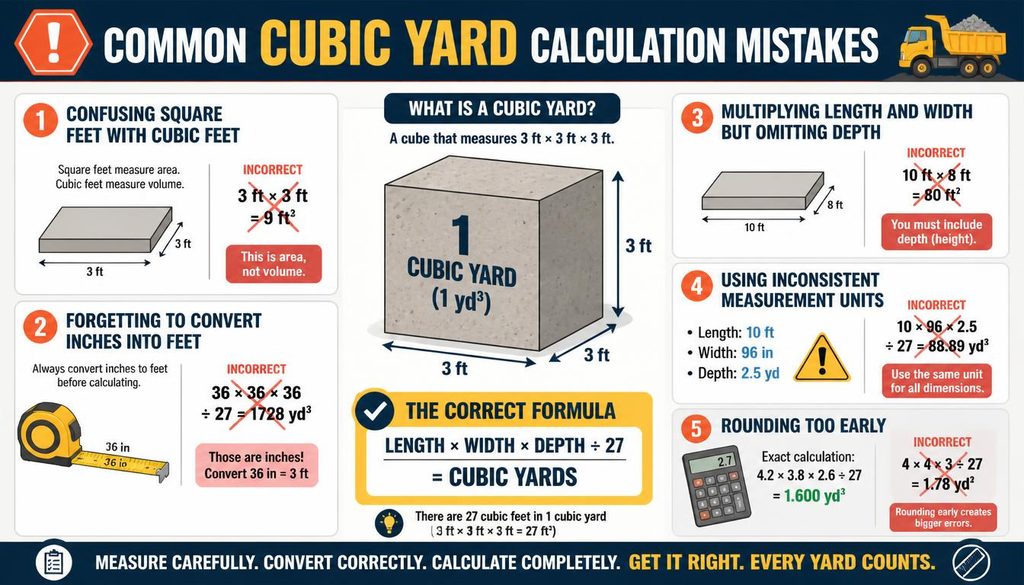
One common mistake is forgetting to convert inches into feet. If the project is measured in feet but the depth is given as inches, convert that depth first.
Another is forgetting the division by 27. Multiplying length, width, and depth gives cubic feet when the measurements are in feet. It does not magically become cubic yards just because you’re hoping for a convenient answer.
People also sometimes confuse square yards with cubic yards. Square yards measure area; cubic yards measure volume. The moment depth enters the calculation, you’re dealing with three dimensions.
Another little troublemaker is rounding too early. Keep several decimal places during the calculation and round the final material quantity instead. Early rounding can create a larger error than you’d expect on a substantial project.
A Simple Real-World Example
Imagine you’re installing gravel around a rectangular patio. The area is 25 feet long and 12 feet wide, and you want the gravel 3 inches deep.
First convert the depth:
3 inches = 0.25 feet
Now calculate:
25 × 12 × 0.25 = 75 cubic feet
Convert to cubic yards:
75 ÷ 27 = 2.78 cubic yards
Your calculated requirement is therefore approximately 2.78 cubic yards.
If your supplier sells by whole cubic yards, you might purchase 3 cubic yards, subject to the supplier’s recommendations and delivery terms. If partial yards are sold, you may have another option. This tiny example is basically the whole idea of a cubic yard estimator in action.
Using a Cubic Yard Calculator for Complex Shapes
Some projects refuse to be rectangles. Perhaps your flower bed curves around a walkway, or your construction area has several different sections.
Don’t panic and start measuring with a piece of string and a confused expression.
Instead, divide the project into manageable geometric areas. A curved or irregular space may be approximated or separated into rectangles, triangles, or cylinders where appropriate. Calculate the volume of each section individually, then add those volumes together.
For example, if one rectangular section requires 1.8 cubic yards and another requires 2.4 cubic yards:
1.8 + 2.4 = 4.2 cubic yards
The total estimated material volume is 4.2 cubic yards.
For highly irregular or technically important projects, a professional measurement may be worthwhile. A calculator is excellent for ordinary estimates, but it isn’t a substitute for a site survey when precision is critical.
Practical Tips Before Ordering Material
Measure twice. It is an old piece of advice, yes, but it survives because it works.
Write every measurement down with its unit. “12” isn’t useful by itself; “12 feet” is.
Convert all dimensions into compatible units before multiplying. This one habit prevents a surprising number of calculation errors.
Check the supplier’s selling unit. Some companies sell by cubic yard, others by partial yard, bag, ton, or another quantity. Don’t assume that a mathematical answer automatically matches the supplier’s ordering system.
Finally, ask whether the quoted material is sold by volume or weight. Yards to tons is not a universal conversion because different materials have different densities and moisture levels. A ton of one material does not necessarily occupy the same volume as a ton of another.
Frequently Asked Questions About Cubic Yard Calculations
How do you calculate cubic yards?
For measurements in feet, multiply length × width × depth to find cubic feet, then divide by 27. The basic formula is length × width × depth ÷ 27.
How many feet are in a cubic yard?
A cubic yard contains 27 cubic feet. Think of it as a cube measuring 3 feet on every side: 3 × 3 × 3 = 27.
How do I calculate cubic yards from inches?
Convert the measurements from inches to feet first, then use the standard feet-based formula. You can also calculate in cubic inches and divide by 46,656, since that is the number of cubic inches in one cubic yard.
How much does a cubic yard cost?
There isn’t one fixed price. The price per cubic yard depends on the material, supplier, location, quality, and delivery arrangements.
How much material does one cubic yard cover?
Coverage depends on depth. A cubic yard spread thinly covers a larger area, while a deeper layer covers less area. Always include the intended depth when estimating coverage.
How do I calculate cubic yardage for a cylinder?
Use π × radius² × height to calculate cylindrical volume. If you know the diameter, divide it by two to get the radius first.
How many cubic yards do I need for a landscaping project?
Measure the project dimensions, determine the desired depth, calculate the volume, and convert the result into cubic yards. For irregular areas, divide the space into smaller sections and add the results.
Should I round up my order?
Often, a small amount of extra material can be practical, especially where settling, spillage, or uneven ground is expected. However, the appropriate amount depends on the material and project, so supplier guidance is useful.
cy calculator
A CY calculator helps you quickly calculate the volume of a space in cubic yards. Enter the required dimensions to estimate the amount of material needed.
calculate cubic yards
To calculate cubic yards, multiply the length, width, and depth of the area, then convert the result to cubic yards. This helps determine the quantity of material required.
volume calculator cubic yards
A volume calculator cubic yards tool determines the volume of a space in cubic yards using its dimensions. It is useful for estimating materials such as dirt, gravel, soil, and concrete.
dirt volume calculator
A dirt volume calculator estimates how much dirt is needed to fill a specific area. Enter the length, width, and depth to calculate the required volume.
cyd calculator
A CYD calculator is used to calculate cubic yardage for different spaces and materials. It can help estimate the quantity needed for landscaping and construction projects.
Read more: https://avenzum.com/interactive-analog-clock/
Final Thoughts: Make the Measurement Work for You
A Cubic Yard Calculator may look like a simple digital tool, but its real value is that it translates a physical space into a quantity you can purchase, budget for, and work with. A patch of soil becomes 2.3 cubic yards. A concrete slab becomes 4.4 cubic yards. A mysterious heap of gravel becomes something you can actually measure, which is rather satisfying.
The essential ideas are wonderfully uncomplicated: measure the length, width, and depth; keep your units consistent; calculate the volume; and remember that 27 cubic feet equal one cubic yard.
Whether you’re ordering concrete, gravel, soil, mulch, dirt, or fill, a careful cubic yards calculation can help prevent expensive guesswork. Take the measurements seriously, check your conversions, compare the result with your supplier’s recommendations, and give yourself enough room for the realities of a real project.
And perhaps that’s the nicest thing about understanding cubic yardage: once you know what the numbers are saying, a huge pile of material stops looking like a huge pile of material. It becomes a measurable amount, an estimated cost, and a plan you can actually do something with.