There is something almost magical about watching a family welcome a baby girl. One minute, everyone is checking the clock, waiting for the big moment, and the next, time seems to slow down completely.
A tiny new person arrives, and suddenly Hours, Minutes, and even Seconds feel more meaningful than they did before. A grandparent may remember the exact Date, a parent may never forget the Start Time, and someone else will proudly say, “She arrived just after sunrise.” Little details like these become family memories.
That is one reason a Time Calculator or Day Calculator can be surprisingly useful. Time is everywhere in our lives, from planning appointments and birthdays to measuring how long an event lasted or finding out how many days remain before a special celebration.
But calendar arithmetic can become confusing when months have different lengths, daylight-saving changes affect the clock, or a calculation crosses midnight. Honestly, a simple calculation can turn into a tiny headache.
A good calculator makes these questions much easier. You can compare a Start Time with an End Time, find the Time Difference, work out a Date Difference, or discover the exact Date and Time Duration between two moments.
Whether you are planning a birthday, tracking an event, counting down to an anniversary, or simply wondering how much time has passed, the right calculation gives you a clear answer without making you wrestle with a calendar.
| Time Calculator / Day Calculator | What It Calculates |
|---|---|
| Start Date & End Date | Days, weeks, months, and years between dates |
| Start Time & End Time | Hours, minutes, and seconds between times |
| Days Between Dates | Total number of days |
| Weeks Between Dates | Total number of weeks |
| Hours Between Times | Total hours and remaining minutes |
| Minutes Between Times | Total minutes |
| Seconds Between Times | Total seconds |
| Add Time to a Date | Future date after adding years, weeks, days, hours, minutes, or seconds |
| Subtract Time | Previous date or time after subtracting a duration |
| Current Date & Time | Uses the present date and time as a starting point |
What Is a Time Calculator?
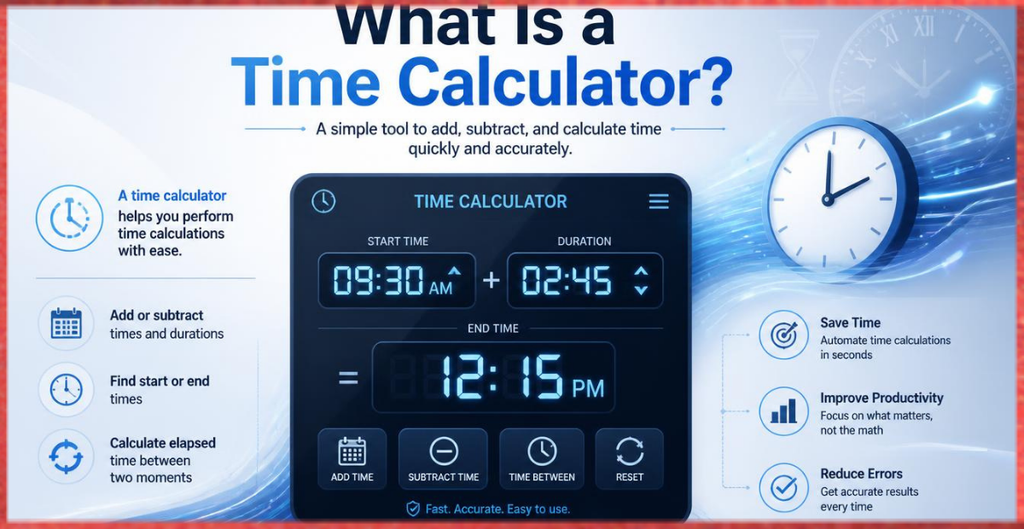
A Time Calculator is a tool designed to work with clock-based measurements such as Hours, Minutes, and Seconds. Instead of manually subtracting one clock reading from another, you enter the beginning and ending times and let the calculation handle the arithmetic. It sounds simple, and thats exactly why it is useful.
For example, imagine an event begins at 2:15 PM and finishes at 5:40 PM. The Time Difference is 3 hours and 25 minutes. If you tried to calculate it mentally while also planning ten other things, there is a fair chance your brain would decide to take a coffee break.
A time tool can help calculate:
- Time Between Two Times
- Hours between two times
- Minutes between two times
- Seconds between two times
- Time Duration
- Time Interval
- Elapsed Time
- Total Hours
- Total Minutes
- Total Seconds
This makes it helpful for everyday scheduling as well as more detailed calculations where every minute counts.
How a Time Calculator Works
Most time calculations begin with two simple pieces of information: a Start Time and an End Time. The calculator determines how much time separates those points, even when the calculation crosses an hour or midnight.
Suppose the Start Time is 9:45 AM and the End Time is 1:20 PM. The calculator breaks the interval into manageable units and returns the Time Duration as 3 hours and 35 minutes. You don’t have to manually borrow an hour from the minutes column, which is where things sometimes get messy.
Some tools also allow calculations in smaller units. You might want the answer entirely in Minutes, Seconds, or Hours, depending on what you are measuring. This flexibility is especially useful when comparing work sessions, travel periods, study time, exercise sessions, or scheduled events.
What Is a Day Calculator?
A Day Calculator focuses primarily on calendar-based calculations. Instead of asking how many minutes separate two clock readings, you may want to know how many Days, Weeks, or Years separate two dates.
For instance, if you know the Start Date and End Date of a vacation, a day calculator can determine the length of the trip. If you are planning an anniversary, it can show the Number of Days Between Dates. And if you are counting toward a future celebration, it can help you find exactly how many days remain.
A Day Calculator can be useful for:
- Finding Days Between Dates
- Calculating Weeks Between Dates
- Finding Years Between Dates
- Calculating a Date Duration
- Adding days to a date
- Adding weeks to a date
- Finding a future or past date
- Checking the length of a date range
Calendar math is less predictable than it looks because months do not all contain the same number of days. Thats why using an actual calculation tool can save time and avoid silly mistakes.
How a Date Calculator Helps
A Date Calculator works with calendar dates rather than only clock times. You might use it to determine what date falls 90 days after a particular day, or how many days separate two important events.
Imagine a baby girl is born on March 12. Her family may later want to know when she reaches 100 days old, six months, or one year. A Date Calculator can make those milestones easier to identify without manually counting through every page of a calendar.
It can also handle common questions such as:
- What date is 30 days from today?
- How many days are between two dates?
- How many weeks are between two dates?
- How many years separate two dates?
- What date was a specified number of days ago?
- What date comes after adding several weeks?
The answer becomes especially valuable when a calculation spans different months or years.
Time Calculator for Everyday Planning
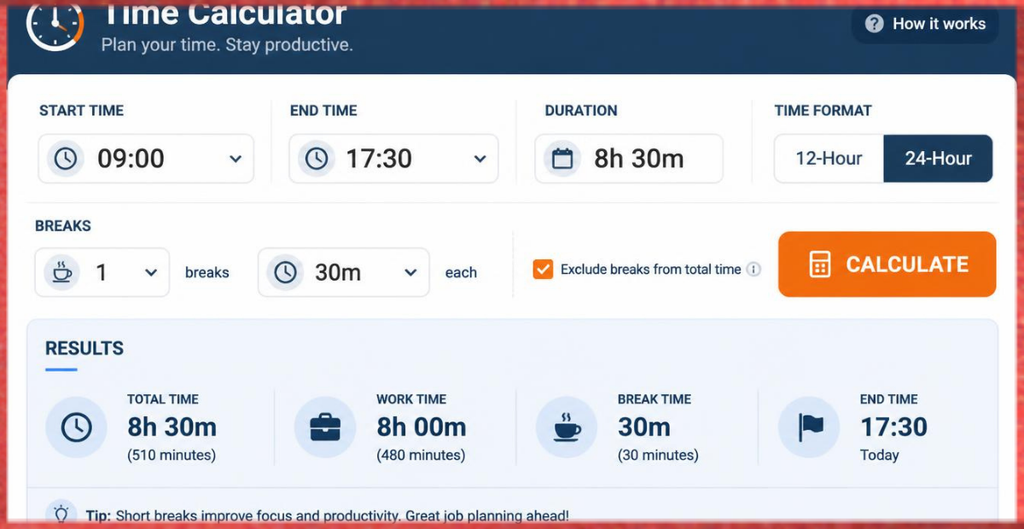
A Time Calculator isn’t just for complicated schedules. It can be useful for ordinary moments that happen every day.
Perhaps you start work at 8:30 AM and finish at 4:45 PM. Maybe a family celebration begins at 6:00 PM and ends at 9:30 PM. Or you are simply trying to determine how long a road trip took. These are small calculations, but repeated small calculations can quietly eat up time.
You can use a time tool to:
- Calculate hours worked
- Measure the length of an appointment
- Find the duration of a meeting
- Calculate travel time
- Measure study sessions
- Track exercise duration
- Find the Time Between Two Times
- Convert a duration into Hours, Minutes, and Seconds
It becomes a quiet little helper in the background, doing the boring arithmetic while you get on with the interesting stuff.
Day Calculator for Birthdays and Special Dates
Birthdays have a funny relationship with time. A newborn’s first day can feel incredibly long, yet the first birthday somehow appears almost overnight. A Day Calculator can help families keep track of those milestones.
Parents can calculate the number of Days between a child’s birth date and future milestones. Grandparents might calculate how many weeks old a baby will be during a family gathering. Friends can even use a Date Calculator to determine how far away a birthday is.
These calculations can also be useful for:
- First birthdays
- Anniversaries
- Family reunions
- Wedding dates
- Holiday planning
- School events
- Vacation dates
- Personal milestones
Sometimes the number itself becomes part of the celebration. “She is 365 days old today” sounds more mathematical than “Happy first birthday,” but somehow it still carries that little bit of wonder.
Time Difference Between Two Times
The Time Difference between two clock readings tells you how much time has passed from one moment to another. This is one of the most common reasons people use a time calculator.
For example, from 10:10 AM to 12:45 PM:
- 10:10 to 12:10 = 2 hours
- 12:10 to 12:45 = 35 minutes
- Total = 2 hours and 35 minutes
A calculator can perform the same Time Difference calculation instantly.
The same method works when you need to calculate Hours Between Two Times, Minutes Between Two Times, or Seconds Between Two Times. When the interval crosses midnight, a calculator becomes even more helpful because the date changes as well.
Date Difference Between Two Dates
The Date Difference tells you the amount of calendar time separating two dates. Depending on the calculator, the answer may appear in Years, Weeks, Days, or a combination of units.
For example, someone may want to know how many days have passed since a wedding anniversary. Another person may want to know how many weeks remain until a vacation.
A useful date tool can calculate:
- Days Between Dates
- Weeks Between Dates
- Years Between Dates
- Number of Days Between Dates
- Number of Weeks Between Dates
- Number of Years Between Dates
- Duration Between Dates
- Time Between Two Dates
The important thing is to understand whether the result counts calendar days, complete weeks, or a combination. Different calculators can display the same interval in different ways, even when the underlying duration is identical.
Calculating Hours, Minutes, and Seconds
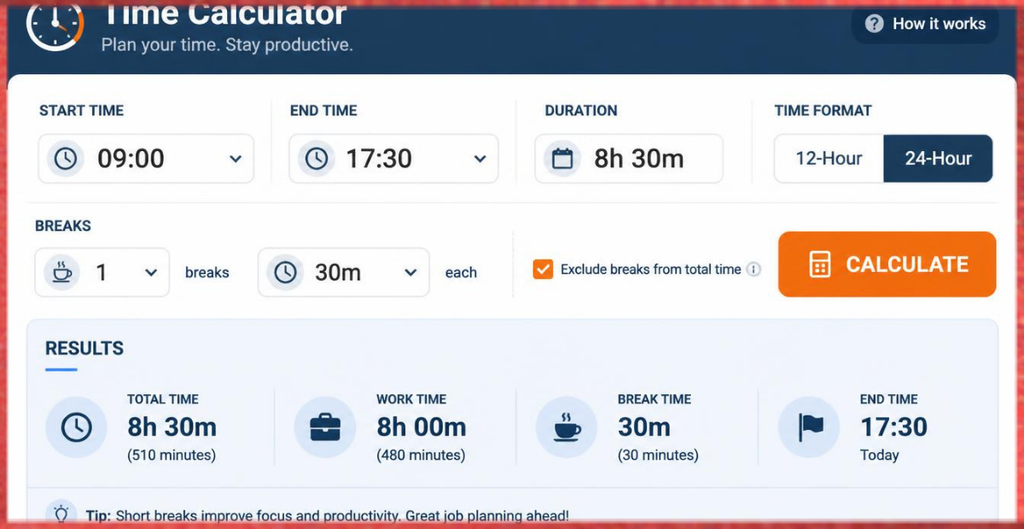
Sometimes hours alone are not enough. If an event lasts 2 hours and 18 minutes, that may be perfectly useful. But if you are measuring a short recording, race, experiment, or countdown, Seconds may matter.
A detailed calculator can help you Calculate Hours and Minutes, convert durations into Total Minutes, or perform a Seconds Calculation.
For example:
2 hours = 120 minutes
So:
2 hours 18 minutes = 138 minutes
And if you need the result in seconds:
138 minutes × 60 = 8,280 seconds
This is easy enough when the numbers behave themselves. But once you have several intervals to combine, doing the calculation by hand gets annoying pretty fast.
Calculate Days and Weeks From a Date
One of the handiest features of a Date Calculator is the ability to add a specific amount of time to a calendar date.
You may want to:
- Add Days to a Date
- Add Weeks to a Date
- Add months to a date
- Find a future milestone
- Find a previous date
- Calculate a deadline
For example, adding 14 days to a Monday gives you the Monday two weeks later. But adding 30 days is not necessarily the same as adding one calendar month. Thats an important distinction, especially when planning deadlines.
A calculator helps keep these concepts separate so that “30 days from now” and “one month from now” don’t accidentally become the same thing.
Date and Time Duration: When Both Matter
Some situations need more than a date or clock time by itself. You might need to know the complete Date and Time Duration between two exact moments.
Imagine an event begins on August 20 at 8:30 PM and ends on August 22 at 11:15 AM. The calculation includes both the calendar change and the clock difference.
This is where combining Date and Time becomes useful. Instead of treating the two separately, a calculator can determine the complete elapsed interval.
This type of calculation can help with:
- Travel itineraries
- Event scheduling
- Project timelines
- Reservations
- Work shifts
- Long-running activities
- Countdown planning
It is basically the difference between asking, “How many days?” and asking, “Exactly how long?”
Time Between Two Dates
The phrase Time Between Two Dates can mean different things depending on the context. In everyday use, people often mean the number of calendar days separating two dates. In more detailed calculations, they may want a result expressed as Years, Weeks, Days, Hours, Minutes, and Seconds.
Suppose a project starts on January 1 and ends on January 15. You could describe the interval as 14 days, 2 weeks, or 336 hours. All three can describe the same elapsed period, but each format is useful for a different reason.
That flexibility is one of the nicest things about a good calculator. You choose the unit that makes sense instead of forcing every answer into one format.
Current Date and Current Time Calculations
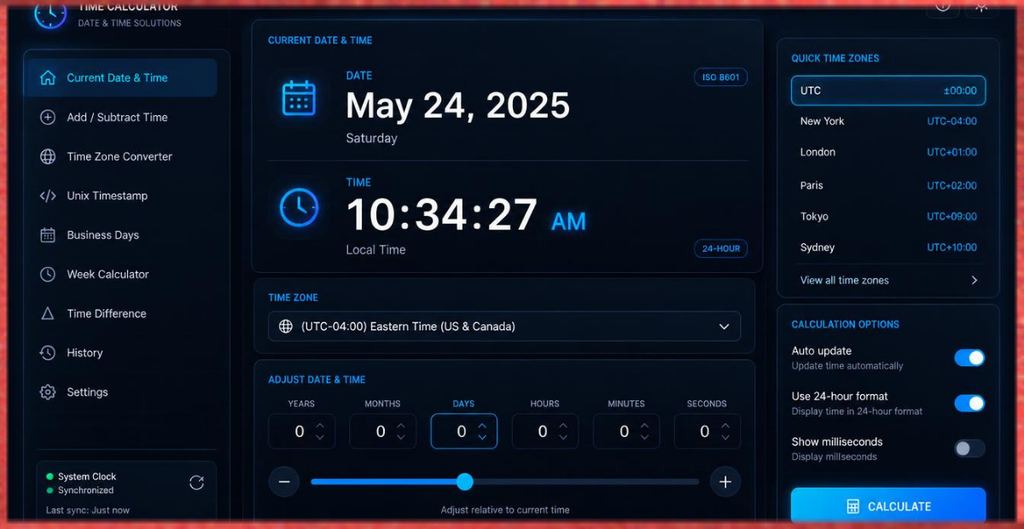
Many online tools use the Current Date and Current Time as the starting point for calculations. This is handy when you want to know what happens a certain number of days or hours from now.
For example, you might ask:
- What date is 45 days from today?
- What time will it be 6 hours from now?
- How many days until an event?
- How many hours remain today?
- What date was 100 days ago?
Using the Current Date and Time makes the calculation dynamic, though it is always smart to check the time zone when accuracy matters.
A calculation based on one time zone can produce a different answer from a calculation based on another, especially near midnight. Time zones are sneaky little things.
Why Time Zones and Daylight Saving Time Matter
Time calculations become more complicated when different locations are involved. A meeting scheduled for 3:00 PM in one city might occur at a completely different local time somewhere else.
Daylight saving changes can also affect the actual elapsed time between two clock readings. A clock may move forward or backward, meaning the displayed difference is not always as simple as subtracting one number from another.
For ordinary personal planning, this may never cause trouble. But for international meetings, flights, digital events, and scheduled communications, it is worth checking the relevant time zone.
Time Interval Calculator for Work and Projects
A Time Interval Calculator can be particularly helpful when several activities happen during a day.
Suppose someone works from 9:00 AM to noon, takes a break, then works again from 1:00 PM to 5:00 PM. Instead of treating the entire day as one continuous period, you can calculate each Time Interval separately and add them together.
This is useful for:
- Work schedules
- Freelance projects
- Study plans
- Exercise routines
- Production tracking
- Meeting durations
- Volunteer hours
The result can show Total Hours worked rather than simply the amount of time between arriving and leaving.
Elapsed Time Calculator for Real Life Events
An Elapsed Time Calculator answers a simple question: how much time passed?That question appears everywhere. How long was the journey? How long did the appointment take? How long has it been since the event began?
Elapsed time can be expressed in different ways, including Days Hours Minutes Seconds. Choosing the right format depends on how precise you need to be.
For longer periods, saying “4 days and 6 hours” may be clearer than converting everything into 102 hours. For a short event, however, minutes and seconds may be much easier to understand.
Annual Calculations and Long Term Planning

When working with an Annual timeline, it is important to distinguish between a calendar year and a fixed number of days.A year can contain 365 days, while a leap year contains 366.
That small extra day can affect long-term calculations. This matters when calculating anniversaries, age milestones, contracts, subscriptions, and recurring events.
If someone was born on a particular Date, a calendar-based birthday generally occurs on the same month and day each year. But calculating an exact elapsed duration in days can produce a slightly different perspective.Both answers can be correct because they answer different questions.
Common Mistakes When Calculating Time and Dates
Manual calculations often go wrong for surprisingly ordinary reasons. Someone forgets that a month has 30 rather than 31 days, crosses midnight without changing the date, or treats a calendar month as exactly 30 days.
Other common mistakes include:
- Forgetting leap years
- Confusing AM and PM
- Ignoring time zones
- Forgetting daylight-saving changes
- Mixing calendar duration with elapsed duration
- Counting both starting and ending dates when only the interval is required
- Assuming every month contains the same number of days
A calculator doesn’t eliminate the need for careful thinking, but it removes much of the repetitive arithmetic. Thats a pretty good trade.
Choosing the Right Calculator
The best tool depends on what you are trying to measure.
Use a Time Calculator when your question involves clock readings, such as 8:15 AM to 3:40 PM.
Use a Day Calculator when you want to count days or weeks between calendar dates.
Use a Date Calculator when you need to find a future or past date by adding or subtracting time.
Use a Time Duration Calculator when the exact length of an event matters.
Use a Date Duration Calculator when your focus is the span between two calendar dates.
And use a combined date-and-time tool when both the calendar day and clock time are important.
How to Make Your Calculation More Accurate
Before calculating, write down exactly what you know. This little step saves more confusion than people expect.
Start with the Start Time or Start Date, then enter the End Time or End Date. Confirm the time zone if locations are different. Decide whether you want the result in days, weeks, hours, minutes, or seconds.
If you are calculating a future date, decide whether you mean a fixed number of days or a calendar period. For example, “60 days from January 1” is not necessarily the same as “two months from January 1.”Being precise about the question usually makes the answer precise too.
Creative Ways to Use a Time or Day Calculator
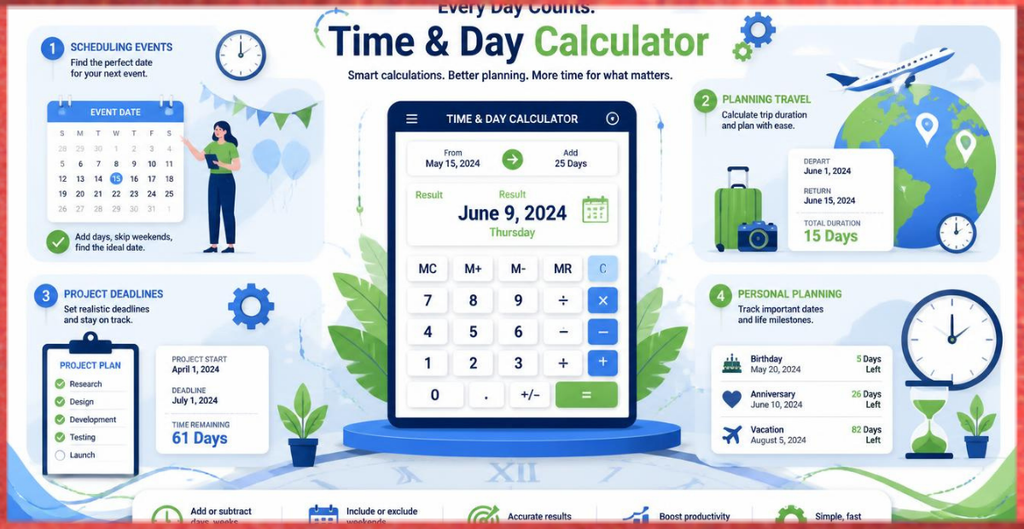
A calculator can be practical without being boring. Families can use it to count down to birthdays, anniversaries, holidays, vacations, or other memorable occasions.
For a baby’s first year, parents might calculate milestone dates and create little monthly memories. Friends planning a surprise party can calculate the exact remaining hours. Someone celebrating a wedding anniversary might discover the number of days they have shared together.
These little numbers can become meaningful because behind every calculation is a real moment.
How to Write a Personal Message Around a Special Date
If you are using a calculated date for a birthday, anniversary, or newborn celebration, don’t let the number become the whole message. Add something human.
Instead of saying:
“Happy birthday. You are 365 days old.”
you might say:
“One whole year has passed since you arrived and changed everyone’s idea of what a perfect day looks like.”
The calculation gives you the fact. Your words give the fact its feeling.
This is especially lovely when welcoming a baby girl. The exact Date, Time, and even number of Seconds may become part of her family story, but what people remember most is usually how that moment felt.
Frequently Asked Question
how many hours until 2026
Since 2026 has already begun, there are 0 hours until 2026. The year 2026 started on January 1, 2026.
how many hours until tomorrow
The exact number of hours until tomorrow depends on your current time. Generally, it is the number of hours and minutes remaining until midnight tonight.
how long till 2026
2026 is already here. It began on January 1, 2026, so there is no waiting time left.
how long until 1:55
The time until 1:55 depends on whether you mean 1:55 AM or 1:55 PM and your current local time. A countdown calculator can give the exact remaining hours and minutes.
how many minutes until 2026
There are 0 minutes until 2026, because the year 2026 has already started.
Read this blog https://avenzum.com/timer-until-4pm-2/
Final Thoughts on Time Calculator / Day Calculator
Time is strange. We measure it in Seconds, Minutes, Hours, Days, Weeks, and Years, yet none of those measurements quite capture what a meaningful moment feels like.
A minute waiting for wonderful news can feel endless, while an entire year with a new child can disappear almost suspiciously fast.
A Time Calculator, Day Calculator, or Date Calculator gives structure to that passing time. It can help you find a Time Difference, calculate a Date Difference, measure a Time Interval, or discover the exact Duration Between Dates and times. More importantly, it can turn an abstract question into something clear and useful.
Whether you are planning a deadline, tracking an event, counting down to a birthday, or celebrating the arrival of a beautiful baby girl, accurate time calculations can make planning easier. And when the numbers point toward a special moment, don’t forget to pause for a second and enjoy it.
Because sometimes the most important thing about calculating time is remembering that the time itself is the thing we are actually living.