There is something strangely beautiful about waiting for a moment that has not arrived yet. A family waiting for a baby girl knows this feeling better than most every hour seems to carry a tiny promise, every minute feels like it is walking toward a new chapter.
You might look at the clock and wonder, what time will it be in 8 hours? At first, it sounds like a simple question, but when your day is crowded with appointments, celebrations, work, travel, or preparing a little corner for a newborn daughter, knowing the exact future time can suddenly become very useful.
The phrase 8 Hours From Now simply means moving forward eight complete hours from the current time. It does not mean eight hours from midnight, nor does it automatically mean the same clock time tomorrow.
You take the Current time, add eight Hours, and arrive at a Future time. Easy enough, though clocks have a funny habit of making easy things look complicated when you’re tired.
Imagine a family celebrating the arrival of a baby girl. Perhaps grandparents are traveling, relatives are waiting for a video call, and someone has promised to send photographs later in the day. Knowing the time eight hours from now can help everyone coordinate without that classic “wait, what time did you say?” moment.
| Item | Details |
|---|---|
| Main Keyword | 8 Hours From Now |
| Equivalent | 8 hours = 480 minutes |
| Purpose | Find the exact future time |
| Calculation | Current time + 8 hours |
| Useful For | Planning, reminders, appointments, and schedules |
| Time Units | Hours, minutes, seconds |
| Calculator Type | Future Time Calculator |
What Does 8 Hours From Now Mean?

8 hours from now means exactly eight hours after the moment you begin your calculation. If the starting time is 5:21 AM, adding eight hours gives 1:21 PM on the same day. In this example, the calculation moves forward through the morning and lands in the afternoon, rather neatly.
For example, if the date is Wednesday, September 9, 2026, and the starting time is 5:21 AM, then the time eight hours later is 1:21 PM on Wednesday, September 9, 2026. Nothing mysterious is happening here; you’re simply adding eight hours to the clock.
This is why the phrase what time is 8 hours from now is really asking for a future clock position. The answer depends entirely on the starting point.
If you begin at 10:00 AM, the result is 6:00 PM. If you begin at 8:00 PM, eight hours later is 4:00 AM the next day. The calendar can change while the number of hours stays exactly the same, which is where people sometimes get caught.
How to Calculate 8 Hours From Now
The simplest way to calculate 8 hours from now is to write down the current time and add eight hours. If the hour remains below 24, the calculation stays on the same date. If the total passes midnight, the answer moves to the following day.
Suppose your current date and time is 5:21 AM on Wednesday, September 9, 2026. Add eight hours:
5:21 AM + 8 hours = 1:21 PM
So, 8 hours from today in this example is 1:21 PM on Wednesday, September 9, 2026.
If your starting time is 8:30 PM, however, adding eight hours produces 4:30 AM the following morning. That’s an important little detail because “eight hours later” does not care whether the calendar has changed.
A useful mental trick is to add six hours first and then two more. For 5:21 AM, six hours gives 11:21 AM, and another two hours gives 1:21 PM. It feels almost like moving stepping stones across the clock.
8 Hours From Now in Minutes, Seconds, and Milliseconds
Sometimes hours are not the most convenient unit. A scheduling system, computer program, scientific calculation, or detailed countdown may require the answer in smaller units.
Eight hours contains 480 minutes because one hour contains 60 minutes:
8 × 60 = 480 minutes
Therefore, 8 hours in minutes equals 480 minutes.
To convert the same period into seconds, multiply 480 by 60:
480 × 60 = 28,800 seconds
So, 8 hours in seconds equals 28,800 seconds.
For even greater precision, one second contains 1,000 milliseconds:
28,800 × 1,000 = 28,800,000 milliseconds
That means 8 hours in milliseconds equals 28,800,000 milliseconds. It looks like a huge number, but it is still exactly the same eight-hour period wearing a much smaller unit of clothing.
These conversions can be useful when working with software, timers, technical systems, or detailed Time calculation tasks. For an ordinary person checking when dinner starts, milliseconds are probably overkill, but hey, sometimes the calculator wants to show off.
Example: 8 Hours From 5:21 AM
Let’s make the calculation very plain. Suppose the starting point is 5:21 AM on Wednesday, September 9, 2026.
Start with:
5:21 AM
Add eight hours:
5:21 AM + 8 hours = 1:21 PM
The date remains Wednesday because the calculation has not crossed midnight.
So the result is:
Wednesday, September 9, 2026 at 1:21 PM
This is also a good example of why the starting time matters. If you instead begin at 1:21 PM, eight hours later would be 9:21 PM. Same number of hours, completely different answer.
8 Hours From Now Using Pacific Time
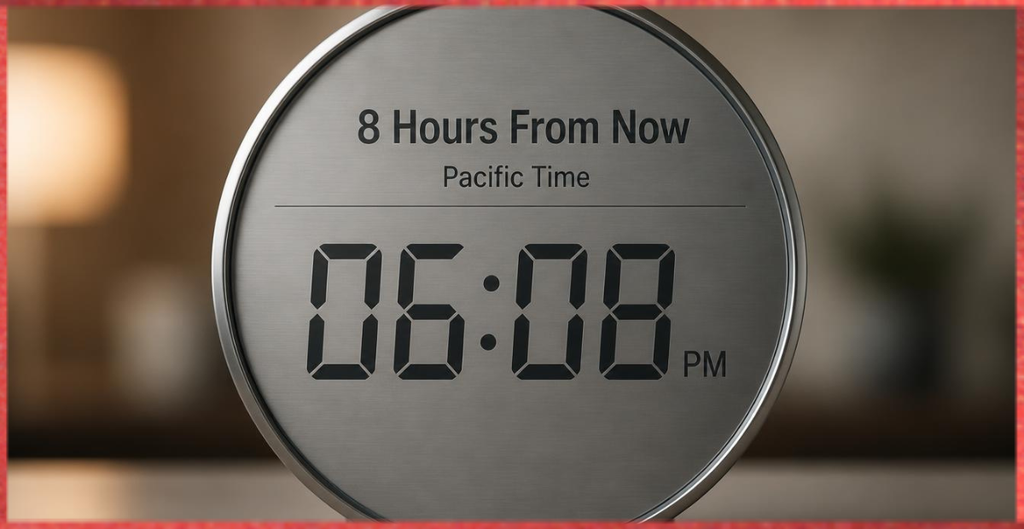
Time zones make future-time calculations a little more interesting. If you are using Pacific Time, the result should first be calculated from the local clock in that time zone. You should not casually mix Pacific Time with another location’s clock unless you are intentionally converting between zones.
For example, a calculation beginning at 5:21 AM Pacific Time gives 1:21 PM Pacific Time eight hours later. The eight-hour difference itself does not change because of the time zone.
The tricky part comes when another person is in a different region. A relative waiting for news about a newborn baby girl might be several hours ahead, so their local clock could show a different time even though both people are waiting for the same moment.
When coordinating family calls, medical appointments, celebrations, or travel, always identify the time zone. “At 1:21 PM” is much less useful than “at 1:21 PM Pacific Time” when people are scattered across different places.
What Time Will It Be in 8 Hours?
The question what time will it be in 8 hours can be answered by adding eight hours to the current clock time. The minutes usually stay unchanged when you’re adding whole hours.
For example:
- 4:00 AM 12:00 PM
- 6:15 AM 2:15 PM
- 9:30 AM 5:30 PM
- 11:45 AM 7:45 PM
- 2:10 PM 10:10 PM
- 7:20 PM 3:20 AM the next day
Notice how the minutes remain the same. Only the hour changes, unless you are adding minutes as well. That’s the little shortcut many people forget when they reach for a calculator too quickly.
8 Hours Later vs. 8 Hours Ago From Now
There is an important difference between 8 hours later and 8 hours ago from now.
“Eight hours later” means moving forward eight hours from a starting point. “Eight hours ago from now” means moving backward eight hours from the current moment.
If the current time is 1:00 PM:
- 8 hours from now = 9:00 PM
- 8 hours ago from now = 5:00 AM
The direction is the entire game here. One travels into the future, while the other walks backward into the earlier part of the day.
The same idea applies to Hours ago from now, Minutes ago from now, and Minutes from now. A time calculation becomes much easier when you first decide whether you are moving forward or backward.
Using a Time Calculator for 8 Hours From Now
A Time Calculator can make these calculations nearly instant. Instead of manually counting around the clock, you enter the starting time, select the number of hours, and let the tool produce the future result.
An Hours Calculator is especially useful when you need to calculate several future times. For example, someone might need to know what happens four hours from now, eight hours from now, and twelve hours from now. Doing each calculation manually isn’t difficult, but computers are pretty good at repetitive things.
A Preset Hours Calculator can be even more convenient when the same intervals are used regularly. If your routine involves checking 2, 4, 8, or 12-hour periods, preset values save a few clicks and reduce silly little mistakes.
Still, understanding the manual method matters. A calculator is helpful, but knowing the underlying calculation means you can quickly check whether the result makes sense.
How to Add Hours to Time Manually
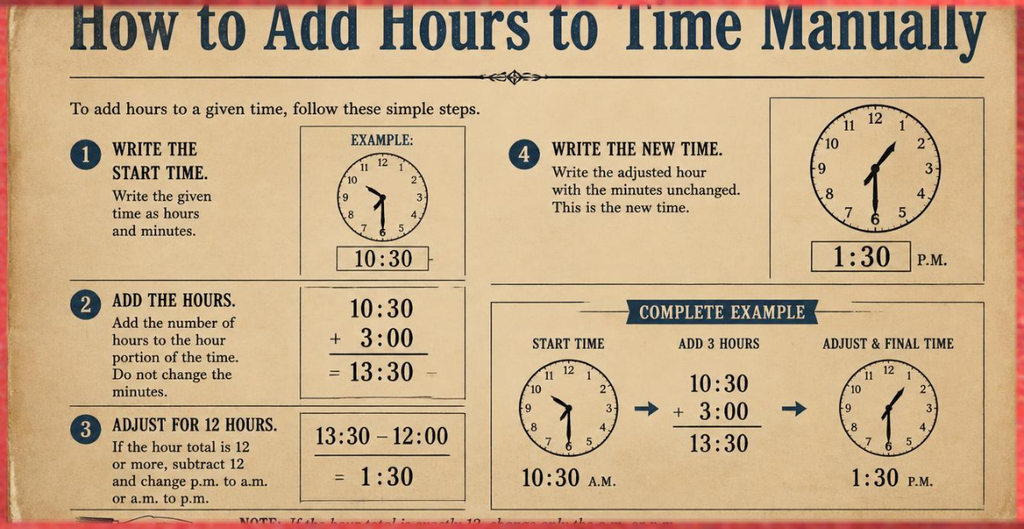
To add hours to time, begin with the hour displayed on the clock and move forward one hour at a time. Keep the minutes unchanged if you’re adding whole hours.
For example:
7:40 AM + 8 hours = 3:40 PM
Another example:
9:50 PM + 8 hours = 5:50 AM the next day
When the calculation crosses midnight, remember to advance the date too. This sounds obvious, but midnight is where many otherwise simple calculations quietly go wrong.
For a more complicated calculation, such as adding 8 hours and 45 minutes, first add the eight hours and then add the 45 minutes. Breaking a problem into smaller pieces makes the answer easier to verify.
Why 8 Hours From Now Can Matter in Everyday Life
At first glance, 8 Hours From Now may sound like a simple calculator phrase, but future-time calculations show up everywhere. People use them for work shifts, medication schedules, travel plans, sleep routines, online events, cooking, meetings, deadlines, and family arrangements.
For new parents, time can become particularly important. A newborn baby girl can turn a normal day into a strange mixture of joy, tiredness, feeding, naps, visitors, and messages from relatives.
Knowing when eight hours from now will occur can help someone organize the next part of the day without constantly checking the clock.
A person preparing food might need to know when eight hours have passed. A traveler might need to calculate arrival-related times. Someone working across time zones may need to determine when a colleague becomes available.
So yes, it’s a tiny calculation, but tiny calculations are often the ones quietly holding a busy day together.
8 Hours From Current Time and Midnight
One of the most important things to understand is whether the calculation crosses midnight. If you start early in the morning, eight hours usually remains within the same day. If you start in the evening, the answer may belong to tomorrow.
For example:
3:00 PM + 8 hours = 11:00 PM
But:
6:00 PM + 8 hours = 2:00 AM the next day
The second answer is not “2:00 AM today.” It belongs to the next calendar date. That’s why a proper future time calculator should consider both the clock and the calendar.
This becomes even more important when a countdown is being used near midnight. A person may think they’re asking about “today,” but mathematically the future moment has already stepped into tomorrow.
Understanding 480 Minutes in 8 Hours
The conversion from hours to minutes is one of the easiest ways to verify your calculation. Since one hour has 60 minutes, eight hours contain:
8 × 60 = 480 minutes
Therefore, if you are using a countdown, 480 minutes should represent the full eight-hour interval.
This can be useful when a website or app expresses remaining time entirely in minutes. Instead of wondering whether 480 minutes really means eight hours, you can confirm it instantly.
Likewise, if someone tells you there are 480 minutes remaining until an event, you know they have eight hours left. It’s the same amount of waiting, just counted differently.
Understanding 28,800 Seconds

The next conversion takes us from minutes to seconds. Eight hours equal 480 minutes, and each minute contains 60 seconds:
480 × 60 = 28,800 seconds
So there are 28,800 seconds in eight hours.
That number may look intimidating, but the calculation is wonderfully ordinary. Eight hours is not suddenly longer because the number has five digits; we’ve simply changed the measuring stick.
Seconds become particularly useful for digital countdowns, programming, timers, and technical applications where a system needs a precise numerical value rather than a phrase such as “eight hours.”
Understanding 28,800,000 Milliseconds
Going one step smaller gives us milliseconds. Since every second contains 1,000 milliseconds:
28,800 × 1,000 = 28,800,000 milliseconds
Thus, eight hours equals 28,800,000 milliseconds.
Most everyday schedules don’t need millisecond accuracy. Nobody planning a baby shower usually says, “Let’s meet at 28,800,000 milliseconds from now.” That would make the invitation slightly dramatic, and maybe a bit suspicious.
Still, milliseconds matter in computing, digital systems, technical measurements, and automated time calculations.
8 Hours From Today: Does the Date Change?
The phrase 8 hours from today can sometimes cause confusion because “today” refers to the current calendar day, while “eight hours from now” refers to a duration from the current moment.
If the current time is morning, the future time may still be today. If the current time is late evening, eight hours from now will likely be tomorrow.
For example, at 5:21 AM on Wednesday, September 9, 2026, eight hours later is 1:21 PM on the same Wednesday.
But at 9:00 PM on Wednesday, eight hours later is 5:00 AM on Thursday.
The duration never changes. The date simply moves when the clock passes midnight.
Making Future Time Calculations Easier

When you need to calculate future time, start with three things: the date, the clock time, and the number of hours you want to add. Don’t begin by guessing. The clock is usually less forgiving than our memory.
For a quick calculation, mental math is enough. For repeated calculations, use an Hours Calculator or time calculation tool. For time-zone-heavy planning, use a time difference calculator that allows locations to be specified.
If your task involves smaller units, you may also need to convert hours to minutes, hours to seconds, or hours to milliseconds. These conversions are straightforward and can serve as useful checks.
A good calculation should always answer two questions: What time? and What date? If the time is correct but the date is missing, the answer may still be incomplete.
A Simple Reference Table for 8 Hours From Now
| Starting Time | 8 Hours From Now |
|---|---|
| 12:00 AM | 8:00 AM |
| 2:00 AM | 10:00 AM |
| 5:21 AM | 1:21 PM |
| 7:00 AM | 3:00 PM |
| 9:30 AM | 5:30 PM |
| 12:00 PM | 8:00 PM |
| 3:15 PM | 11:15 PM |
| 6:00 PM | 2:00 AM next day |
| 8:30 PM | 4:30 AM next day |
| 10:00 PM | 6:00 AM next day |
This table gives a quick visual sense of how the eight-hour shift works. Notice that once the starting point moves into the evening, the answer crosses midnight and becomes part of the next calendar day.
When a Time Calculator Is Better Than Mental Math
Mental calculation works beautifully for simple examples, but a current time calculator becomes useful when seconds, minutes, dates, or time zones are involved. A reliable calculator reduces the chance of accidentally counting an hour twice or forgetting that midnight changes the date.
A Preset Hours Calculator is particularly handy when you repeatedly calculate common intervals. Instead of entering the same values again and again, you can select the desired number of hours and get a result quickly.
For everyday users, the best approach is not to choose between manual calculation and technology. Use both. Calculate it yourself when the problem is simple, then use a calculator when precision or repetition makes it worthwhile.
Frequently Asked Questions About 8 Hours From Now

What is 8 hours from now?
It is the exact time that occurs eight hours after the current time. For example, 5:21 AM becomes 1:21 PM after eight hours.
What time will it be in 8 hours?
Add eight hours to your current clock time. If the calculation crosses midnight, the answer falls on the following calendar day.
How many minutes are in 8 hours?
There are 480 minutes in eight hours because 8 × 60 equals 480. That’s the whole calculation, no hidden clock magic.
How many seconds are in 8 hours?
Eight hours contain 28,800 seconds, based on 480 minutes multiplied by 60 seconds.
How many milliseconds are in 8 hours?
There are 28,800,000 milliseconds in eight hours. This is mostly useful for technical or digital calculations rather than normal scheduling.
Is 8 hours from now always today?
No. If the current time is late enough in the day, adding eight hours will cross midnight and produce a time on the next day.
What is 8 hours ago from now?
It means subtracting eight hours from the current time rather than adding them. If the current time is 1:00 PM, eight hours ago was 5:00 AM.
Can I use a time calculator for 8 hours from now?
Yes. A time calculator can quickly add eight hours and, depending on the tool, account for dates, minutes, seconds, and time zones.
Frequently Asked Question
8 hours from now is what time
8 hours from now is calculated by adding eight hours to the current time. For example, if it is 5:21 AM now, it will be 1:21 PM after 8 hours.
what time is it in 8 hours
To find the time in 8 hours, simply add 8 hours to the current clock time. If the calculation passes midnight, the answer will fall on the next day.
what time is 8 hours from now
The time 8 hours from now depends on your current time and time zone. Add eight hours to the starting time to get the exact future time.
8 hrs from now
8 hrs from now means the moment that occurs exactly eight hours after the current time. Eight hours is equal to 480 minutes or 28,800 seconds.
what time will it be 8 hours from now
Add eight hours to the current time to determine what time it will be 8 hours from now. For instance, 9:00 AM plus 8 hours equals 5:00 PM.
Read this blog https://avenzum.com/how-long-until-400-pm/
Final Thoughts on 8 Hours From Now
Time has a funny personality. Eight hours can feel incredibly short when you’re waiting for someone you love, and strangely long when you’re watching the clock during a busy afternoon.
For a family welcoming a baby girl, those hours can hold everything from excitement and phone calls to quiet moments when everyone simply pauses and realizes that life has changed.
Understanding 8 Hours From Now is ultimately simple: take the Current time, add eight Hours, and check whether the calculation crosses midnight.
Eight hours equals 480 minutes, 28,800 seconds, and 28,800,000 milliseconds. Whether you’re using mental math, an Hours Calculator, a Time Calculator, or a time calculation tool, the underlying idea stays the same.
And perhaps that’s the nicest thing about time calculations they turn an uncertain “when?” into something concrete. A future moment gets a place on the clock.
A plan gets a little clearer. A waiting family knows when to call, when to celebrate, or when to simply sit together and enjoy the next chapter.
So the next time you ask, what time is 8 hours from now, don’t just look at the number. Look at what that future hour might hold. Sometimes eight hours is just eight hours. Sometimes, it’s the distance between an ordinary morning and a memory your family will talk about for years.