There are moments when the clock feels strangely slippery. You look at your phone, remember something happened “earlier,” and suddenly you’re wondering, what time was it 6 hours ago?
Maybe you are checking when you sent a message, remembering when a delivery arrived, figuring out when a work shift started, or simply trying to place an event in your day. It sounds like a tiny calculation, but time has a funny habit of making simple things feel complicated.
If the current time is 12:22 PM, for example, going six hours backward takes you to 6:22 AM. That is the basic idea: take the current local time, move backward six complete hours, and you have your answer. No dramatic mathematics involved, thankfully.
Still, there are little details that can trip people up. AM and PM can change, midnight can appear in the middle of the calculation, and sometimes moving six hours backward means entering the previous day. Your timezone, device settings, and even a poorly set device clock can also make the answer look different than expected.
This guide explains how to find 6 hours ago from now, how to handle midnight and date changes, and why a time calculator can be handy when you need an instant answer.
| Time Reference | Result |
|---|---|
| Current Time | Your local time now |
| 1 Hour Ago | Current time − 1 hour |
| 2 Hours Ago | Current time − 2 hours |
| 3 Hours Ago | Current time − 3 hours |
| 4 Hours Ago | Current time − 4 hours |
| 5 Hours Ago | Current time − 5 hours |
| 6 Hours Ago | Current time − 6 hours |
| Example | If it is 9:00 PM, 6 hours ago was 3:00 PM |
What Time Was It 6 Hours Ago From Now?
To find what time was it 6 hours ago from now, simply subtract six hours from the current time. The minutes and seconds normally stay the same while the hour moves backward by six.
For instance, if the current time is 12:22 PM, subtracting six hours gives 6:22 AM. If it is 8:30 PM, six hours earlier is 2:30 PM. Pretty straightforward, though it gets a little sneaky around midnight.
The easiest formula is:
Current time 6 hours = time 6 hours ago
So if you are asking what time was 6 hours ago, just look at the clock right now and count six hours backward.
A few quick examples make it clearer:
- 12:00 PM 6:00 AM
- 1:00 PM 7:00 AM
- 2:00 PM 8:00 AM
- 4:00 PM 10:00 AM
- 6:00 PM 12:00 PM
- 8:00 PM 2:00 PM
- 10:00 PM 4:00 PM
- 12:00 AM 6:00 PM on the previous day
That final example is where the clock starts playing its little tricks.
How to Calculate 6 Hours Ago
A simple time subtraction method is all you need for most situations. Start with the hour shown by your clock, then move six hours backward. Keep the minutes unchanged unless you are working with a more complicated time interval.
Suppose your clock says 10:45 AM. You can mentally count backward:
10:45 AM 9:45 AM 8:45 AM 7:45 AM 6:45 AM 5:45 AM 4:45 AM.
Therefore, 10:45 AM minus 6 hours equals 4:45 AM.
You can also think of it as a 6 hour time calculator in your head. The calculation is small enough that most people can do it without writing anything down, although a tool becomes useful when seconds, dates, or different time zones are involved.
The main thing is not to accidentally count the starting time as one of the six hours. That common mistake turns a six-hour calculation into a five-hour one, and suddenly your answer is wandering around somewhere it shouldnt be.
What Is 6 Hours Ago From Now?
When someone asks what is 6 hours ago from now, they usually want a precise past clock time based on the moment they are asking.
For example, if the present moment is 3:15 PM, then six hours earlier was 9:15 AM. If the present moment is 5:15 AM, then six hours earlier was 11:15 PM on the previous calendar day.
This is why the phrase “from now” matters. The answer changes continuously because the current time keeps moving. At 3:15 PM the answer is 9:15 AM, but ten minutes later it becomes 9:25 AM.
A real-time calculation tool handles this automatically. Instead of manually checking the clock and doing subtraction, it can use the current local time and provide an instant result.
What Time Was 6 Hours Ago If It Crosses Midnight?
Midnight is the part of time calculation that catches people off guard. When you subtract six hours from a time shortly after midnight, you move into the day before.
Imagine the clock says 2:00 AM on Monday. Six hours earlier was 8:00 PM on Sunday.
So:
2:00 AM Monday 6 hours = 8:00 PM Sunday
The time itself is easy, but the calendar day has changed. This is called a date change, and it matters whenever you are recording appointments, deliveries, work events, or anything else where the date is important.
Another example:
- 1:30 AM Monday 7:30 PM Sunday
- 3:15 AM Monday 9:15 PM Sunday
- 4:00 AM Monday 10:00 PM Sunday
- 5:45 AM Monday 11:45 PM Sunday
- 6:30 AM Monday 12:30 AM Monday
Notice that once the current time reaches 6:00 AM, subtracting six hours brings you to exactly midnight on the same calendar day.
6 Hours Before Now in AM/PM Format
The AM/PM system is familiar, but it can make mental calculations slightly confusing. AM represents the period from midnight until before noon, while PM covers noon until before midnight.
If the current time is PM, subtracting six hours may keep you in PM or take you into AM.
For example:
- 2:00 PM 8:00 AM
- 5:00 PM 11:00 AM
- 7:00 PM 1:00 PM
- 11:00 PM 5:00 PM
And in the other direction:
- 2:00 AM 8:00 PM previous day
- 5:00 AM 11:00 PM previous day
- 8:00 AM 2:00 AM
- 11:00 AM 5:00 AM
When people ask what time was it 6 hours ago, the AM-to-PM transition is usually the only part requiring a second thought.
6 Hours Ago Using the 24-Hour Format
The 24-hour format can make time subtraction even easier because there is no AM or PM label to switch around.
For example, if the current time is 18:30, subtract six hours:
18:30 − 6:00 = 12:30.
So the answer is 12:30.
Another example:
04:15 6 hours = 22:15 on the previous day.
The hour becomes negative if you subtract six directly from 04, which tells you that you have crossed midnight. Add 24 hours after moving to the previous date:
04:15 − 6:00 = −01:45 22:15 the previous day.
This approach is useful for scheduling systems, transportation records, technical logs, and time tracking because the 24-hour format avoids confusion between morning and evening.
Examples of Current Time Minus 6 Hours
Sometimes the fastest way to understand a calculation is to see a bunch of ordinary examples. Here are several common cases for current time minus 6 hours.
| Current Time | 6 Hours Earlier |
|---|---|
| 12:00 AM | 6:00 PM previous day |
| 1:00 AM | 7:00 PM previous day |
| 2:00 AM | 8:00 PM previous day |
| 4:00 AM | 10:00 PM previous day |
| 6:00 AM | 12:00 AM |
| 8:00 AM | 2:00 AM |
| 10:00 AM | 4:00 AM |
| 12:00 PM | 6:00 AM |
| 2:00 PM | 8:00 AM |
| 4:00 PM | 10:00 AM |
| 6:00 PM | 12:00 PM |
| 8:00 PM | 2:00 PM |
| 10:00 PM | 4:00 PM |
The pattern is wonderfully repetitive, which is exactly what you want from a time calculation. Once you understand it, you can calculate 6 hours ago almost automatically.
Why People Need to Know the Exact Time 6 Hours Ago
At first glance, knowing an exact time 6 hours ago might seem like a very small thing. In real life, though, these little calculations pop up everywhere.
Someone might be checking when they last took an action, when a customer contacted them, when a package was marked delivered, or when an online activity happened. The past can be surprisingly difficult to reconstruct when you only remember “it was sometime this morning.”
Work Shifts
Workers often need to review when a shift started or ended. A work shift time calculator can help determine previous clock times without doing mental arithmetic during a busy day.
For example, if an employee checks a system at 2:00 PM and needs to know what time it was six hours earlier, the answer is 8:00 AM. Easy enough, but when dozens of records are involved, automatic time calculation saves a bit of headache.
Activity Logging
People tracking tasks may ask what time was it earlier to understand when an activity happened. This can be useful for personal productivity, project records, or digital logs.
A person who finished a task at 7:20 PM can use six-hour subtraction to identify 1:20 PM as the corresponding earlier time.
Event Verification
Sometimes the exact timing of an event matters. You may have a notification timestamp, message, screenshot, or system record and want to compare it with something that happened six hours earlier.
In these situations, an accurate result matters more than a rough estimate.
Sleep Tracking
Sleep schedules are another everyday example. If someone wakes at 7:00 AM and wants to estimate a point six hours earlier, the answer is 1:00 AM.
Of course, sleep itself isn’t always neat enough to fit perfectly into six-hour blocks, but the calculation can still help when reviewing a night.
Delivery Timing
Delivery notifications often make people wonder when a package was processed or marked as delivered relative to another event. Six-hour subtraction gives a quick reference point without needing a complicated formula.
Using a Time Calculator for a Faster Answer
A time calculator is useful when you want a quick answer without manually moving around the clock. A good time calculation tool can take the current time and subtract six hours automatically.
This becomes particularly helpful when the calculation includes seconds, dates, or multiple time intervals. Instead of writing the calculation on paper, the tool gives an instant time result.
For a basic six-hour calculation, the process is simple:
- Check the current local time.
- Confirm your time zone.
- Subtract six hours.
- Check whether the result crosses midnight.
- Confirm the calendar day.
- Read the exact time.
The benefit of a tool is consistency. You do not have to wonder whether you accidentally counted one hour twice. Your brain may be excellent at many things, but doing clock arithmetic before breakfast is not always one of them.
Device Clock vs. System Clock
Your device clock is usually the quickest way to determine the current time. Phones, computers, tablets, and smartwatches generally synchronize with network time services automatically.
Still, there can be differences if your device has the wrong timezone or if its settings were changed manually.
The system clock is especially important for computers and software applications because timestamps may be generated directly from system settings. If the system time is wrong, an otherwise perfect time subtraction calculator could appear to give a strange result.
Before checking what time was 6 hours ago, make sure the clock you are using displays the correct local time.
How Time Zones Affect the Answer
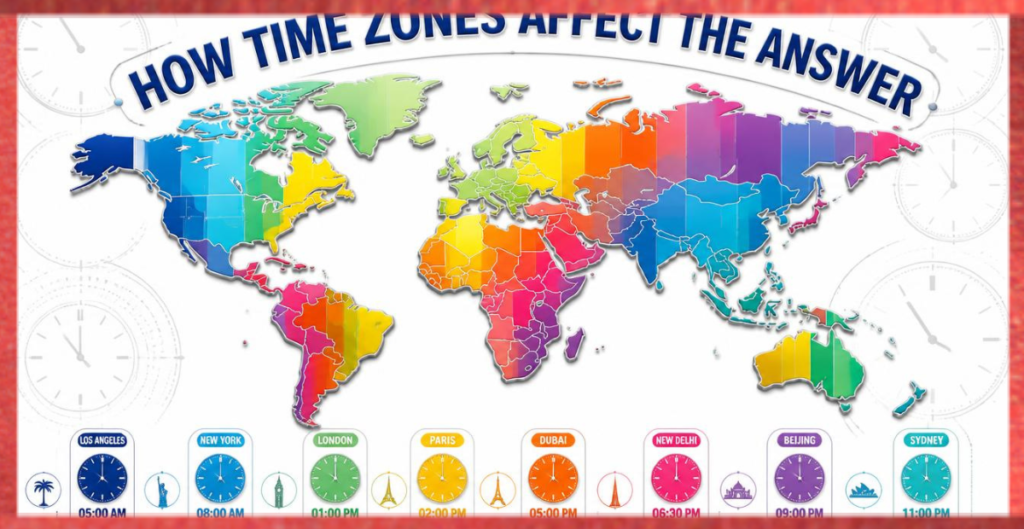
A time zone determines which local clock time applies to your location. Six hours is always six hours, but the displayed clock time can differ between places.
Imagine it is 2:00 PM in one location. Six hours earlier there is 8:00 AM locally. Someone in another timezone might have a completely different local clock reading at that same instant.
This matters when people work internationally, schedule online meetings, coordinate travel, or compare timestamps from different countries.
For a simple personal calculation, use your current local time. For international calculations, confirm the relevant time zones before subtracting.
Manual Calculation vs. Automatic Calculation
A manual calculation works perfectly for straightforward cases. If your clock says 9:00 AM, you probably don’t need an app to tell you that six hours earlier was 3:00 AM.
But automatic tools become useful when several factors are involved. A time difference calculator may handle dates, seconds, time zones, and other details more neatly than mental arithmetic.
Think of it this way: manual calculation is great for one cup of tea; an automatic tool is better when somebody suddenly asks you to make tea for thirty people.
Both approaches work. The right choice depends on how complicated the situation is.
Common Mistakes When Calculating 6 Hours Ago
Even a small calculation can go wrong in surprisingly creative ways. Here are some mistakes worth avoiding.
Forgetting the Previous Day
If the current time is between midnight and 5:59 AM, subtracting six hours will usually move into the previous day.
Confusing 12 AM and 12 PM
12 AM means midnight, while 12 PM means noon. Mixing them up can create a massive six-hour calculation error, not a tiny one.
Ignoring the Time Zone
If you are checking an event recorded somewhere else, the local clock may not match yours. Always consider the relevant timezone.
Changing the Minutes
If you are subtracting exactly six hours, the minutes normally remain unchanged. For example, 4:37 PM becomes 10:37 AM, not 10:31 AM.
Forgetting the Date
The clock might show the correct hour while the calendar day has changed. This matters for appointments, records, and historical event verification.
Real-Life Uses of a Six Hour Time Calculation
The phrase 6 hours earlier appears in more situations than people expect. It can support productivity, planning, record keeping, and everyday organization.
Someone working remotely might check when a colleague was active six hours earlier. A traveler may compare departure and arrival records. A parent might look back at a notification timestamp. A student could review when they began studying. A business may compare delivery timing with order processing.
Even scheduling can benefit from simple backward calculations. If a meeting is planned for 3:00 PM and you need a six-hour reference point, you know it corresponds to 9:00 AM.
The calculation itself is small, but accurate timestamps can make a larger timeline much easier to understand.
What If the Current Time Is 10 AM?
A common example people use is 10 AM minus 6 hours.
The calculation is:
10:00 AM − 6 hours = 4:00 AM
So the answer is 4:00 AM on the same day.
If the current time were 10:25 AM, then the answer would be 4:25 AM. The minutes stay exactly where they are, which makes the calculation wonderfully simple.
What If the Current Time Is 2 PM?
For 2 PM minus 6 hours, subtract six from the hour:
2:00 PM − 6 hours = 8:00 AM.
So 6 hours before now would be 8:00 AM if the current time were 2:00 PM.
With minutes included, 2:40 PM becomes 8:40 AM. Nothing mysterious there, really.
What If the Current Time Is 4 AM?
The 4 AM calculation is a useful example because it crosses midnight.
4:00 AM − 6 hours = 10:00 PM on the previous day.
If today is Monday, then six hours before 4:00 AM Monday was 10:00 PM Sunday.
This is exactly why a good past time calculator should account for the date rather than returning only a clock number.
How to Calculate Time Six Hours Ago Instantly
If you need an instant result, use this simple three-step approach:
Step 1: Look at the current clock.
Step 2: Move six hours backward.
Step 3: If you cross midnight, move the date back by one calendar day.
For example:
Current time: 7:35 PM
Six hours earlier: 1:35 PM
Another:
Current time: 3:35 AM
Six hours earlier: 9:35 PM on the previous day.
That is essentially all a 6 hour time calculator is doing behind the scenes, only much faster and with less chance of human error.
Why Accurate Time Subtraction Matters
An accurate time subtraction result can be important when timestamps are being compared. A one-hour mistake might not matter when you’re casually remembering lunch, but it can matter for business records, attendance, digital activity, delivery logs, or scheduled events.
Modern devices make time tracking almost invisible. We rarely think about the clock itself because phones and computers handle so much of it automatically. Yet when we need to reconstruct the past, we suddenly notice how valuable those little timestamps are.
That is why knowing how to calculate time difference remains a useful everyday skill, even in an age of automatic tools.
Quick Reference: Six Hours Earlier
Here is a compact reference for common times:
| If Now Is | Six Hours Ago Was |
| 1 AM | 7 PM previous day |
| 2 AM | 8 PM previous day |
| 3 AM | 9 PM previous day |
| 4 AM | 10 PM previous day |
| 5 AM | 11 PM previous day |
| 6 AM | 12 AM |
| 7 AM | 1 AM |
| 8 AM | 2 AM |
| 9 AM | 3 AM |
| 10 AM | 4 AM |
| 11 AM | 5 AM |
| 12 PM | 6 AM |
| 1 PM | 7 AM |
| 2 PM | 8 AM |
| 3 PM | 9 AM |
| 4 PM | 10 AM |
| 5 PM | 11 AM |
| 6 PM | 12 PM |
| 7 PM | 1 PM |
| 8 PM | 2 PM |
| 9 PM | 3 PM |
| 10 PM | 4 PM |
| 11 PM | 5 PM |
| 12 AM | 6 PM previous day |
This table works as a quick hours ago calculator when you only need the hour and not a more detailed date-and-time calculation.
Frequently Asked Question
6 hours ago from now is what time
Six hours ago means subtracting six hours from the current time. For example, if it is 12:00 PM now, six hours ago it was 6:00 AM.
what time was six hours ago
To find what time it was six hours ago, simply count backward six hours from the current time. The date may also change if you cross midnight.
what time was 6 hrs ago
“6 hrs ago” means six hours before the present time. For instance, 8:00 PM minus six hours is 2:00 PM.
what tome was it 6 hours ago
If you mean “what time was it 6 hours ago,” subtract six hours from the current clock time. This gives the exact earlier time.
6 hours ago time
The 6 hours ago time is found by moving the clock backward by six hours. It is a simple way to determine the time from earlier in the day.
Read this blog https://avenzum.com/time-until-330-pm/
Final Thoughts on What Time Was It 6 Hours Ago
Knowing what time was it 6 hours ago is a simple skill, but it has plenty of practical uses. From time tracking and work shifts to sleep tracking, scheduling, activity logging, and event verification, knowing how to move backward from the present moment can help you reconstruct your day with surprising accuracy.
The basic rule never changes:
Current time 6 hours = exact past time
Just remember to watch for midnight, the previous day, AM/PM changes, and your local time zone. If the calculation becomes more complicated, a real-time time calculator can handle the automatic time calculation for you and provide an accurate result almost instantly.
And maybe that is the nicest thing about understanding time: the past isn’t as unreachable as it feels. Sometimes it is only six hours behind you, sitting quietly on the other side of the clock, waiting for you to count back and find it.