Sometimes a date looks ordinary until you try to place it on a calendar. You know today, you know the number of weeks you want to travel backward, and somehow the answer still feels just a little slippery. If today is September 22, 2026, then the question “what date is 12 weeks ago from today?” has a wonderfully straightforward answer: June 30, 2026.
That means 12 weeks ago was Tuesday, June 30, 2026. No mysterious calendar gymnastics are needed here, thankfully. Twelve complete weeks equal 84 days, so the calculation simply moves 84 days backward from the starting date.
This kind of date calculation is useful for much more than curiosity. People use relative dates when checking deadlines, reviewing records, remembering when something happened, calculating project timelines, comparing appointments, or simply trying to remember what life looked like a few months earlier. Dates have a funny habit of becoming foggy, but arithmetic is less sentimental about it.
12 Weeks Ago From Today
| Calculation | Result |
|---|---|
| Today | September 22, 2026 |
| 12 weeks ago | June 30, 2026 |
| Weeks | 12 weeks |
| Days | 84 days |
| Day of the week | Tuesday |
| Hours | 2,016 hours |
| Minutes | 120,960 minutes |
| Seconds | 7,257,600 seconds |
| Calculation | September 22, 2026 − 84 days |
| Final answer | Tuesday, June 30, 2026 |
What Date Is 12 Weeks Ago From Today?
As of September 22, 2026, the date 12 weeks ago from today is June 30, 2026.
The calculation is:
September 22, 2026 − 12 weeks = June 30, 2026
Because:
1 week = 7 days
and:
12 × 7 = 84 days
we can also say that June 30, 2026 was 84 days ago from September 22, 2026. The result lands on a Tuesday, which gives us another useful way to check the answer.
There is a small but important point here: “12 weeks ago” means twelve full seven-day periods before the reference date. It does not mean “roughly three months ago.” Months have different numbers of days, while a week is always seven days, so the two expressions aren’t interchangeable.
That distinction matters when precision is important. A person checking a contract date, school attendance record, appointment history, or project milestone may need the exact previous date rather than an approximate month.
How to Calculate the Date 12 Weeks Ago
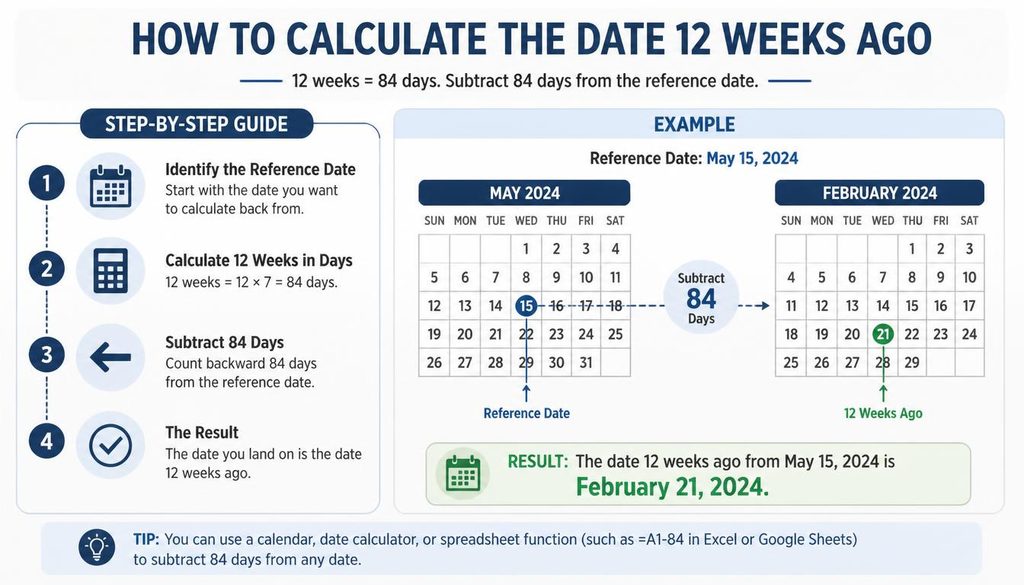
The easiest way to calculate date backward is to convert weeks into days first. This removes most of the confusion and turns the problem into a normal calendar calculation.
Start with the reference date:
September 22, 2026
Then determine the number of days:
12 weeks × 7 days = 84 days
Now subtract 84 days from September 22, 2026. The resulting date is:
June 30, 2026
You can also perform the calculation week by week. Moving backward seven days from September 22 gives September 15, then September 8, September 1, August 25, and so on until twelve weekly steps have been completed. This approach takes longer, but it can be handy when checking the answer manually on a physical calendar.
Another useful method is to use a date calculator. A weeks ago calculator, relative date calculator, or past date calculator can perform the same backward calculation automatically. These tools are especially useful when you’re working with several dates at once, though it’s still good to understand what the calculator is actually doing.
12 Weeks Ago From Today in Days, Hours, Minutes, and Seconds
The phrase 12 weeks ago can be expressed in several different units, and the conversion is surprisingly neat.
Twelve weeks contain:
- 12 weeks
- 84 days
- 2,016 hours
- 120,960 minutes
- 7,257,600 seconds
The arithmetic follows a simple chain.
12 × 7 = 84 days
Then:
84 × 24 = 2,016 hours
Then:
2,016 × 60 = 120,960 minutes
And finally:
120,960 × 60 = 7,257,600 seconds
So, if someone asks how many days is 12 weeks, the answer is 84 days. If they ask how many hours are in 12 weeks, it is 2,016 hours. Likewise, there are 120,960 minutes and 7,257,600 seconds.
These conversions describe the duration mathematically. They don’t account for unusual clock-time complications such as daylight-saving changes when someone is asking about exact elapsed clock hours between local timestamps. For a plain date-based calculation, however, 12 weeks is cleanly equivalent to 84 calendar days.
Why June 30, 2026 Is the Correct Previous Date
It can be tempting to estimate the answer by thinking that twelve weeks is approximately three months. That shortcut is where date calculations sometimes go sideways.
Three calendar months before September 22 would not necessarily produce June 30. Calendar months don’t all contain the same number of days, while twelve weeks always contains exactly 84 days.
Starting from September 22, 2026, count backward by the remaining days in September. Then continue through August and July until reaching June. The 84-day interval ends on June 30.
There is also a weekday check. September 22, 2026 is a Tuesday. Moving backward by exactly 12 complete weeks means moving backward by 12 × 7 days, so the weekday stays exactly the same. Therefore, June 30, 2026 must also be a Tuesday.
That makes June 30, 2026 — Tuesday a useful three-part answer: exact date, exact weekday, and exact duration.
12 Weeks Prior Compared With 12 Weeks From Today
One of the easiest mistakes in relative-date questions is confusing “ago” with “from today.”
12 weeks ago means moving backward from the reference date.
12 weeks from today means moving forward.
For September 22, 2026:
- 12 weeks ago: June 30, 2026
- Today: September 22, 2026
- 12 weeks from today: December 15, 2026
These are opposite directions on the calendar. The wording may look nearly identical, but the temporal relationship is completely different.
This is why phrases such as 12 weeks before today, 12 weeks prior, and 12 weeks ago generally point backward, while 12 weeks from today points forward. When entering a date into a calculator, choosing the wrong direction can produce a perfectly calculated answer to the wrong question, which is a rather annoying kind of correctness.
A Quick Table for Dates Around 12 Weeks Ago
Sometimes the easiest way to understand a relative date is to see nearby dates around it. The following examples use September 22, 2026 as the reference point.
| Reference expression | Resulting date |
|---|---|
| 16 weeks ago | June 2, 2026 |
| 15 weeks ago | June 9, 2026 |
| 14 weeks ago | June 16, 2026 |
| 13 weeks ago | June 23, 2026 |
| 12 weeks ago | June 30, 2026 |
| 11 weeks ago | July 7, 2026 |
| 10 weeks ago | July 14, 2026 |
| 9 weeks ago | July 21, 2026 |
| 8 weeks ago | July 28, 2026 |
Each additional week changes the result by exactly seven days. This makes a calendar date calculation much easier to audit when several neighboring dates are involved.
For example, if June 30 is 12 weeks ago, then June 23 is one week earlier and July 7 is one week later. The sequence has a consistent seven-day rhythm, which is useful for spotting mistakes.
What Day Was 12 Weeks Ago?
The answer to what day was 12 weeks ago depends on the starting date, because “today” changes from one day to another.
For the reference date used here, September 22, 2026, twelve weeks earlier was:
Tuesday, June 30, 2026.
The weekday is not an independent coincidence. Because 12 weeks equals 84 days, and 84 is evenly divisible by seven, the weekday remains unchanged after moving exactly twelve weeks backward.
So Tuesday leads to Tuesday. Wednesday would lead to Wednesday. Sunday would lead to Sunday. It’s one of the handy little rules that makes a date calculation easier to verify without redoing the whole calculation.
What About 13, 14, 15, and 16 Weeks Ago?
Once the twelve-week calculation is known, nearby calculations become almost effortless.
From September 22, 2026:
- 13 weeks ago was June 23, 2026.
- 14 weeks ago was June 16, 2026.
- 15 weeks ago was June 9, 2026.
- 16 weeks ago was June 2, 2026.
Each additional week moves the date seven days backward. So if you’re wondering what was the date 13 weeks ago, you only need to move one more week backward from June 30.
The same idea works in the other direction. 13 weeks from today would be December 22, 2026, followed by December 29 for 14 weeks, January 5, 2027 for 15 weeks, and January 12, 2027 for 16 weeks.
It sounds almost too simple once it’s written down, but thats exactly why relative-date questions are nice candidates for a small table rather than complicated arithmetic.
Common Mistakes When Calculating 12 Weeks Ago
The first common mistake is treating twelve weeks as three calendar months. They are not the same duration. Three months can contain 89, 90, 91, or 92 days depending on the months involved, while twelve weeks is always 84 days.
Another mistake is counting the starting date as day one. In a standard “12 weeks ago” calculation, you move backward through twelve complete seven-day periods. You don’t simply count dates on your fingers and include today as part of the 84 days.
A third mistake is mixing up 12 weeks ago with 12 weeks from today. One travels backward and the other travels forward. It is a tiny wording difference with a very large effect on the result.
Finally, some people use a calculator without checking the reference date. A time duration calculator may be perfectly accurate, but if the starting date was entered incorrectly, the final answer will still be wrong. The calculator isn’t psychic, sadly.
Using a Calendar to Verify the Date
A physical or digital calendar is one of the simplest ways to verify that June 30, 2026 is twelve weeks before September 22, 2026.
Find September 22 and move backward by seven days twelve times. The dates form a clean sequence:
September 22 → September 15 → September 8 → September 1 → August 25 → August 18 → August 11 → August 4 → July 28 → July 21 → July 14 → July 7 → June 30.
There are twelve backward weekly moves in that sequence. This is a useful manual technique when you don’t have access to a date calculator from today.
It’s also a nice reminder that calendars are essentially visual maps of time. Instead of thinking “84 days,” you can physically watch the date travel backward, one small square at a time.
When a 12-Week Date Calculation Is Useful
Knowing a date 12 weeks prior can be helpful in everyday situations. Someone might need to identify when a project started, check an earlier appointment, review a payment period, establish a reporting window, or understand the timing of an event.
In work settings, relative dates can help with progress reviews and recurring schedules. In personal planning, they can help someone remember when a particular commitment began or determine the date associated with a previous milestone.
The calculation is also useful when comparing date difference and time duration. If two dates are separated by exactly 84 days, they are twelve weeks apart, assuming the comparison is based on calendar days rather than a specialized elapsed-time convention.
For repeated calculations, a weeks from today calculator can save time. Still, knowing the underlying formula gives you a way to check whether the automated answer makes sense.
The Difference Between Date and Time Calculations
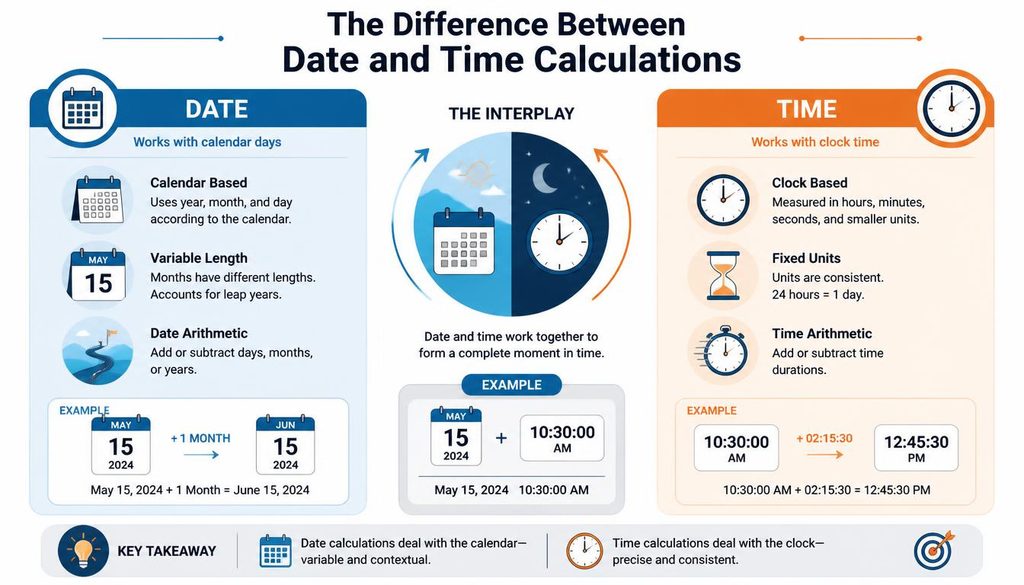
A date calculation answers a question such as, “What calendar date was 12 weeks before September 22?”
A time calculation can be more specific, asking how many hours, minutes, or seconds have elapsed between two exact timestamps.
For the simple question what date is 12 weeks ago from today, the calendar date is the important part. The answer is June 30, 2026.
If the question instead includes an exact time, time zone, or daylight-saving transition, the calculation may need additional information. That’s where a more detailed date and time calculator becomes useful.
For ordinary week-based calculations, however, there is no need to make the problem more complicated than it is. Twelve weeks is 84 days, and 84 days before September 22, 2026 is June 30, 2026.
A Simple Formula for Finding Any Date in the Past
The general method can be written very simply:
Past date = starting date − (number of weeks × 7 days)
For twelve weeks:
September 22, 2026 − (12 × 7 days)
= September 22, 2026 − 84 days
= June 30, 2026
This formula works for other questions too. If you need to subtract weeks from a date, multiply the number of weeks by seven and then move backward by that many calendar days.
For example, 20 weeks means 140 days. Five weeks means 35 days. Seventeen weeks means 119 days. The week-to-day conversion never changes, which is rather reassuring in a world where calendars can otherwise get messy.
Frequently Asked Questions
what day was it 12 weeks ago
12 weeks ago from today was Tuesday, June 30, 2026. It was exactly 84 days before September 22, 2026.
12 weeks ago from today
12 weeks ago from today was June 30, 2026. This is calculated by subtracting 12 weeks, or 84 days, from September 22, 2026.
what date was 12 weeks ago
The date 12 weeks ago was June 30, 2026. It falls on a Tuesday.
how long was 12 weeks ago
12 weeks is equal to 84 days, or 2,016 hours. It is also 120,960 minutes or 7,257,600 seconds.
what was 12 weeks ago
Tuesday, June 30, 2026 was 12 weeks ago from September 22, 2026. This represents a period of exactly 84 days.
Read more: https://avenzum.com/what-date-is-2-weeks-from-today-2/
Final Answer: What Date Is 12 Weeks Ago From Today?
If today is September 22, 2026, then the exact answer to what date is 12 weeks ago from today is:
Tuesday, June 30, 2026.
Twelve weeks equals 84 days, which is also 2,016 hours, 120,960 minutes, or 7,257,600 seconds. The calculation is simply a matter of moving 84 days backward from the starting date.
So if you came here searching for date 12 weeks ago, 12 weeks before today, date 84 days ago, or what was the date 12 weeks ago from today, they all lead to the same calendar result when the reference date is September 22, 2026: June 30, 2026.
Dates can feel strangely slippery when we’re trying to remember them from memory, but the calendar gives us something wonderfully dependable. Put in the starting date, count the weeks carefully, move in the right direction, and the past becomes a little less foggy. For this particular calculation, the answer is pleasantly clear: June 30, 2026 was exactly twelve weeks ago.