There is something oddly satisfying about looking at a calendar and asking, how many days until May 1st? Maybe you are waiting for a trip, planning a birthday, preparing for a project deadline, or simply watching spring move closer one square at a time. A date can feel far away until you give it a number, and suddenly the future becomes something you can actually count.
As of September 22, 2026, the answer is 221 days until May 1, 2027. That means the countdown to May 1st has 221 calendar days remaining when September 22 is treated as today and May 1 is the target date. It sounds like a lot, but calendars have a sneaky habit of eating up days quicker than we expect.
If you’re searching for a May 1 countdown, a countdown timer, or simply the time remaining until May 1, this guide breaks it down in a way that’s easy to check yourself. And yes, the answer can look different if you’re counting weekdays, workdays, or business days, which is where things get a tiny bit tricky.
| Starting Date | Days Until May 1, 2027 | Weeks + Days |
|---|---|---|
| September 22, 2026 | 221 days | 31 weeks, 4 days |
| September 23, 2026 | 220 days | 31 weeks, 3 days |
| September 24, 2026 | 219 days | 31 weeks, 2 days |
| September 25, 2026 | 218 days | 31 weeks, 1 day |
| September 26, 2026 | 217 days | 31 weeks |
| September 27, 2026 | 216 days | 30 weeks, 6 days |
| September 28, 2026 | 215 days | 30 weeks, 5 days |
| September 29, 2026 | 214 days | 30 weeks, 4 days |
| September 30, 2026 | 213 days | 30 weeks, 3 days |
| October 1, 2026 | 212 days | 30 weeks, 2 days |
| October 31, 2026 | 182 days | 26 weeks |
| November 30, 2026 | 152 days | 21 weeks, 5 days |
| December 31, 2026 | 121 days | 17 weeks, 2 days |
| January 31, 2027 | 90 days | 12 weeks, 6 days |
| February 28, 2027 | 62 days | 8 weeks, 6 days |
| March 31, 2027 | 31 days | 4 weeks, 3 days |
| April 26, 2027 | 5 days | 5 days |
| April 27, 2027 | 4 days | 4 days |
| April 28, 2027 | 3 days | 3 days |
| April 29, 2027 | 2 days | 2 days |
| April 30, 2027 | 1 day | 1 day |
| May 1, 2027 | 0 days | Target date |
How Many Days Until May 1st From September 22, 2026?
From September 22, 2026 to May 1, 2027, there are 221 days. This is a straightforward calendar-day difference, meaning Saturdays, Sundays, and holidays are all included in the total.
The target date is May 1, 2027, and the starting point is September 22, 2026. In other words, if you opened a date calculator today and entered those two dates, the ordinary date difference would be 221 days. Pretty neat, once the months stop looking like a pile of numbers.
Here’s the month-by-month breakdown:
- September 23–30: 8 days
- October: 31 days
- November: 30 days
- December: 31 days
- January 2027: 31 days
- February 2027: 28 days
- March: 31 days
- April: 30 days
- May 1: 1 day
Add those numbers together and you get 221 days. So the May 1st countdown is not a mysterious calculator trick; it’s simply the sum of the calendar days between the two dates.
There is one small counting detail worth remembering. If you count September 22 itself as day one, you may see a different number on a personal countdown list. Standard date-difference calculations usually measure the elapsed time after the starting date, which is why September 22 to May 1 gives 221 days.
How Many Days Until May 1, 2027 in Other Units?
Sometimes “221 days” doesn’t quite give the feeling you’re looking for. You might want to know how many weeks, hours, or months are left until the target date, because 221 days can feel abstract. Calendars are funny like that.
The period from September 22, 2026, to May 1, 2027, is approximately 7 months and 9 days, or 31 weeks and 4 days. In hours, 221 full days equal 5,304 hours, assuming each day is treated as exactly 24 hours.
That gives you a few useful ways to describe the same time remaining until May 1:
- 221 calendar days
- 31 weeks and 4 days
- 7 months and 9 days
- 5,304 hours
The hours figure is mathematical rather than a live countdown, though. A real countdown timer changes continuously as the hours, minutes, and seconds pass, while a calendar countdown normally changes once each day. So don’t let the calculator bully you into thinking both displays must say the exact same thing.
May 1 Countdown: A Simple Calendar View
A calendar countdown becomes much easier to understand when you stop staring at the final number and look at the months. September is the starting point, then come October, November, December, and the first four months of 2027 before May finally arrives.
Think of it as walking across a long hallway where every month is another door. September gives you the first few steps, October takes a bigger chunk, and February quietly contributes fewer days because it has only 28 days in 2027. February really does enjoy being the odd little month.
The final stretch looks like this:
- April 26th: 5 days remain
- April 27th: 4 days remain
- April 28th: 3 days remain
- April 29th: 2 days remain
- April 30th: 1 day remains
- May 1st: The target date arrives
This is why checking the days left until May 1 at different points can be useful. The number becomes increasingly tangible as the date gets close, and suddenly that distant May morning is sitting right there on the calendar.
How Many Weekdays Until May 1st?
If weekends don’t count for your purpose, you need a different calculation. The question becomes how many weekdays until May 1st, rather than how many calendar days.
From September 22, 2026 through May 1, 2027, the interval contains 31 complete weeks plus four additional days. Since a normal week contains five weekdays, that gives 155 weekdays from the 31 complete weeks, with the extra portion contributing additional weekdays depending on whether the starting date is included.
Using the common inclusive approach that counts September 22 as a weekday, the period contains 159 weekdays. If you mean strictly the weekdays after September 22 and before May 1, the figure is 158 weekdays. This tiny distinction is why two perfectly ordinary calculators can occasionally appear to disagree.
For planning purposes, always decide whether your weekdays until May 1st calculation includes the current day. It sounds fussy, maybe, but it can matter when a deadline has consequences.
How Many Work Days or Business Days Until May 1st?
Work days, working days, and business days are often used as if they mean exactly the same thing as weekdays. Usually they mean Monday through Friday, but an actual business-day calculation may also remove public holidays.
If you are simply excluding Saturdays and Sundays, the weekday calculation above is a useful starting point. If your organization also excludes holidays, the number becomes smaller.
For example, a U.S.-style business-day calendar may remove federal holidays such as Presidents’ Day, along with other recognized holidays during the period. Different countries, companies, schools, and organizations follow different holiday calendars, so there isn’t one universal number of business days.
That distinction matters especially for someone using a business days calculator for payroll, contracts, shipping, project management, or government paperwork. “Business day” isn’t just a mathematical term; it depends on the calendar rules you’re using.
How to Calculate Days Until May 1st Manually
You don’t need a special days until date calculator to find the answer. A basic calendar and a little patience are enough, though patience is sometimes the part people forget.
Start by counting the remaining days after September 22, then add each complete month between September and May. Finally, add May 1 itself. The calculation looks like this:
8 + 31 + 30 + 31 + 31 + 28 + 31 + 30 + 1 = 221 days
This is a simple example of date arithmetic. You are not counting the starting date as elapsed time, but you are counting the target date as the final day reached by the interval.
The same method works for almost any days between dates question. Change the starting date, change the target date, check the number of days in each month, and keep an eye on leap years. It isn’t glamorous work, but it gets the job done without requiring a fancy calculator.
How to Calculate Days Until May 1 in Google Sheets
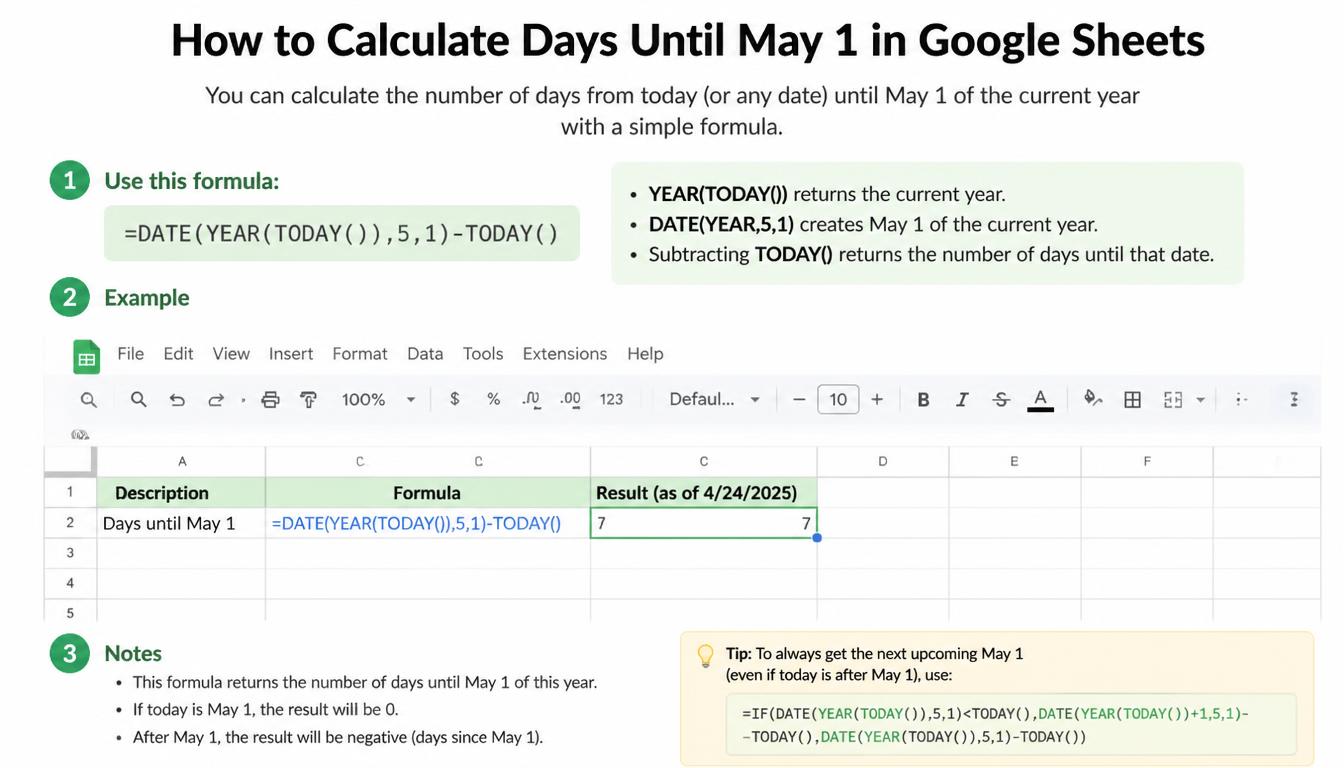
If you use Google Sheets, you can make the spreadsheet do the counting for you. This is particularly handy when you want a countdown that updates automatically instead of typing a new number every morning, which gets old rather fast.
For a direct calculation, you can use:
=DATE(2027,5,1)-TODAY()
The DATE() function creates the target date, while TODAY() returns the current date. If today’s date is September 22, 2026, the formula returns 221.
You can also put the target date in a cell, such as A1, and use:
=A1-TODAY()
This makes the spreadsheet more flexible. Change A1 to another future date and the same spreadsheet formula immediately calculates the new number of days. It’s a simple little trick, but surprisingly useful.
If you want the calculation to remain specifically tied to May 1, another clear formula is:
=DATE(2027,5,1)-TODAY()
Just remember that TODAY() follows the date on which the spreadsheet is opened or recalculated. It isn’t a frozen historical value.
How to Calculate Days Until May 1 in Microsoft Excel
Microsoft Excel handles date calculations in a very similar way. You can enter the target date into a cell and subtract the current date, or create the date directly with the DATE formula.
For example:
=DATE(2027,5,1)-TODAY()
If the current date is September 22, 2026, the result is 221. Excel stores dates as numerical values behind the scenes, so subtracting one valid date from another gives you the number of elapsed calendar days.
For a reusable date formula, place the target date in Cell A1 and enter:
=A1-TODAY()
This approach is useful if you’re building a deadline tracker, project calendar, or simple countdown calculator. You can change the date in A1 whenever the deadline moves, and the formula keeps doing its little bit of magic.
Why Different Countdown Calculators Can Show Different Numbers
It can be confusing when one website says 221 days while another shows a number that seems slightly different. Usually, nobody has broken mathematics; the calculators are simply using different counting rules.
One calculator may include today. Another may exclude today. A date difference calculator may count calendar days, while a working days calculator removes weekends and possibly holidays.
Time zones can also matter when a countdown timer measures exact hours and minutes. A date-only calculator doesn’t care much about the clock, while a live timer absolutely does.
So before comparing two results, check whether both tools use the same current date, same target date, same time zone, and same treatment of weekends and holidays. A little clarification saves a surprisingly large amount of head-scratching.
A Quick May 1, 2027 Countdown Chart
If you are keeping track of the final days manually, this short countdown chart makes the last stretch easier to see. The dates below use ordinary calendar-day counting.
- April 26th: 5 days remaining
- April 27th: 4 days remaining
- April 28th: 3 days remaining
- April 29th: 2 days remaining
- April 30th: 1 day remaining
- May 1st: 0 days remaining
On May 2nd, the countdown has already ended and the date is one day in the past. Then May 3rd, May 4th, May 5th, and May 6th move the calendar farther beyond the target.
This is useful if you’re creating a visual tracker or writing a short reminder. Sometimes seeing “3 days” on a page feels much more immediate than seeing a long string of numbers somewhere else.
What Happens When the Current Date Changes?
The answer to how many days until May 1st is never permanently fixed. Every sunrise quietly removes another day from the countdown, which is perhaps the calendar’s least dramatic form of progress.
On September 18, 2026, there were 225 days remaining. On September 19, there were 224. Then came September 20 with 223, September 21 with 222, and September 22, 2026 with 221.
The following day, September 23, 2026, the count becomes 220 days. On September 24 it becomes 219, and on September 25 it becomes 218. By September 26, there are 217 days left.
That sequence is a useful reminder that a May 1 2027 date countdown is always connected to a particular starting date. The answer changes every day, even though the target date stays exactly where it is.
The Easiest Way to Keep a May 1 Countdown

For a simple personal countdown, write May 1, 2027 on your calendar and mark the remaining months. You don’t really need complicated software unless you enjoy spreadsheets, in which case, well, spreadsheets are waiting patiently for you.
For a changing automatic count, use a countdown timer or a spreadsheet with =DATE(2027,5,1)-TODAY(). For a one-time answer, ordinary date subtraction is enough.
If your purpose involves a deadline, however, decide first whether you need calendar days, weekdays, work days, or business days. Those terms sound interchangeable until the missing Saturday or holiday suddenly matters.
Frequently asked Qeustions
how many days till may 1st
Find out exactly how many days are left until May 1st, including the remaining time from today.
how many days until may 1
Use the countdown to see the exact number of days remaining until May 1 and plan ahead with ease.
how many days until may 1 2026
See how many days remained until May 1, 2026, based on the starting date used for the countdown.
how many days until may 1st
Check the remaining days until May 1st with a simple and accurate date countdown.
how many months until may 2026
Find out how many months are left until May 2026 and convert the remaining time into days for a more precise countdown.
Read this Blog: https://avenzum.com/what-date-is-2-weeks-from-today/
Final Answer: How Many Days Until May 1st?
As of September 22, 2026, there are 221 days until May 1st, 2027.
That is the standard calendar-day difference between the current date and the target date. In other words, the May 1st 2027 countdown currently stands at 221 days, equal to 31 weeks and 4 days, or 5,304 hours when converted into complete 24-hour periods.
If you’re counting weekdays, the answer can be different because weekends disappear from the calculation. If you’re counting business days, holidays and local working calendars may reduce it further. There isn’t a single magic number for every situation; the right answer depends on what exactly you want the countdown to measure.
The nicest thing about a future date, perhaps, is that it doesn’t ask you to rush. It simply waits there on the calendar while the number gets smaller. Today it’s 221 days. Soon it’ll be 200, then 100, then just a handful. And before the countdown can make much noise about it, May 1st will arrive.