Sometimes a question about time arrives in a strangely simple disguise: what time was it 15 hours ago? It sounds like something you should answer without thinking, yet once midnight gets involved, AM and PM start playing their little tricks. One minute you are looking at the current time, and the next you are wondering which day you have somehow travelled back into.
Knowing the time 15 hours ago can be useful for checking when a message was sent, understanding an activity timestamp, working out an appointment, or simply satisfying that oddly persistent curiosity. The good thing is that the calculation itself isn’t difficult, once you know which direction to move and when the previous day enters the picture.
In this guide, we’ll work through 15 hours ago, explain the calculation in plain language, look at minutes and seconds, and show why the date can change too. A clock is only twelve numbers going round and round, but the calendar sitting underneath it is where things become interesting.
| Current Time | 15 Hours Ago | Date |
|---|---|---|
| 12:00 AM | 9:00 AM | Previous day |
| 1:00 AM | 10:00 AM | Previous day |
| 2:00 AM | 11:00 AM | Previous day |
| 3:00 AM | 12:00 PM | Previous day |
| 4:00 AM | 1:00 PM | Previous day |
| 5:00 AM | 2:00 PM | Previous day |
| 6:00 AM | 3:00 PM | Previous day |
| 7:00 AM | 4:00 PM | Previous day |
| 8:00 AM | 5:00 PM | Previous day |
| 9:00 AM | 6:00 PM | Previous day |
| 10:00 AM | 7:00 PM | Previous day |
| 11:00 AM | 8:00 PM | Previous day |
| 12:00 PM | 9:00 PM | Previous day |
| 1:00 PM | 10:00 PM | Previous day |
| 2:00 PM | 11:00 PM | Previous day |
| 3:00 PM | 12:00 AM | Same day |
| 4:00 PM | 1:00 AM | Same day |
| 5:00 PM | 2:00 AM | Same day |
| 6:00 PM | 3:00 AM | Same day |
| 7:00 PM | 4:00 AM | Same day |
| 8:00 PM | 5:00 AM | Same day |
| 9:00 PM | 6:00 AM | Same day |
| 10:00 PM | 7:00 AM | Same day |
| 11:00 PM | 8:00 AM | Same day |
What Time Was It 15 Hours Ago?
If the current time is 9:05 AM, then going back 15 hours takes you to 6:05 PM on the previous day. That is the direct answer to the example calculation, and the date matters just as much as the clock time.
So, if the starting point is 9:05 AM on Wednesday, September 16, 2026, then 15 hours ago was 6:05 PM on Tuesday, September 15, 2026. The clock moves backward, and because the calculation crosses midnight, the calendar quietly moves backward too.
It can feel slightly backwards at first. You don’t subtract 15 from 9 and call it 6 AM, because hours wrap around the 12-hour clock. You have to think in terms of a full 24-hour day, which makes the answer much less slippery.
The calculation can be written like this:
- 9:05 AM − 15 hours = 6:05 PM
- The result falls on the previous day
- Therefore, the answer is 6:05 PM on September 15, 2026
This is why asking what was the time 15 hours ago is partly a clock question and partly a date question. The two are travelling together, whether we notice it or not.
How to Calculate 15 Hours Ago Manually
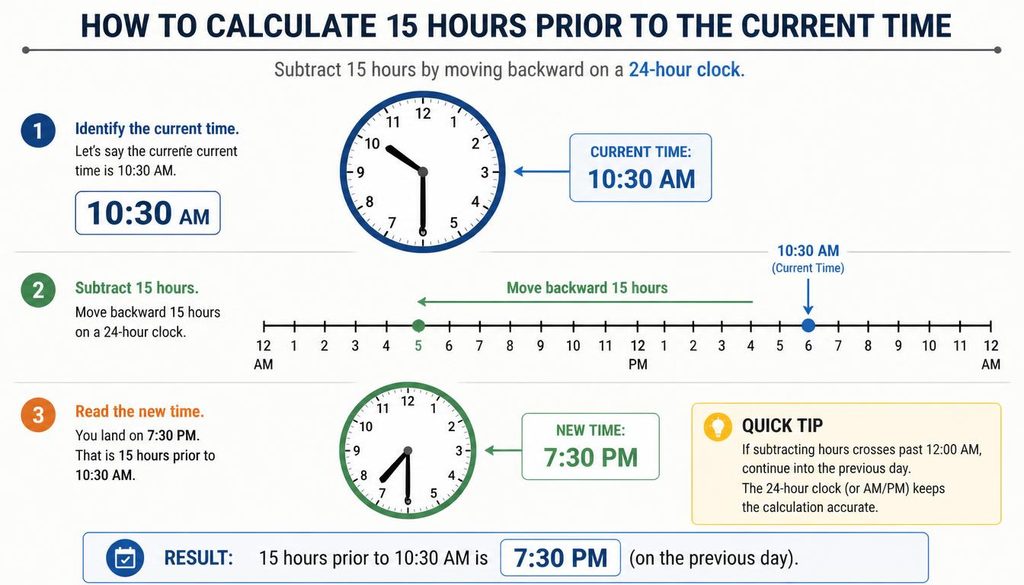
The easiest time calculation method is to convert the starting time into a 24-hour format. This removes the AM/PM confusion that tends to sneak into the calculation when you’re doing it quickly.
For example, 9:05 AM becomes 09:05. Now subtract 15 hours:
09:05 − 15:00 = −05:55
A negative result simply tells us that we have crossed midnight. Add 24 hours back to place the result inside the normal day:
−05:55 + 24:00 = 18:05
And 18:05 in 24-hour notation is 6:05 PM. Since we crossed midnight, the answer belongs to the previous calendar date, not the date we started with.
There is another way which some people find more natural. From 9:05 AM, go backward 9 hours to reach midnight, then go backward another 6 hours. That lands at 6:05 PM the previous evening. It feels more like walking backward around a clock rather than doing arithmetic on paper.
This second method is especially handy when you need to subtract 15 hours from the current time quickly and don’t have a calculator nearby. Your brain may complain for a second, but it gets there.
15 Hours Ago in the Example Time Zone
The provided example uses GMT+5 as the time zone reference. In that setting, a starting time of 9:05 AM means that the calculation begins from 9:05 in GMT+5.
Using the example date, Tuesday, September 15, 2026, and the stated clock relationship, the result is 6:05 PM on the previous day when moving backward from 9:05 AM on September 16. The important point is that a time calculation should always preserve the same time zone unless you are specifically converting between zones.
This becomes important when messages or online services show timestamps from different places. A person in GMT+5 and someone in GMT might see different local clock readings for the same instant. The elapsed amount of time hasn’t changed, but the displayed local time certainly has.
So when searching time 15 hours ago in GMT+5, first make sure the starting time really belongs to GMT+5. Otherwise, you may perform perfectly correct mathematics on the wrong starting clock, which is a rather impressive way to get the wrong answer.
How Many Minutes Is 15 Hours?
Hours are often easier to calculate when converted into smaller units. Fifteen hours contains 900 minutes, because every hour contains 60 minutes.
The conversion is straightforward:
- 15 hours × 60 = 900 minutes
- 15 hours = 900 minutes
So if you were building a time calculator that works entirely with minutes, you could simply subtract 900 minutes from the starting timestamp. It sounds more dramatic than subtracting 15 hours, but mathematically it is exactly the same trip.
This can be useful in schedules, programming, travel planning, work logs, and other situations where time is represented as a number of minutes rather than a familiar clock face. Sometimes the clock says “6:05 PM,” while the computer underneath is quietly thinking “something something 900 minutes.” Computers are like that.
How Many Seconds Is 15 Hours?
For an even smaller time conversion, 15 hours equals 54,000 seconds. Since one hour contains 3,600 seconds, the calculation is:
15 × 3,600 = 54,000 seconds
Therefore:
- 15 hours = 900 minutes
- 15 hours = 54,000 seconds
This conversion is mostly unnecessary for everyday questions about what time was it, but it becomes useful in technical systems, timestamps, programming, experiments, and detailed elapsed-time calculations.
If you were measuring an event that happened fifteen hours before another event, the difference remains 54,000 seconds whether you describe it with a clock, a stopwatch, or a slightly intimidating spreadsheet. The unit changes, but the elapsed duration doesn’t.
How Many Milliseconds Is 15 Hours?
Going one step further, 15 hours equals 54,000,000 milliseconds. One second contains 1,000 milliseconds, so multiplying 54,000 seconds by 1,000 gives the result.
The relationship looks like this:
- 15 hours = 900 minutes
- 15 hours = 54,000 seconds
- 15 hours = 54,000,000 milliseconds
You probably won’t need milliseconds to figure out what time was 15 hours ago, unless your question happens to involve software, timestamps, or a system that records events with very fine precision. For ordinary human schedules, knowing whether something happened at 6:05 PM is generally enough; nobody needs to know that the event happened 54 million milliseconds earlier unless the spreadsheet has become unusually serious.
Why 15 Hours Ago Can Mean the Previous Day
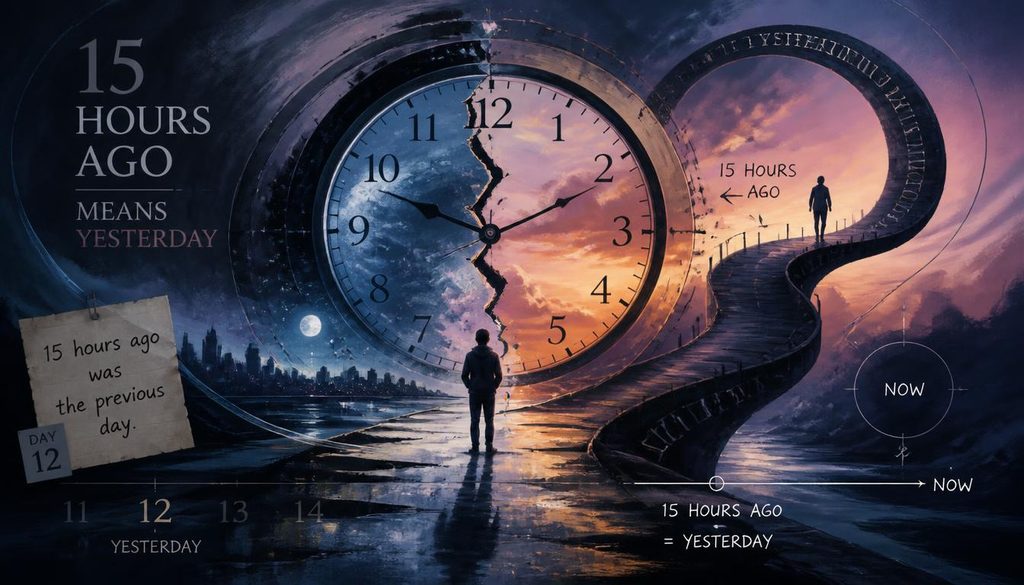
The most important detail in this kind of time calculation is midnight. Midnight is the point where a subtraction can change not only the clock reading but also the date.
Suppose the starting time is 9:05 AM. Going backward 15 hours takes you past midnight. Nine hours takes you from 9:05 AM back to 12:05 AM, and the remaining six hours carry you into the previous evening.
That means the answer isn’t merely a different time. It is a different time and date.
This is why what date was 15 hours ago can be just as important as asking what time it was. If you only write “6:05 PM,” someone might reasonably ask, “Which day?” And suddenly your supposedly simple answer needs another sentence.
The safest habit is therefore to include both pieces of information whenever the calculation crosses midnight: the exact time and the previous calendar date. It removes ambiguity before it starts causing trouble.
What Time Was It 16, 17, 18, 19, or 20 Hours Ago?
Once you understand the basic calculation, nearby values become easier to work out. Starting from 9:05 AM, each additional hour simply pushes the answer one hour farther backward.
For the same example starting point:
- 16 hours ago: 5:05 PM on the previous day
- 17 hours ago: 4:05 PM on the previous day
- 18 hours ago: 3:05 PM on the previous day
- 19 hours ago: 2:05 PM on the previous day
- 20 hours ago: 1:05 PM on the previous day
Notice something useful here: the minutes remain 05 throughout. Subtracting whole hours changes the hour portion while leaving the minutes untouched. This little observation makes mental calculations much faster, and it is easy to miss if you are staring too hard at the AM/PM labels.
The same logic works for what time was it 16 hours ago, what time was it 17 hours ago, and the other nearby searches. Start with the actual current time, move backward the requested number of hours, and check whether midnight was crossed.
What Time Is 15 Hours From Now?
The reverse calculation is just as simple. Instead of subtracting 15 hours, you add 15 hours to the current time.
If the starting time is 9:05 AM, adding 15 hours gives 12:05 AM on the following day. Here, too, the calendar changes, except now it moves forward instead of backward.
The process can be visualized like this:
9:05 AM → 12:05 AM → 12:05 AM
The first nine hours carry the clock to 6:05 PM, then another six hours take it to 12:05 AM. The final answer is therefore on the next calendar day.
Questions such as what time is 15 hours from now or calculate 15 hours from now are especially sensitive to the exact starting time. “Now” keeps moving, after all. A calculation made at 9:05 AM won’t produce the same clock reading if you repeat it at 11:30 AM.
AM and PM: The Part That Causes Most Confusion
The AM/PM calculation is where many otherwise easy time problems become messy. The 12-hour clock repeats itself twice each day, so 6:05 can mean morning or evening.
The 24-hour clock avoids this problem:
- 6:05 AM = 06:05
- 6:05 PM = 18:05
- 9:05 AM = 09:05
- 9:05 PM = 21:05
When subtracting or adding a large number of hours, converting to 24-hour time first is often the cleanest approach. It removes the need to keep asking yourself whether you’ve somehow wandered from evening back into morning.
A useful rule is simple: if you are unsure about AM and PM, stop using the 12-hour clock for the calculation. Convert it, do the arithmetic, then convert the final answer back. It takes a few extra seconds but can save a very silly mistake.
Using an Hours Ago Calculator
An hours ago calculator can handle these calculations automatically. You enter a starting time and tell the tool how many hours to move backward, and it returns the corresponding time and often the date as well.
Similarly, an hours from now calculator works in the opposite direction. These tools can be helpful when the calculation involves unusual numbers, several days, or time-zone changes where doing everything mentally gets annoying.
Still, knowing the manual method is worthwhile. Online tools can give you an answer, but understanding how to calculate 15 hours ago lets you check whether that answer makes sense. A calculator is useful; knowing what the calculator should roughly say is even more useful.
For important schedules, it’s sensible to validate the result by checking the date, AM/PM status, and time zone. A correct-looking clock time can still belong to the wrong day.
A Simple Formula for Calculating Past Time
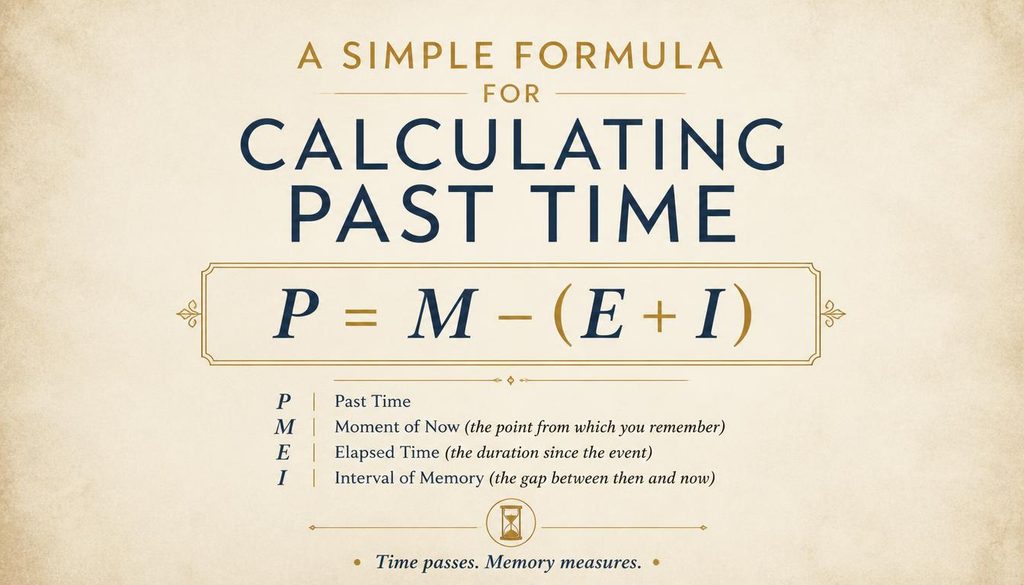
There is no mysterious formula required. For most ordinary cases, think of it as:
Past time = starting time − elapsed hours
If the subtraction moves before midnight, subtract one calendar day from the date. If it moves back across several midnights, continue reducing the date accordingly.
For example, if the starting point is 9:05 AM and the requested interval is 15 hours:
09:05 − 15 hours = 18:05 on the previous day
That is the whole calculation. The intimidating-looking part is mostly the clock’s habit of wrapping around after midnight, like it has somewhere else to be.
For a future calculation, simply reverse the operation:
Future time = starting time + elapsed hours
Once these two ideas are familiar, most basic past time and future time questions stop feeling like puzzles.
Why the Exact Current Time Matters
When someone asks what time was 15 hours ago, the phrase “from now” makes the answer dynamic. There is no single permanent answer to that question because now keeps changing.
For instance, if it is 9:05 AM today, the result is one thing. If it becomes 9:05 PM later that same day, the result is twelve hours different. The number “15” has stayed perfectly still while the starting point moved.
This is why online pages that answer time-based questions often display the current time and date before showing a result. Without that starting point, the answer is incomplete.
The same principle applies to 15 hours previously, 15 hours prior, and 15 hours earlier. These phrases describe a duration, not a fixed moment on the calendar.
A Quick Way to Check Your Answer
After you calculate 15 hours ago, do a reverse check. Take your answer and add 15 hours. You should arrive back at the original starting time.
For the example:
6:05 PM on September 15 + 15 hours = 9:05 AM on September 16
If you land somewhere else, something went sideways in the calculation. Most often, the mistake will be an AM/PM mix-up or forgetting that the calculation crossed midnight.
You can also check the duration in smaller units. Fifteen hours should equal 900 minutes, 54,000 seconds, or 54,000,000 milliseconds. If your calculation somehow says 54,000 minutes, the clock has not betrayed you; the arithmetic has.
Frequently asked Questions
15 hours ago
15 hours ago refers to the exact time and date that occurred 15 hours before the current time.
what was 15 hours ago
To find what was 15 hours ago, subtract 15 hours from the current time. If the calculation crosses midnight, the result falls on the previous day.
when was 15 hours ago from now
15 hours ago from now means the time that occurred 15 hours before the present moment. The exact result depends on your current time and time zone.
15 hours ago from now
To calculate 15 hours ago from now, count backward by 15 hours from the current time. This may also change the calendar date if it passes midnight.
how long was 15 hours ago
15 hours is equal to 900 minutes, 54,000 seconds, or 54,000,000 milliseconds.
Read more: https://avenzum.com/what-time-was-it-9-hours-ago-2/
Final Thoughts on Calculating 15 Hours Ago
The answer to what time was it 15 hours ago depends on the exact starting point, but the method is pleasantly ordinary: take the current time, move backward 15 hours, and adjust the calendar if you cross midnight.
Using the example of 9:05 AM in GMT+5 on Wednesday, September 16, 2026, the result is 6:05 PM on Tuesday, September 15, 2026. In other words, 15 hours earlier was not just a different clock reading; it was the evening of the previous day.
Remember the useful conversions too: 15 hours equals 900 minutes, 54,000 seconds, and 54,000,000 milliseconds. And when AM/PM starts making the calculation look more complicated than it really is, switch to the 24-hour clock.
Time calculations don’t really require complicated machinery. Sometimes all you need is a clock, a calendar, and the willingness to walk backward around the day for a little while. Once you get used to that small dance around midnight, even questions about 16, 17, 18, 19, or 20 hours ago become pretty straightforward.