There is something strangely comforting about waiting for a particular hour. Maybe it is 4:30 PM, when the afternoon begins loosening its grip and the day feels like it has finally started walking toward evening.
For some people, it is the moment school finishes. For others, it means the workday is nearly over, a meeting is about to begin, an appointment is waiting, or a long-awaited plan can finally happen. And sometimes, even a small clock time becomes attached to a big personal moment.
Imagine a family waiting through the afternoon for a loved one to arrive after work, or parents watching the clock while preparing for a small celebration welcoming a baby girl. In those moments, time doesn’t feel like ordinary numbers anymore.
Every minute feels noticeable. Every glance at the phone asks the same little question: How long until 4:30 PM today?
The answer depends on your current time, your local time zone, and the exact moment you check. A countdown can turn that uncertainty into something wonderfully simple: hours, minutes, and seconds remaining until 4:30 PM today.
| Current Time | Time Until 4:30 PM |
|---|---|
| 12:00 PM | 4 hours 30 minutes |
| 1:00 PM | 3 hours 30 minutes |
| 2:00 PM | 2 hours 30 minutes |
| 3:00 PM | 1 hour 30 minutes |
| 4:00 PM | 30 minutes |
| 4:30 PM | 0 minutes |
How Long Until 4:30 PM Today?
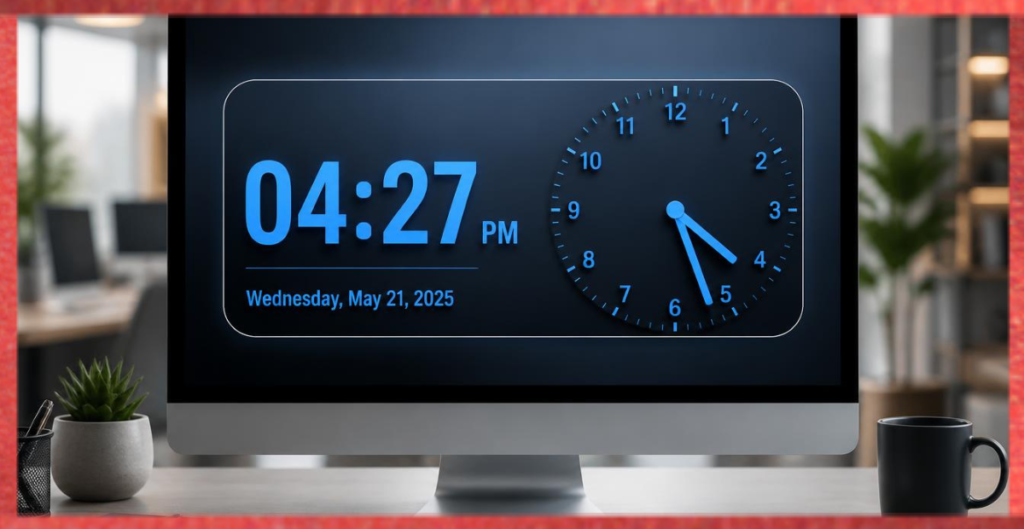
If it is currently before 4:30 PM, the amount of waiting time is simply the difference between the current time and 4:30 PM. A countdown timer can perform this calculation automatically, updating the result as every second passes.
For example, if your local clock says 1:30 PM, there are exactly three hours until 4:30 PM. If it says 3:30 PM, you have only one hour left. But if it is already 5:00 PM, today’s 4:30 PM has already passed, so you would need to wait until 4:30 PM tomorrow.
This sounds obvious, yet people often want an exact answer because the final stretch of a day can feel oddly elastic. Ten minutes can disappear during a busy meeting, while twenty minutes waiting for an appointment may feel like an entire small century.
A useful time until calculator removes the guesswork by comparing the present moment with the target time. If the tool supports real-time updates, the result keeps changing automatically rather than requiring you to refresh the page every few seconds.
How Many Hours Until 4:30 PM Today?
The number of hours until 4:30 PM today depends entirely on when you check.
If the current time is:
- 12:00 PM, there are 4 hours until 4:30 PM.
- 1:00 PM, there are 3 hours and 30 minutes.
- 2:00 PM, there are 2 hours and 30 minutes.
- 3:00 PM, there are 1 hour and 30 minutes.
- 4:00 PM, there are 30 minutes.
- 4:15 PM, there are 15 minutes.
- 4:29 PM, there is only 1 minute.
The interesting part is that a clock doesn’t care whether you’re excited, tired, impatient, or wonderfully distracted. It simply keeps moving. Your time calculation therefore needs a fixed starting point and a fixed target.
For someone checking at 11:45 AM, the remaining time is much longer than for someone checking at 4:05 PM. That’s why asking how many hours till 4:30 PM without knowing the current time doesn’t have one permanent numerical answer.
What Time Is 4:30 PM Today?
4:30 PM today means half past four in the afternoon on the current calendar day. It comes after 12:00 PM noon and before the evening hours.
In the 24-hour clock, 4:30 PM is written as 16:30. This is useful when you’re reading travel schedules, workplace systems, digital calendars, appointment confirmations, or international timetables.
The phrase “when is 4:30 PM?” may seem almost too easy to ask, but there is a small catch: 4:30 PM in local time depends on the person’s location. If two people live in different countries, they may experience 4:30 PM at very different moments.
So when scheduling something, it is smarter to consider the local time zone, particularly when people are joining from different places.
Why a Countdown to 4:30 PM Can Be Surprisingly Useful
A countdown to 4:30 PM is more than a decorative clock ticking away in a browser tab. It can become a tiny planning assistant.
A student might use a 4:30 PM countdown to know how long remains before school dismissal. A professional could use it to measure the remaining portion of a work shift.
Someone planning an appointment may simply want to know how much longer they have before leaving home.
There is also a psychological advantage. A large block of time can feel vague, but breaking it into hours, minutes, and seconds makes it easier to understand.
“Later this afternoon” feels fuzzy.
“Two hours, eleven minutes, and forty seconds” feels concrete.
That difference can make planning your day much easier.
How a 4:30 PM Timer Calculates the Remaining Time
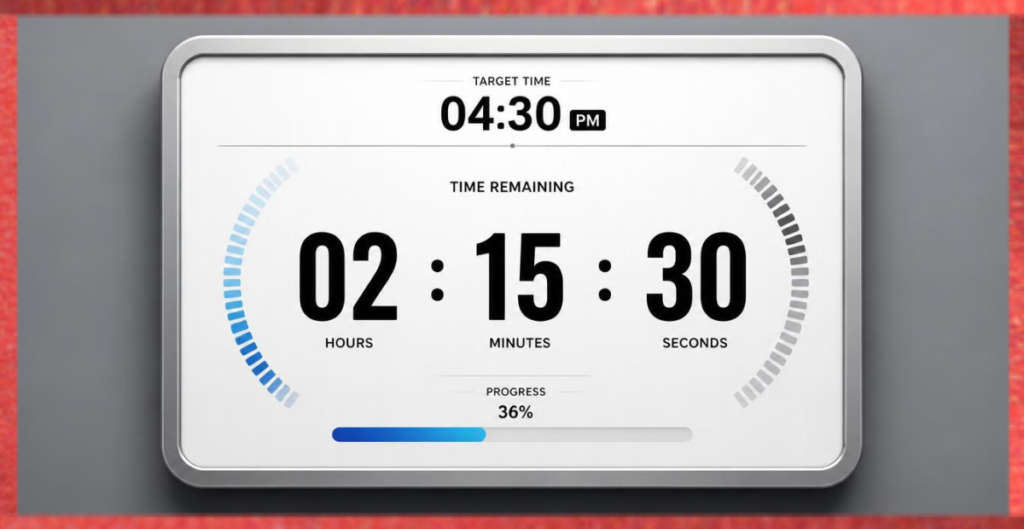
A 4:30 PM timer generally compares the current clock value with the target time of 4:30 PM.
The process is simple:
- Find the current local time.
- Identify today’s 4:30 PM.
- Calculate the time difference.
- Display the remaining hours, minutes, and seconds.
- Continue updating the result as the clock moves.
Modern online tools can perform this automatic calculation almost instantly. Some also use time zone detection to determine the appropriate local time without requiring the visitor to calculate an offset manually.
That becomes especially handy on mobile devices, where people are often checking schedules while travelling, shopping, commuting, or standing somewhere wondering why the afternoon is moving so slowly.
How Long Until 4:30 PM Today in Different Situations?
The same target time can mean very different things depending on what your day looks like.
For a student, 4:30 PM may mean the beginning of free time. After a full day of classes, that final stretch can feel like the clock has developed a personal grudge.
For a professional, 4:30 PM might be the end of workday target, particularly if the normal schedule finishes around then. Watching the countdown can help organize unfinished tasks without turning the entire afternoon into frantic clock-watching.
For someone with an appointment, 4:30 PM is a fixed point that requires preparation beforehand.
For event planning, it could represent an event start time, guest arrival, photography session, or a small family gathering.
And for someone waiting for a loved one, well, the number means something completely different. Sometimes the clock is not counting toward an event. It is counting toward a person.
Using 4:30 PM for Personal Scheduling
A good daily schedule is not necessarily packed from sunrise to bedtime. Sometimes it simply needs a few dependable landmarks.
You can treat 4:30 PM as one of those landmarks.
For example, you might schedule:
- Focused work before 4:30 PM.
- A short break around mid-afternoon.
- An appointment at 4:30 PM.
- A workout session afterward.
- Family time during the evening.
- Dinner and relaxation later at night.
This makes the countdown useful as a time management tool, rather than just a number sitting on a webpage.
The trick is not to let the timer boss you around. A timer should serve your routine, not become the tiny manager living inside your phone.
4:30 PM Today for Meetings and Appointments
Meetings often become easier when everyone has the same understanding of the start time.
If someone says, “Let’s meet at 4:30,” that could create confusion when participants are in different locations. Adding the time zone removes much of that uncertainty.
For local meetings, a simple meeting countdown can help participants prepare their documents, notes, presentations, or travel plans.
For appointments, knowing the time remaining until 4:30 PM can help you decide when to leave. If traffic, walking distance, parking, or public transportation is involved, the clock becomes part of your practical planning.
A few minutes of preparation before leaving can sometimes save twenty minutes of unnecessary panic. Funny how that works.
4:30 PM and School Dismissal

For students and parents, afternoon time can have a very particular rhythm.
The phrase school dismissal time may sound ordinary to an adult, but to a child sitting through the last lesson, 4:30 PM can feel like a distant island.
Parents may use a countdown to remember pickup time, organize transportation, or prepare an after-school activity. Students might use it to estimate how long remains before homework, sports practice, or heading home.
The countdown becomes especially useful when the school schedule changes for exams, special events, or seasonal activities.
4:30 PM During a Work Shift
If your work shifts ends at 4:30 PM, the afternoon countdown can become a small motivational ritual.
At 2:00 PM, there is still a substantial chunk of the shift left. At 3:30 PM, the finish line begins appearing. At 4:15 PM, suddenly every minute has a personality.
Of course, watching the clock constantly can make the final minutes feel longer. A better approach is to use the remaining time for one manageable task at a time.
Think:
Finish this email.
Complete this document.
Check tomorrow’s schedule.
Then go home.
That is much calmer than staring at the seconds and hoping they get embarrassed enough to move faster.
4:30 PM for Online Classes, Webinars, and Live Streams
Digital events often depend on precise timing.
An online class, webinar, or live stream might begin at 4:30 PM, and participants may join from multiple cities or countries. A real-time countdown timer can help everyone understand exactly how long remains before the event begins.
This is particularly useful when the event is important enough that arriving late means missing introductions, instructions, or the first part of a presentation.
If you’re hosting an event, mentioning the expected local time alongside the time zone can prevent confusion.
Travel Planning Around 4:30 PM
Travel is another situation where a few minutes can become surprisingly important.
Suppose your train, bus, ride, or pickup is connected to a 4:30 PM schedule. You don’t only need to know what time is 4:30 PM today. You need to know how much time remains, how long your journey takes, and how much extra time you should leave for delays.
A local time calculator or countdown can help with the basic timing, while your travel plan should include a buffer.
If your journey takes 25 minutes, leaving at exactly 4:05 PM for a 4:30 PM event may be unnecessarily risky. Real life has traffic lights, slow elevators, missing keys, and that one mysterious shoe that disappears exactly when you’re already late.
What If 4:30 PM Has Already Passed?
This is where the calculation changes.
If your current time is after 4:30 PM, today’s target has already happened. You are no longer calculating the remaining time for today. Instead, the next target becomes 4:30 PM tomorrow.
For example, if it is 6:00 PM today, the next occurrence of 4:30 PM is tomorrow afternoon.
That means a good countdown timer today should ideally understand whether the target is still ahead. If it has passed, the timer can roll forward to the next day.
This is one reason automatic tools are useful. They can handle the date transition without requiring you to sit there doing mental arithmetic at 6 PM.
4:30 PM Today vs. 4:30 PM Tomorrow
These two phrases sound nearly identical, but they refer to different calendar moments.
4:30 PM today means the next 4:30 PM occurring on the current date, provided it has not already passed.
4:30 PM tomorrow means 4:30 PM on the following calendar day.
If today is Monday, then 4:30 PM tomorrow is Tuesday at 4:30 PM.
The difference matters for deadlines, appointments, travel reservations, meetings, and event planning. A single word like “tomorrow” can shift the target by an entire day.
Why Time Zones Matter for 4:30 PM
A person in one country can be experiencing afternoon while someone elsewhere is having dinner or preparing for bed.
That is why time zone detection is valuable for online countdown tools.
If you’re using a 4:30 PM live timer, it should ideally understand your device’s local settings and display the countdown according to your location. A time zone calculator can also help when comparing schedules across regions.
For international meetings, never assume that “4:30 PM” means the same moment for everybody. Include the city, country, or time-zone abbreviation when precision matters.
How Students and Professionals Can Use the Countdown
Students can use the time management idea behind a countdown to divide study periods into smaller blocks. Instead of thinking, “I have all afternoon,” they might think, “I have until 4:30 PM to finish these two tasks.”
Professionals can use the same approach for deadlines, meetings, email work, or end-of-shift planning.
The goal is not to squeeze every second out of your day. That would be exhausting. The better goal is awareness.
Knowing how much time remains gives you a clearer picture of what can realistically be done.
Creative Ways to Use a 4:30 PM Countdown
A countdown doesn’t have to be serious.
You can use a free countdown timer for:
- A family gathering.
- A surprise announcement.
- A birthday preparation.
- A workout session.
- A study break.
- A livestream.
- A small afternoon celebration.
- A travel departure.
- A personal deadline.
- The end of a long workday.
Sometimes having a visible target makes an ordinary afternoon feel like it has a little storyline.
And if you’re preparing to welcome a baby girl or celebrating another meaningful family milestone, a simple time marker can become part of the memory.
Years later, nobody may remember the exact countdown, but they may remember everyone waiting together, laughing, preparing food, checking the clock, and wondering why the final ten minutes took approximately seven geological eras.
How to Calculate Time Until 4:30 PM Manually
You don’t always need an online tool.
If it is 2:00 PM, simply count forward:
2:00 → 3:00 = 1 hour
3:00 → 4:00 = 1 hour
4:00 → 4:30 = 30 minutes
Total = 2 hours and 30 minutes.
For a more exact calculation, include the current minutes and seconds.
If it is 3:42:20 PM, then the remaining time until 4:30 PM is 47 minutes and 40 seconds.
This is the basic principle behind an exact countdown timer. The software is simply doing the same comparison much faster and continuously.
Why Seconds Become Important Near 4:30 PM
When the target is several hours away, seconds barely matter.
But when only a few minutes remain, seconds suddenly become important.
At 4:25 PM, you may say, “Five minutes left.”
At 4:29 PM, you might want the exact number of seconds until 4:30 PM.
This is where a real-time countdown becomes more interesting. Instead of showing only whole hours or minutes, it can provide a constantly changing display of the remaining time.
The numbers keep dropping.
4:29:58
4:29:57
4:29:56
And just like that, 4:30 PM arrives.
Making 4:30 PM Part of a Better Daily Routine

One practical way to use a fixed time is to create a repeatable afternoon habit.
Maybe 4:30 PM is your daily transition point.
Before it, you handle focused work. After it, you exercise, study, spend time with family, or prepare for the evening.
This gives your day a natural boundary.
It can also make planning your day less overwhelming because you don’t have to organize every single minute. You simply create a few anchors and let the spaces between them breathe.
A schedule with no breathing room is not really a schedule. It’s a hostage situation wearing a calendar costume.
Frequently Asked Questions About 4:30 PM
How long until 4:30 PM today?
It depends on your current local time. Subtract the present time from 4:30 PM to find the remaining hours, minutes, and seconds.
How many hours until 4:30 PM today?
The answer changes throughout the day. At 12:00 PM, there are four and a half hours; at 3:30 PM, there is one hour remaining.
What time is 4:30 PM in 24-hour time?
4:30 PM is 16:30 in the 24-hour clock.
What happens if 4:30 PM has passed?
If today’s 4:30 PM is already gone, the next target is 4:30 PM tomorrow.
Can a countdown show seconds?
Yes. Many modern countdown tools can display hours, minutes, and seconds with continuous updates.
Does the countdown depend on location?
Yes, particularly when a target time is defined according to local time. Your time zone can change when that 4:30 PM moment occurs.
Can I use a 4:30 PM timer on my phone?
Yes. A browser-based countdown can generally work on mobile devices, tablets, and desktop computers, depending on the tool.
How to Make a Time Countdown More Personal
The best use of a countdown is not merely knowing a number. It is knowing why you’re waiting.
Maybe you’re waiting for a meeting to finish.
Maybe you’re waiting for the school bell.
Maybe you’re counting down to an appointment.
Maybe 4:30 PM is when you finally get to leave work.
Or perhaps it’s the hour when your family gathers, a celebration begins, or someone important walks through the door.
Give the time a purpose.
Instead of saying, “There are 45 minutes left,” tell yourself, “There are 45 minutes to finish what matters before I switch into family time.”
That tiny mental shift can make the countdown feel less like waiting and more like moving toward something.
Final Thoughts on How Long Until 4:30 PM Today
So, how long until 4:30 PM today? The honest answer is beautifully simple: it depends on the moment you’re asking.
Your current time, local time zone, and today’s date determine the exact time difference. A countdown timer can then turn that difference into an easy-to-follow display of hours, minutes, and seconds.
But there is something more interesting hiding behind the calculation.
Time is not only a measurement. It is also anticipation.
We count down to meetings, school dismissal, work shifts, appointments, travel, online classes, workouts, celebrations, and reunions. We count because the destination matters. A plain number on a clock can quietly become connected to a memory we haven’t even made yet.
So whether you’re watching a 4:30 PM countdown, planning your afternoon, finishing a deadline, or waiting for someone you love, let the remaining minutes have their little meaning.
And when 4:30 PM finally arrives, don’t just notice that the timer reached zero.
Notice what you were waiting for.
That is usually where the real story begins.